
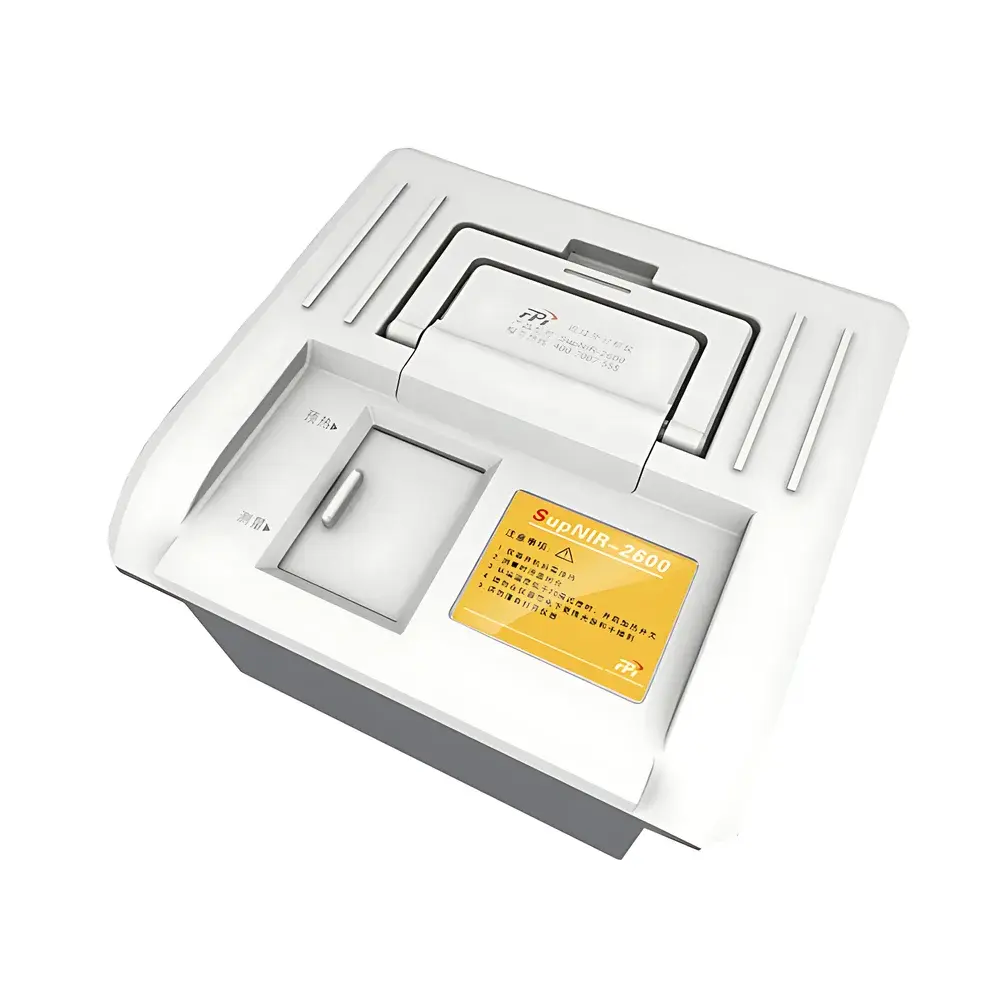
FPI SupNIR-2600 Series Near Infrared Spectrometer
| Brand | FPI |
|---|---|
| Origin | Zhejiang, China |
| Manufacturer Type | Original Equipment Manufacturer (OEM) |
| Instrument Type | Laboratory Benchtop NIR Spectrometer |
| Optical Design | Holographic Scanning Grating with TEC-Cooled InGaAs Detector |
| Wavelength Range | 1000–1800 nm |
| Spectral Resolution | ≤ 8 nm (FWHM) |
| Wavelength Accuracy | ±0.2 nm |
| Data Sampling Interval | 1 nm |
| Scan Speed | Full-spectrum acquisition in < 60 s |
| Measurement Mode | Transmission |
| Chemometrics Software | RIMP v4.x (with PLS, PCR, SVM, and model validation modules) |
| Temperature Control | Integrated Peltier-based sample compartment (±0.1 °C stability) |
| Compliance | Meets ISO 12099:2017 for NIR instrument performance verification |
| Connectivity | Ethernet (RJ45), USB 2.0, optional Wi-Fi module |
Overview
The FPI SupNIR-2600 Series Near Infrared Spectrometer is a laboratory-grade, transmission-mode benchtop instrument engineered for rapid, non-destructive quantitative analysis of liquid hydrocarbon samples. Based on holographic scanning grating optics and a thermoelectrically cooled indium gallium arsenide (InGaAs) photodiode array detector, the system delivers high spectral fidelity across a calibrated range of 1000–1800 nm. Its optical architecture follows the principles of dispersive NIR spectroscopy, where incident light is collimated, diffracted by a precision-encoded grating, and resolved spectrally onto the detector plane. The instrument operates under fixed-pathlength transmission geometry—typically using standard 10-mm quartz cuvettes—enabling direct correlation between absorbance profiles and physicochemical properties via multivariate calibration models. Designed for operational robustness in regulated environments, the SupNIR-2600 integrates hardware-level thermal stabilization, automatic wavelength validation, and embedded reference standards to ensure long-term measurement reproducibility without routine recalibration.
Key Features
- TEC-cooled InGaAs detector with active temperature control (−5 °C to +25 °C range), minimizing dark current drift and enhancing signal-to-noise ratio (SNR > 10,000:1 at 1550 nm)
- Self-aligned light source module with integrated collimation optics—eliminates manual lamp alignment and supports hot-swap replacement without optical realignment
- Peltier-regulated sample compartment maintaining ±0.1 °C thermal stability during measurement, critical for viscosity- and density-sensitive hydrocarbon assays
- Embedded diagnostic firmware with real-time spectral validation against onboard NIST-traceable reference materials (e.g., polystyrene film, water vapor lines)
- Shock-resistant mechanical chassis compliant with IEC 60068-2-64 for vibration endurance—validated for both fixed-lab and mobile laboratory deployment (e.g., field testing vehicles)
- Full Ethernet (RJ45) and USB 2.0 connectivity supporting remote diagnostics, firmware updates, and centralized model repository synchronization
Sample Compatibility & Compliance
The SupNIR-2600 is optimized for transparent to semi-transparent liquid matrices, including gasoline, diesel, jet fuel, bioethanol blends, lubricants, and solvent-based formulations. It accommodates standard 10-mm pathlength quartz cuvettes (supplied) and supports optional flow cells for continuous monitoring integration. All optical components meet RoHS 2011/65/EU directives. Performance validation adheres to ISO 12099:2017 (Animal feeding stuffs — Guidance for the application of near infrared spectroscopy) and ASTM D8325-22 (Standard Practice for Calibration Transfer of Near-Infrared Spectrometers). While not FDA 21 CFR Part 11–certified out-of-the-box, the RIMP software architecture supports audit trail logging, electronic signature configuration, and role-based access control when deployed within validated GxP environments under customer-defined SOPs.
Software & Data Management
RIMP (Remote Intelligent Modeling Platform) v4.x serves as the native chemometrics suite, providing end-to-end workflow support—from raw spectrum preprocessing (Savitzky-Golay smoothing, multiplicative scatter correction, first/second derivative) to PLS and PCR regression modeling, cross-validation (leave-one-out, k-fold), and model performance reporting (RMSEC, RMSEP, R², bias, slope). Models are stored in encrypted .rimp binary format with metadata tagging (calibration date, operator ID, instrument serial, spectral range used). Data export options include CSV, TXT, and XML formats compatible with LIMS interfaces. Network-enabled RIMP clients allow concurrent access to shared model libraries, version-controlled calibration updates, and centralized instrument health dashboards—facilitating multi-site method harmonization in quality control networks.
Applications
The SupNIR-2600 delivers validated quantitative results for key petroleum parameters per ASTM D7153 (gasoline), D7467 (diesel), and D7706 (jet fuel), including research octane number (RON), motor octane number (MON), density (ASTM D1298), aromatic content (ASTM D5292), olefin content (ASTM D6584), and distillation endpoints (T10, T50, T90, and final boiling point per ASTM D86). It is routinely deployed in refinery QC labs, provincial metrology institutes, third-party testing centers (CNAS-accredited), and university research groups investigating alternative fuel formulation and aging kinetics. Its sub-60-second analysis cycle supports high-throughput screening in product release workflows and enables real-time feedback during pilot-scale blending operations.
FAQ
What sample volume is required for transmission analysis?
A minimum of 2.5 mL is recommended for standard 10-mm pathlength quartz cuvettes; lower volumes may be accommodated using micro-cuvettes (optional accessory) with appropriate pathlength correction.
Can the SupNIR-2600 be used for solid or powder samples?
No—the instrument is configured exclusively for transmission geometry and does not support reflectance or diffuse reflectance accessories; solid-phase analysis requires complementary instrumentation (e.g., SupNIR-3000 series with integrating sphere).
Is RIMP software compatible with Windows 11 and 64-bit architectures?
Yes—RIMP v4.3 and later fully support Windows 10/11 (64-bit), .NET Framework 4.8+, and Intel/AMD x64 processors with ≥8 GB RAM.
How often must the internal reference standards be replaced?
The embedded polystyrene film and water vapor reference elements are rated for ≥5 years under normal lab conditions (25 °C, 50% RH); replacement kits and recalibration services are available through FPI’s global service network.
Does the system support ASTM Method Transfer protocols?
Yes—RIMP includes built-in spectral standardization tools (e.g., piecewise direct standardization, slope/bias correction) aligned with ASTM E1655 Annex A5 for inter-instrument calibration transfer.






