
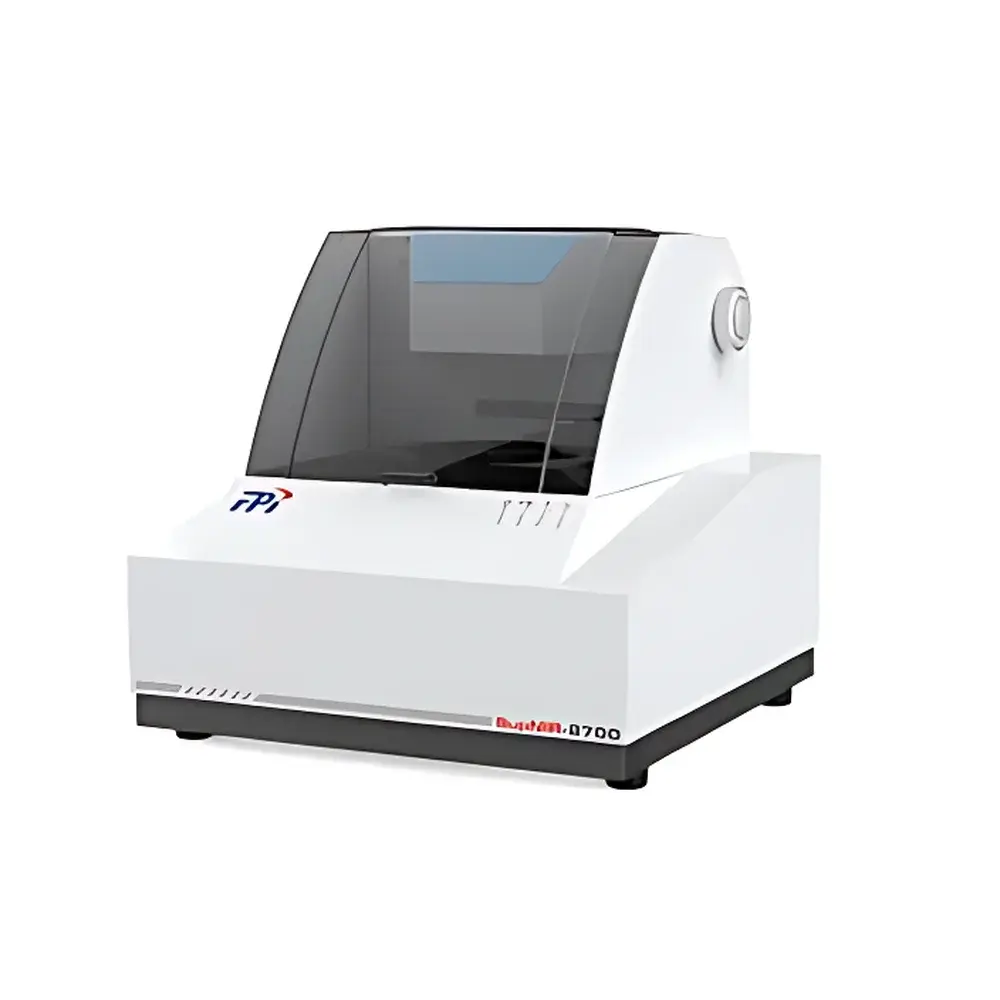
FPI SupNIR 2700 Laboratory Near Infrared Spectrometer
| Brand | FPI |
|---|---|
| Origin | Zhejiang, China |
| Manufacturer Type | Authorized Distributor |
| Instrument Type | Laboratory |
| Principle | Grating Scanning |
| Wavelength Range | 1000–2500 nm |
| Scan Speed | 0.2 s per spectrum |
| Spectral Sampling Interval | 1 nm |
| Measurement Mode | Diffuse Reflectance |
| Chemometrics Software | RIMP |
Overview
The FPI SupNIR 2700 is a high-performance laboratory-grade near infrared (NIR) spectrometer engineered for rapid, non-destructive quantitative and qualitative analysis of heterogeneous solid and semi-solid samples. Operating on the principle of grating-based scanning spectroscopy, the instrument captures full-spectrum NIR reflectance data across a broad spectral window—from 1000 nm to 2500 nm—enabling robust calibration modeling for compositional parameters such as moisture, protein, starch, fat, fiber, and functional additives. Its top-illumination diffuse reflectance optical architecture minimizes sample preparation requirements and ensures consistent light-sample interaction across granular, powdered, pasty, and irregularly shaped materials. Designed specifically for controlled laboratory environments, the SupNIR 2700 delivers stable photometric performance with low noise floor and high wavelength reproducibility—critical for building transferable chemometric models compliant with ISO 12099:2017 (Animal feeding stuffs — Guidance on the application of near infrared spectroscopy) and ASTM E1655–23 (Standard Practices for Infrared Multivariate Quantitative Analysis).
Key Features
- Grating-scanning optical design with fixed slit and precision stepper-motor-driven grating, ensuring long-term wavelength accuracy and minimal drift over extended operation cycles.
- Extended spectral coverage from 1000 nm to 2500 nm—fully encompassing the first and second overtones of C–H, N–H, and O–H bonds—essential for comprehensive organic matrix characterization.
- High-speed acquisition at 0.2 seconds per full spectrum, enabling throughput optimization in high-volume QC laboratories without compromising signal-to-noise ratio.
- 1 nm spectral sampling interval provides sufficient resolution for multivariate regression modeling while maintaining manageable data file sizes and computational efficiency.
- Top-illuminated diffuse reflectance probe configuration accommodates bulk solids, pellets, flakes, and viscous slurries without need for pelletizing or solvent extraction.
- Rugged aluminum alloy optical bench and thermally stabilized detector housing support stable operation under ambient lab conditions (15–30 °C, <70% RH non-condensing).
Sample Compatibility & Compliance
The SupNIR 2700 is validated for direct analysis of unprocessed or minimally prepared samples including cereal grains, oilseeds, feed pellets, dairy powders, pharmaceutical excipients, and polymer blends. Its diffuse reflectance geometry conforms to the measurement principles defined in ISO 21542:2020 (Food products — Determination of moisture content by near-infrared spectroscopy) and supports method validation per ICH Q2(R2) guidelines for analytical procedure verification. While the instrument itself does not carry CE or FDA 510(k) certification, its hardware architecture and software interface are structured to support GLP-compliant workflows—including user access control, audit trail logging (via RIMP software extensions), and electronic signature readiness when deployed with validated IT infrastructure.
Software & Data Management
Data acquisition, preprocessing, model development, and routine prediction are executed through RIMP (Remote Intelligent Modeling Platform), FPI’s proprietary chemometrics suite. RIMP supports standard preprocessing algorithms (SNV, MSC, derivatives, smoothing), PLS and PCR regression, PCA-based outlier detection, and cross-validation diagnostics. The software exports models in .cmp format compatible with third-party deployment engines and allows secure model transfer between instruments within the same network domain. All spectral acquisitions are timestamped and stored with metadata (operator ID, sample ID, instrument serial number), facilitating traceability required under ISO/IEC 17025:2017 accreditation frameworks. Raw spectra are saved in universal .jdx and .csv formats for interoperability with MATLAB, Python (scikit-learn, PyMca), and commercial analytics platforms.
Applications
The SupNIR 2700 serves as a core analytical tool in quality assurance laboratories across agri-food, feed, and industrial chemistry sectors. Typical use cases include real-time monitoring of moisture content in milled wheat flour during milling process control; quantification of crude protein and lysine in soybean meal for feed formulation; discrimination of adulterated spice powders using PCA-based spectral fingerprinting; and rapid assessment of polymer blend homogeneity in R&D settings. In academic and government research labs, it supports breeding program phenotyping (e.g., grain protein mapping in wheat populations) and method development for green analytical chemistry initiatives—reducing reliance on wet chemistry methods that consume solvents and generate hazardous waste.
FAQ
Is the SupNIR 2700 suitable for regulatory submissions in food or feed safety testing?
Yes—when operated within a documented, validated method and supported by appropriate reference methodology correlation (e.g., AOAC 992.15 for moisture), data generated with the SupNIR 2700 and RIMP can form part of regulatory dossiers under national feed safety authorities and EU Commission Regulation (EC) No 1831/2003.
Can calibration models built on one SupNIR 2700 be transferred to another unit?
Model transfer is feasible with instrument standardization using NIST-traceable ceramic reflectance standards and RIMP’s built-in spectral matching algorithms—but requires post-transfer verification per ISO 12099 Annex B.
Does the system support automated sample changers or integration with LIMS?
The SupNIR 2700 features RS-232 and Ethernet interfaces for external trigger input and ASCII-based command protocol, enabling integration with robotic autosamplers and LIMS via middleware; custom API documentation is available under NDA.
What maintenance is required to ensure long-term wavelength calibration stability?
Annual verification using certified wavelength standards (e.g., Holmium oxide filter) is recommended; no routine internal alignment is required due to monolithic optical mount design.





