
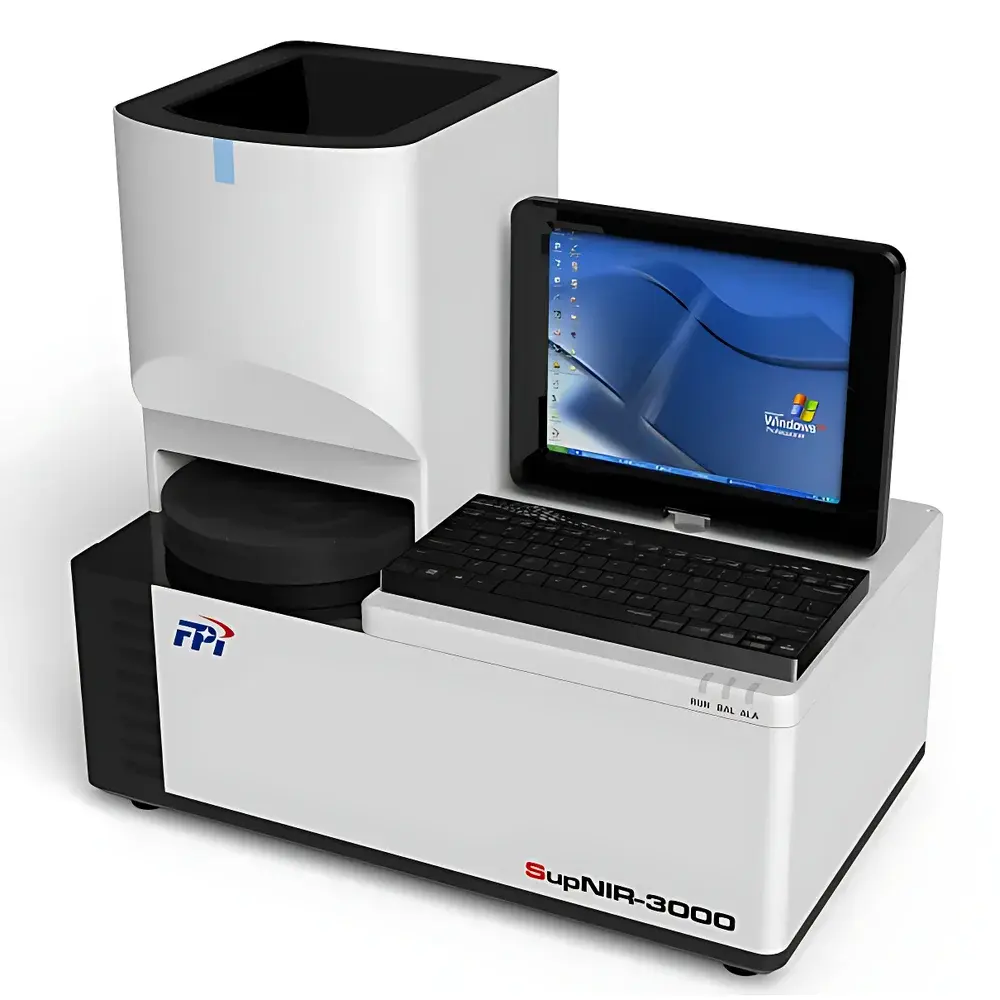
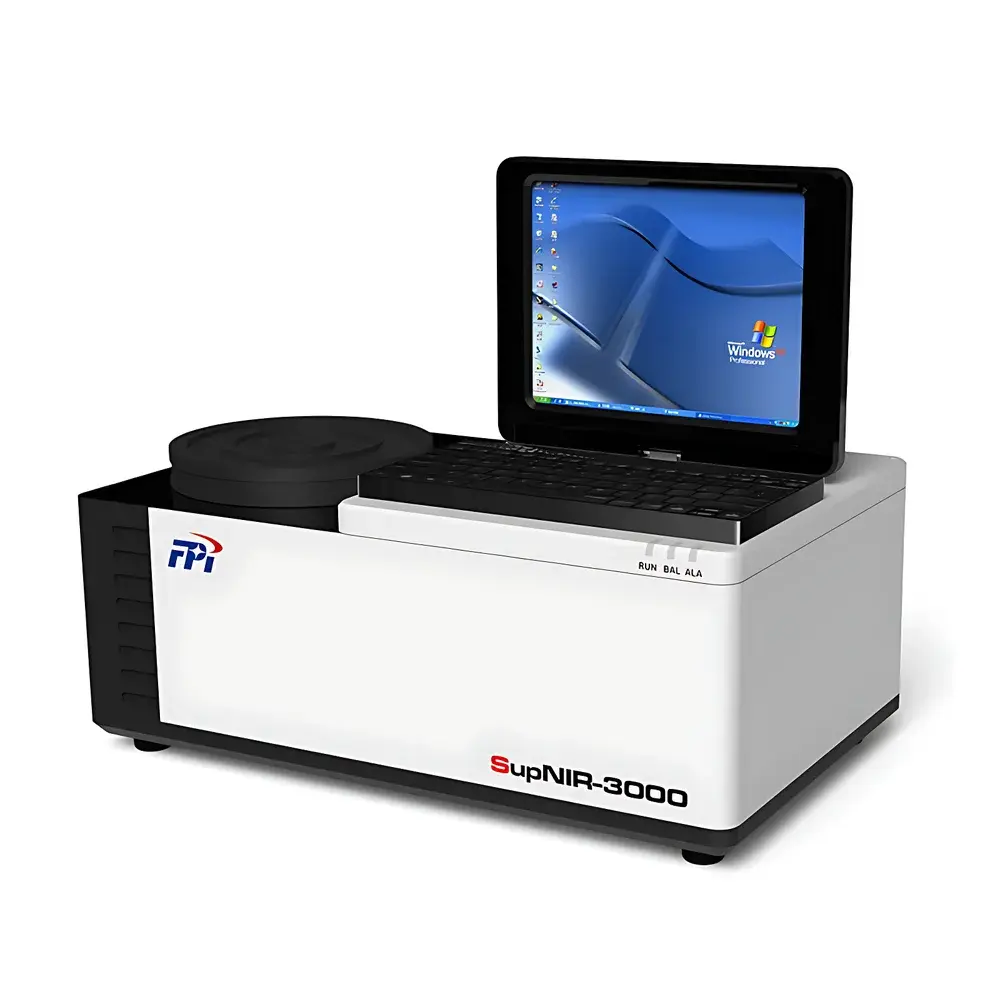
FPI SupNIR-3000 Series Near-Infrared Spectrometer
| Brand | FPI |
|---|---|
| Origin | Zhejiang, China |
| Manufacturer Type | Original Equipment Manufacturer (OEM) |
| Instrument Type | Laboratory Benchtop NIR Spectrometer |
| Optical Design | Holographic Digital Grating + TEC-Cooled InGaAs Detector |
| Wavelength Range | 1000–1800 nm (expandable to 1000–2500 nm) |
| Scanning Mechanism | Grating-Based Wavelength Scanning |
| Software Platform | RIMP Chemometrics Suite (Chinese UI) |
| Connectivity | Ethernet, USB, Remote Management via Web-Based Instrument Control Platform |
| Compliance Support | ASTM E1655, ISO 12099, USP <857>, GLP/GMP-ready audit trail (via RIMP logging) |
Overview
The FPI SupNIR-3000 Series Near-Infrared Spectrometer is a laboratory-grade, grating-scanning NIR instrument engineered for rapid, non-destructive quantitative and qualitative analysis of agricultural and industrial materials. It operates on the principle of diffuse reflectance and transmittance spectroscopy in the short-wave near-infrared region (1000–1800 nm), with optional extension to 2500 nm for enhanced spectral coverage of C–H, N–H, and O–H overtones and combination bands. The system integrates a holographic digital scanning grating with a thermoelectrically cooled (TEC) indium gallium arsenide (InGaAs) photodetector array, delivering high optical stability, low thermal drift, and improved signal-to-noise ratio (SNR) across extended measurement sessions. Designed for routine QC/QA labs in feed, grain, oilseed, and food processing facilities, the SupNIR-3000 eliminates wet chemistry dependency by enabling simultaneous prediction of multiple compositional parameters—including moisture, crude protein, fat, fiber, ash, starch, amino acids, and fatty acid profiles—within six seconds per sample.
Key Features
- Optical architecture combining a precision holographic digital grating and TEC-stabilized InGaAs detector for long-term wavelength accuracy and reproducibility
- Integrated reference standard and self-diagnostic routines for automatic optical alignment verification and fault reporting
- Self-collimating light source module—no manual alignment required during lamp replacement or maintenance
- Touchscreen-driven RIMP software interface with fully localized Chinese UI, supporting intuitive one-click measurement workflow
- Model transfer capability across multiple SupNIR-3000 units, enabling consistent calibration deployment across distributed production sites
- Built-in network connectivity (Ethernet/HTTP) for remote instrument monitoring, spectral data streaming, and centralized model version control
- No sample preparation required—compatible with intact granules, pellets, powders, pastes, and liquids placed directly on the sample stage
Sample Compatibility & Compliance
The SupNIR-3000 accommodates heterogeneous solid and liquid matrices without grinding, drying, or chemical treatment. Its optical path design supports variable sample presentation: bulk solids (e.g., whole grains, soybeans), milled powders (e.g., flour, meal), viscous suspensions (e.g., oilseed slurries), and clear to moderately turbid liquids (e.g., vegetable oils, aqueous extracts). The instrument complies with methodological frameworks referenced in ASTM E1655 (Standard Practices for Infrared Multivariate Quantitative Analysis), ISO 12099 (Animal feeding stuffs — General guidelines for near infrared spectroscopic analysis), and USP (Near-Infrared Spectroscopy). When deployed under validated SOPs with RIMP’s audit-trail-enabled logging, it meets GLP and GMP documentation requirements for regulated environments, including traceability of operator actions, model versions, spectral acquisition timestamps, and calibration history.
Software & Data Management
RIMP (Remote Intelligent Modeling Platform) is a unified chemometrics software suite embedded within the SupNIR-3000. It integrates instrument control, spectral preprocessing, multivariate modeling, validation, and reporting into a single environment. Supported algorithms include Partial Least Squares (PLS) regression for quantitative prediction, Artificial Neural Networks (ANN) for non-linear modeling, and SIMCA-based classification and hierarchical clustering for qualitative discrimination. All models are stored in an encrypted local database with metadata tagging (sample ID, batch, date, operator, instrument serial number). The optional web-based Network Management System extends functionality to enterprise-scale deployments: real-time instrument geolocation mapping, parameter status dashboards, predictive maintenance alerts, remote firmware updates, and role-based access control (RBAC) with multi-level user permissions (e.g., analyst, supervisor, administrator). Data export adheres to CSV, XML, and ASTM E1382-compliant formats for LIMS integration.
Applications
The SupNIR-3000 serves as a primary analytical tool across agri-food supply chains. In feed manufacturing, it enables raw material acceptance testing (e.g., soybean meal protein/fat), in-process blending verification, and finished product release checks (e.g., poultry feed moisture/protein/calcium). Grain elevators utilize it for rapid grading of wheat (moisture, protein, gluten index), rice (amylose content, milling yield proxies), and corn (starch, lysine). Oilseed processors apply it to quantify oil content in rapeseed, erucic acid in canola, glucosinolates in mustard meal, and free fatty acid in crude vegetable oils. Breeding programs leverage its speed and repeatability for high-throughput phenotyping—e.g., screening maize hybrids for kernel hardness or soybean lines for oleic acid profile. Additional validated use cases span DDGS quality assurance, fishmeal authenticity verification, and mycotoxin risk screening via spectral anomaly detection.
FAQ
What wavelength range does the SupNIR-3000 cover by default, and is extension possible?
The base configuration operates from 1000 to 1800 nm; optional detector and grating upgrades extend coverage to 2500 nm for deeper C–H and O–H band analysis.
Does the system support compliance with FDA 21 CFR Part 11?
RIMP software provides electronic signature capability, audit trail logging, and user authentication—features that align with Part 11 expectations when implemented under documented validation protocols.
Can calibration models developed on one SupNIR-3000 be deployed on another unit without revalidation?
Yes—inter-instrument model transfer is supported through built-in standardization routines and spectral correction algorithms, minimizing cross-unit prediction bias.
Is RIMP available in English or other language versions?
RIMP v4.2 and later offer bilingual UI toggle (Chinese/English); full English documentation, method templates, and LIMS API specifications are provided with enterprise licenses.
How is spectral data security managed in networked deployments?
Data encryption (AES-256), TLS 1.2+ secure HTTP communication, hardware-bound license keys, and configurable login session timeouts ensure end-to-end protection of spectral datasets and calibration models.




