
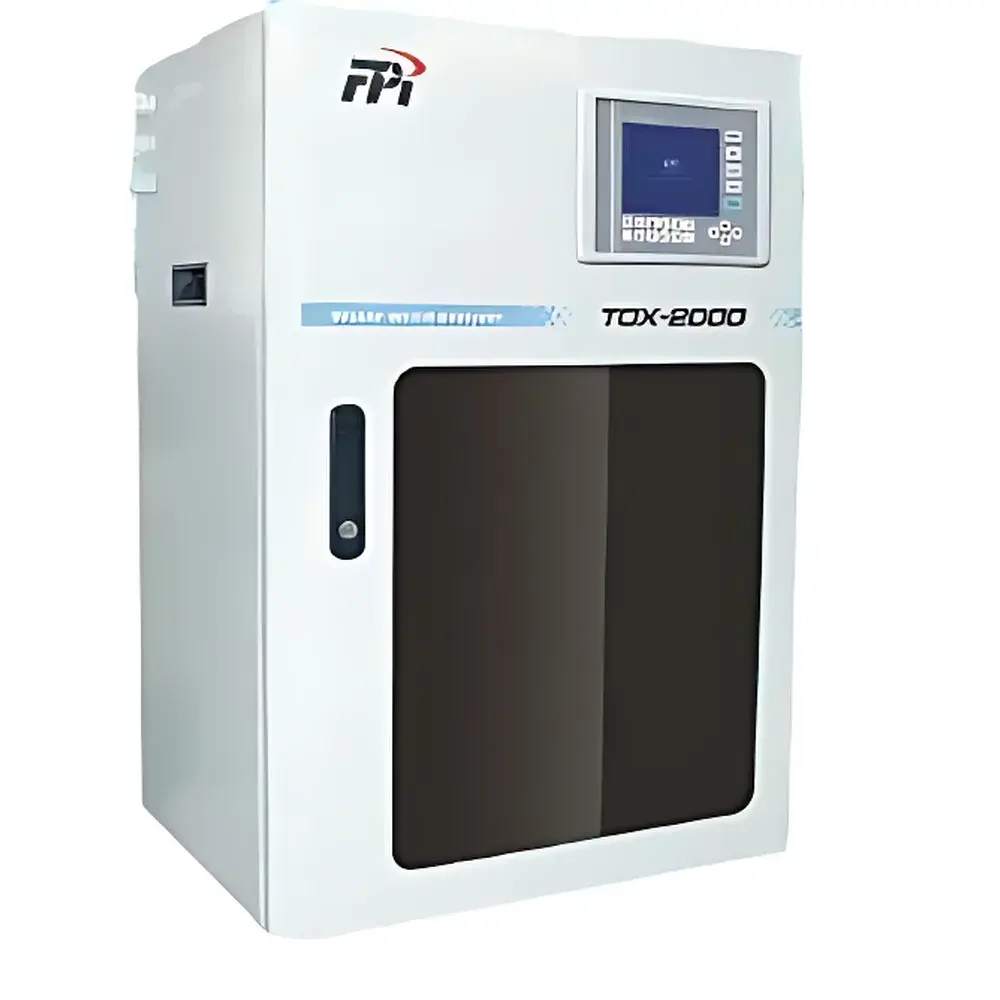
FPI TOX-2000 Online Water Total Toxicity Analyzer
| Brand | FPI |
|---|---|
| Origin | Zhejiang, China |
| Manufacturer | FPI (Hangzhou) Co., Ltd. |
| Model | TOX-2000 |
| Dimensions | 0.60 m × 0.55 m × 1.00 m (L×W×H) |
| Weight | 60 kg |
| Power Supply | 220 V ±10%, 50 Hz ±1% |
| Operating Temperature | 10–30 °C ambient |
| Water Temperature | 0–40 °C (non-freezing) |
| Response Time | <5 min |
| Detectable Toxic Substances | >5,000 compounds including heavy metals, pesticides, herbicides, biocides, and industrial chemicals |
| Sensitivity (EC₅₀) | HgCl₂ < 0.2 mg/L |
| Repeatability | RSD < 5% |
| Bacterial Cartridge Lifespan | 30 days |
| Data Logging Interval | Configurable down to 1 s |
| Output Signals | 4–20 mA analog |
| Toxicity Classification Levels | 5-tier scale (Low, Moderate, High, Severe, Extreme) |
| Compliance | ISO 11348-3 (Vibrio fischeri luminescence inhibition test) |
Overview
The FPI TOX-2000 Online Water Total Toxicity Analyzer is an engineered biological early-warning system designed for continuous, real-time assessment of acute aquatic toxicity in drinking water sources, finished water distribution networks, surface water intakes, and wastewater effluents. It operates on the internationally standardized bioluminescence inhibition principle defined in ISO 11348-3, utilizing freeze-dried Vibrio fischeri (formerly Photobacterium phosphoreum) as the standardized test organism. Upon exposure to toxicants—including heavy metals, organophosphates, carbamates, chlorinated hydrocarbons, phenols, and surfactants—the metabolic activity of the bacteria declines, resulting in a measurable reduction in light emission. The instrument quantifies this inhibition relative to a non-toxic control, calculating percentage inhibition (%) and translating it into a five-level toxicity classification (Low, Moderate, High, Severe, Extreme) aligned with regulatory interpretation frameworks used in EU WFD reporting and US EPA guidance documents. Unlike physicochemical analyzers that target individual contaminants, the TOX-2000 delivers holistic, effect-based toxicity intelligence—enabling detection of unknown or unregulated toxicants, synergistic mixtures, and intentional contamination events where conventional methods fail.
Key Features
- Biological response spectrum covering >5,000 toxic substances across chemical classes—validated against ISO 11348-3 reference toxicity profiles.
- High-sensitivity bioluminescence detection with EC50 values of <0.2 mg/L for mercury(II) chloride and <6 mg/L for zinc sulfate heptahydrate—meeting sensitivity thresholds required for source water early warning applications.
- Integrated bacterial cartridge system with 30-day stable reagent shelf life under onboard temperature-controlled storage—eliminating daily manual inoculation and reducing operator dependency.
- Time-resolved inhibition profiling (TRIP) algorithm enables preliminary discrimination between fast-acting (e.g., cyanide, aldehydes) and slow-onset (e.g., certain organophosphates, metal chelates) toxicants—supporting rapid incident triage.
- Continuous flow-through measurement architecture with automated sample dilution, blank referencing, and self-cleaning fluidic pathways—ensuring reproducibility across variable matrix conditions (turbidity ≤100 NTU, DOC ≤20 mg/L).
- Modular communication interface supporting simultaneous Ethernet (TCP/IP), RS485 (Modbus RTU), RS232, and GPRS—facilitating integration into SCADA, LIMS, and centralized environmental data platforms.
Sample Compatibility & Compliance
The TOX-2000 is validated for use with raw surface water, treated potable water (including finished water from municipal plants and distribution network samples), groundwater, and pre-treated wastewater effluent. Integrated optional pretreatment modules—including particulate filtration (5 µm), pH stabilization (±0.3 unit buffering), and UV disinfection bypass—accommodate site-specific matrix challenges without compromising biological viability. All operational protocols, calibration routines, and maintenance logs comply with GLP-aligned documentation requirements. Instrument firmware supports audit-trail generation for critical parameters (e.g., inhibition %, response time, bacterial activity baseline), satisfying traceability expectations under ISO/IEC 17025 and facilitating readiness for regulatory inspections. While not certified under FDA 21 CFR Part 11, its data integrity controls—including user-authenticated access, immutable timestamped records, and exportable CSV/JSON logs—are structured to support future validation for regulated utility environments.
Software & Data Management
The TOX-2000 is managed via FPI’s AquaGuard™ Remote Operation Suite—a secure, browser-based platform supporting role-based access control (administrator, operator, viewer). Real-time toxicity curves, historical inhibition trends, alarm event logs, and bacterial cartridge usage metrics are visualized through customizable dashboards. Data export adheres to WQX (Water Quality Exchange) and SDMX (Statistical Data and Metadata Exchange) schemas, enabling direct ingestion into national monitoring systems such as China’s National Surface Water Monitoring Network or international platforms like EFSA’s Waterbase. Alarm thresholds are configurable per toxicity level and can trigger SMS/email notifications or PLC interlocks via Modbus TCP. All raw photometric readings, temperature-compensated inhibition calculations, and QC flag metadata are stored locally on industrial-grade microSD and synchronized hourly to cloud-hosted redundancy servers—ensuring continuity during extended network outages.
Applications
- Drinking water utility early-warning systems at intake points and distribution nodes—detecting accidental spills, agricultural runoff, or deliberate contamination.
- Environmental monitoring stations along transboundary rivers and reservoirs—providing effect-based complementarity to conventional nutrient and metal analyzers.
- Industrial park wastewater discharge compliance verification—identifying non-reported toxic discharges before they reach municipal treatment works.
- Emergency response deployment during chemical accidents—rapid field-deployable mode supported by integrated battery backup and GPRS telemetry.
- Research applications in ecotoxicology laboratories requiring high-frequency, low-labor toxicity screening of complex environmental matrices.
FAQ
What biological standard does the TOX-2000 follow?
It implements the ISO 11348-3 protocol using lyophilized Vibrio fischeri, with performance verified against certified reference toxicants (HgCl₂, ZnSO₄·7H₂O) per ISO guidelines.
Can the instrument operate in cold water environments?
Yes—sample temperature tolerance extends to 0–40 °C; however, ambient operating temperature must remain within 10–30 °C to ensure bacterial reactivation stability and optical detector thermal drift control.
How is data integrity ensured during extended power outages?
Onboard non-volatile memory retains ≥30 days of second-resolution data; integrated UPS support (optional) sustains operation for up to 90 minutes, allowing graceful shutdown and synchronization upon recovery.
Is method validation documentation available for regulatory submission?
FPI provides a comprehensive Method Validation Report (MVR) package—including precision, accuracy, LOD/LOQ, matrix interference studies, and interlaboratory comparison data—aligned with ISO/IEC 17025 clause 7.2.2 requirements.
What maintenance tasks require certified technician intervention?
Only annual optical path calibration and fluidic manifold inspection require factory-trained personnel; all other operations—including bacterial cartridge replacement, tubing cleaning, and software updates—are designed for trained utility operators.
Related Products







