
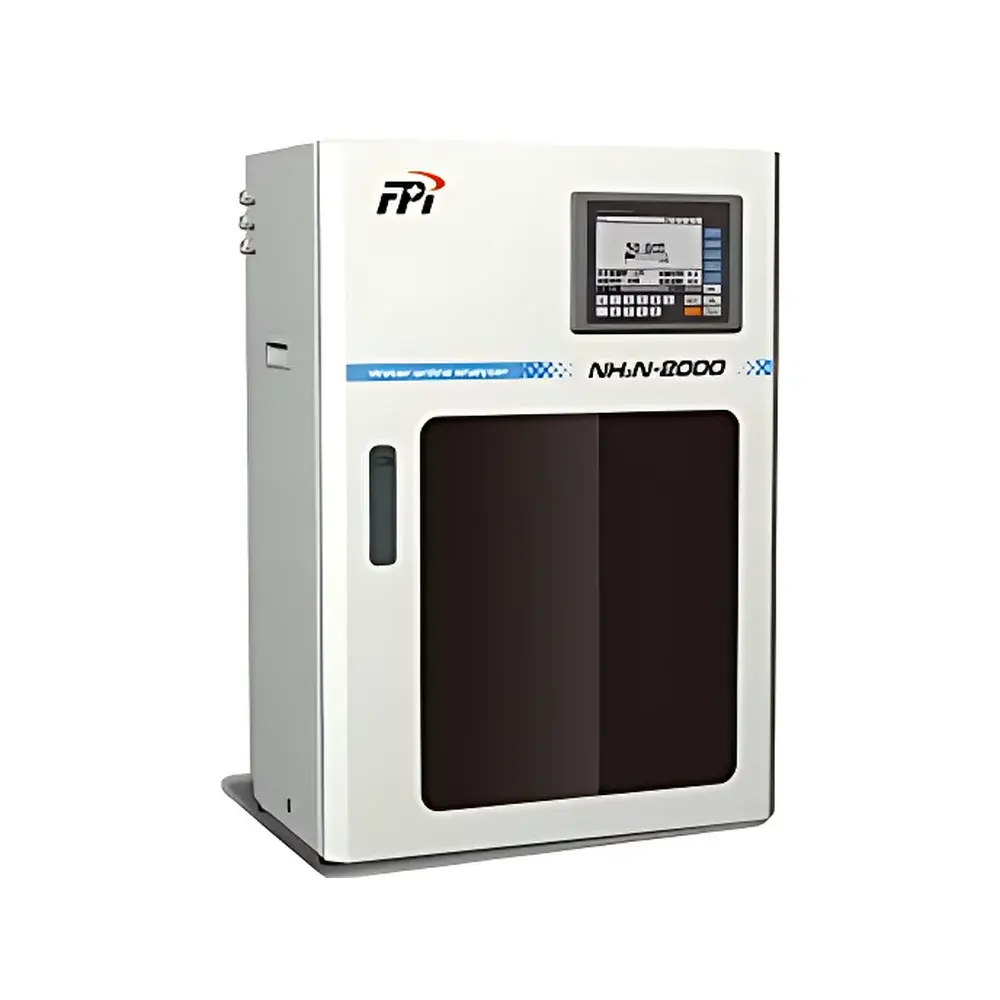
FPI TPN-2000 Online Total Nitrogen Analyzer
| Brand | FPI |
|---|---|
| Origin | Zhejiang, China |
| Manufacturer Type | OEM Manufacturer |
| Country of Origin | China |
| Model | TPN-2000 |
| Instrument Type | Online Analyzer |
| Measurement Principle | High-Temperature/High-Pressure Alkaline Potassium Persulfate Digestion + UV Spectrophotometry |
| Measurement Range | 0–0.5 / 0–2 / 0–5 mg/L (selectable) |
| Accuracy | ±10% of reading |
| Detection Limit | 0.005 mg/L |
| Compliance | HJ 636–2012 |
Overview
The FPI TPN-2000 Online Total Nitrogen Analyzer is an industrial-grade, fully automated water quality monitoring system engineered for continuous, unattended determination of total nitrogen (TN) in aqueous matrices. It implements a rigorously validated analytical sequence based on high-temperature (120–130 °C), high-pressure alkaline potassium persulfate digestion followed by ultraviolet spectrophotometric quantification at 220 nm and 275 nm. This dual-wavelength correction methodology compensates for interference from nitrate, nitrite, dissolved organic matter, and turbidity—ensuring robustness across heterogeneous sample streams. The instrument’s core measurement protocol aligns with the Chinese national standard HJ 636–2012, “Determination of Total Nitrogen in Water Quality—Alkaline Potassium Persulfate Digestion Ultraviolet Spectrophotometric Method,” and is functionally compatible with internationally recognized TN method frameworks including ISO 11905-1 (1997) and ASTM D1426–22 (for ammonia-nitrogen precursors in digestate). Designed for permanent installation in effluent discharge channels, wastewater treatment plant influent/effluent points, surface water gauging stations, and drinking water distribution networks, the TPN-2000 delivers trace-level sensitivity and long-term operational stability under real-world environmental conditions.
Key Features
- Patented online sequential injection platform minimizes reagent consumption to 10–20% of conventional flow-injection or discrete analyzer systems—reducing operational cost and hazardous waste generation.
- Non-contact liquid handling architecture employs high-precision syringe pumps for volumetric dispensing of samples and reagents; eliminates pump tube wear, calibration drift, and cross-contamination risks associated with peristaltic systems.
- Sealed high-pressure digestion chamber operates at up to 0.3 MPa and 125 °C, achieving >95% oxidation efficiency for refractory nitrogen species (e.g., organonitrogen compounds, cyanides, and substituted amines) within ≤30 minutes.
- Real-time color and turbidity compensation algorithm dynamically corrects absorbance readings using dual-wavelength photometry—eliminating manual filtration or dilution steps for moderately turbid or colored samples (up to 500 NTU).
- Integrated reagent level monitoring with predictive low-reagent alerts prevents instrument downtime due to empty reagent reservoirs; supports remote notification via Modbus TCP or 4–20 mA analog output.
- Flexible measurement scheduling—including fixed-interval (e.g., hourly), event-triggered (e.g., flow-pulse synchronized), and demand-based modes—enables adaptive deployment in intermittent discharge scenarios or regulatory compliance windows.
Sample Compatibility & Compliance
The TPN-2000 accepts raw, pre-filtered (≤80 µm), or clarified aqueous samples with pH 4–10 and suspended solids <100 mg/L. It has been validated for municipal wastewater, industrial effluents (textile, food processing, chemical manufacturing), river and lake water, treated drinking water, and cooling tower recirculation streams. All wetted components—including digestion vessel, optical cuvette, and fluidic manifolds—are constructed from quartz, PTFE, and 316L stainless steel to resist corrosion from acidic digestate and oxidizing reagents. The system meets CE marking requirements for electromagnetic compatibility (EN 61326-1) and functional safety (IEC 61508 SIL 2 for critical alarm outputs). Data integrity features—including audit-trail-enabled configuration logs, time-stamped measurement records, and user-access controls—support alignment with GLP and ISO/IEC 17025 laboratory management principles.
Software & Data Management
Embedded firmware provides local web-based interface (HTTPS) for configuration, diagnostics, and historical data review (7-day onboard storage). Raw absorbance values, digestion temperature/pressure profiles, reagent usage metrics, and QC flag status are logged at each measurement cycle. Data export is supported via Modbus RTU/TCP, OPC UA, and optional 4–20 mA analog outputs (with HART 7.5 protocol). Optional FPI CloudConnect gateway enables secure TLS 1.2 transmission to centralized SCADA or LIMS platforms, with configurable retention policies and role-based access control. All software modules comply with IEC 62443-3-3 cybersecurity standards for industrial automation systems.
Applications
- Continuous compliance monitoring at municipal wastewater treatment plant discharge outfalls (per GB 18918–2002 Class I A/B limits)
- Industrial pretreatment verification for facilities discharging to public sewers (e.g., electroplating, pharmaceutical, semiconductor rinse waters)
- Trend analysis of nutrient loading in eutrophic lakes and reservoirs under national surface water quality assessment programs
- Early-warning detection of nitrogen breakthrough in groundwater-fed drinking water sources
- Process control feedback for biological denitrification units in activated sludge systems
FAQ
What regulatory standards does the TPN-2000 meet for total nitrogen measurement?
It complies with HJ 636–2012 and is methodologically consistent with ISO 11905-1 and ASTM D1426–22 for nitrogen speciation validation.
Can the analyzer handle highly saline or brackish water samples?
Yes—salinity up to 15 g/L NaCl has been verified without signal suppression or digestion inefficiency; optional chloride interference correction is available.
Is remote calibration verification supported?
Yes—built-in standard addition functionality allows field verification using certified TN reference solutions traceable to NIST SRM 2193a.
What maintenance intervals are recommended for routine operation?
Preventive maintenance every 3 months includes optical path cleaning, digestion chamber inspection, and pump calibration verification; mean time between failures exceeds 8,000 operating hours.
Does the system support integration with existing PLC-based control infrastructure?
Yes—native Modbus TCP and optional Profibus DP-V1 interfaces enable direct integration into Siemens S7, Rockwell ControlLogix, and Schneider EcoStruxure platforms.







