
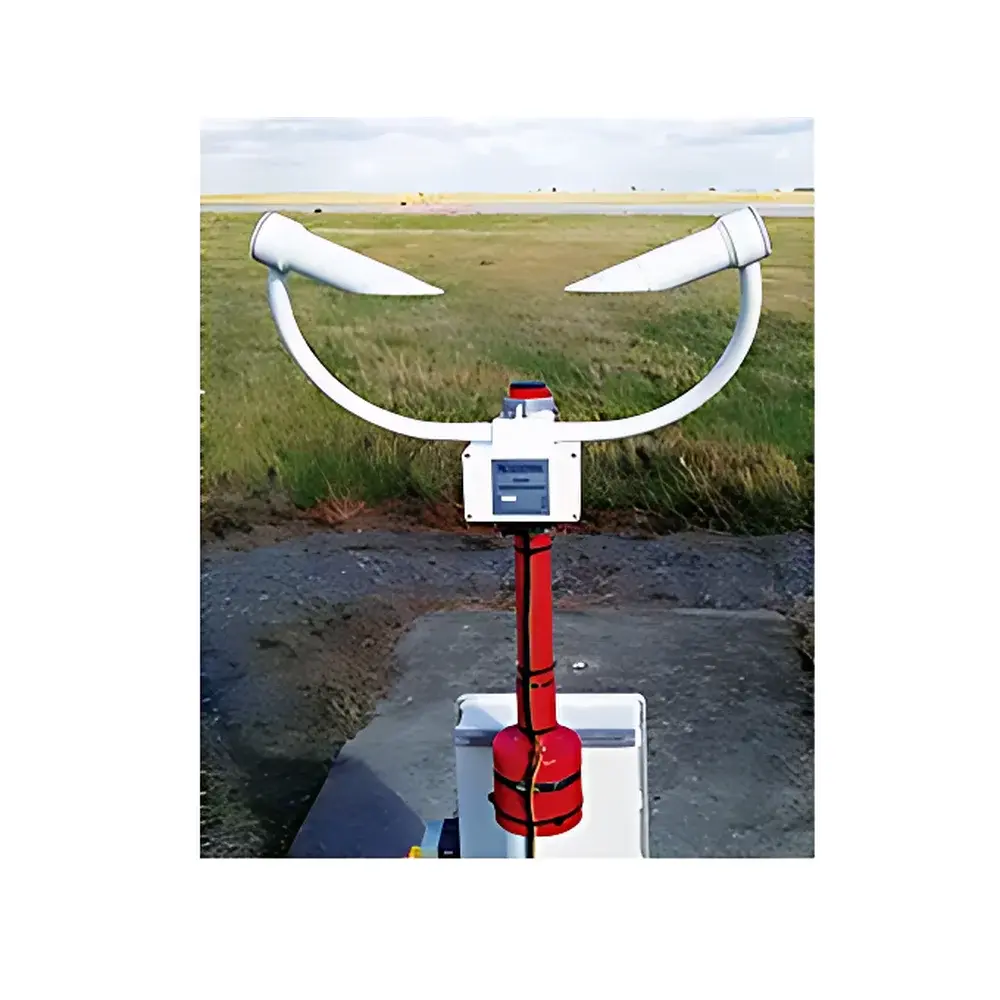
FPI Visibility Sensor V-1000
| Brand | FPI |
|---|---|
| Origin | Zhejiang, China |
| Manufacturer Type | Original Equipment Manufacturer (OEM) |
| Country of Origin | China |
| Model | V-1000 |
| Instrument Category | Meteorological Visibility Sensor |
| Measurement Principle | Infrared Forward Scatter at 42° |
| Range | 10–30,000 m |
| Operating Environment | All-weather, including fog, rain, snow, and freezing conditions |
| Power Consumption | Low-power design for remote deployment |
| Calibration Option | Compatible with FPI Model 28678 Field Calibration Kit |
| Enclosure | Integrated Heated Housing to Prevent Condensation and Ice Accumulation |
| Airflow Management | Aerodynamically Optimized Sensor Geometry to Minimize Flow Disturbance |
Overview
The FPI Visibility Sensor V-1000 is an industrial-grade meteorological instrument engineered for continuous, high-reliability visibility measurement in demanding outdoor environments. It operates on the principle of infrared forward scatter photometry, utilizing a precisely collimated 850 nm infrared light source and a synchronized detector positioned at a fixed 42° scattering angle relative to the incident beam. This optical geometry provides optimal signal-to-noise ratio across the full operational range of 10 to 30,000 meters, enabling accurate quantification of atmospheric extinction coefficient under heterogeneous hydrometeor conditions—including dense fog, drizzle, moderate rain, wet snow, and mixed-phase precipitation. Unlike transmissometers requiring long baseline infrastructure, the V-1000 employs a compact single-ended configuration, making it suitable for rapid deployment on roadside gantries, airport perimeter monitoring networks, marine navigation buoys, wind farm control towers, and unmanned weather stations. Its measurement output conforms to WMO (World Meteorological Organization) definitions of Meteorological Optical Range (MOR), supporting interoperability with national meteorological services and aviation authorities.
Key Features
- Optimized 42° forward scatter geometry ensures stable sensitivity to particle size distributions typical of fog (1–40 µm) and precipitation (100 µm–5 mm), minimizing angular dependence errors.
- Integrated heated housing maintains lens surface temperature above dew point under sub-zero and high-humidity conditions, preventing condensation, frost, or ice buildup without compromising optical path integrity.
- Aerodynamic sensor housing minimizes turbulent airflow around the measurement volume, reducing spurious scattering from boundary layer eddies and enhancing measurement reproducibility during high-wind events.
- High-speed sampling architecture (1 Hz default, configurable up to 10 Hz) enables dynamic response to rapidly evolving visibility conditions—particularly critical during frontal passage, freezing rain onset, or convective shower development.
- Low-power electronics (< 5 W average, < 12 W peak) support solar-battery operation in off-grid locations; compatible with standard 12/24 V DC power inputs and RS-485 Modbus RTU or SDI-12 digital interfaces.
- Designed for field maintainability: optical windows are accessible without disassembly; alignment stability verified per IEC 60068-2 environmental stress screening protocols.
Sample Compatibility & Compliance
The V-1000 is validated for continuous operation across ISO 14644-1 Class 8 ambient particulate environments and meets IP66 ingress protection rating per IEC 60529. It complies with EN 60947-5-2 for industrial proximity sensor electromagnetic compatibility and satisfies CE marking requirements for meteorological instrumentation under Directive 2014/30/EU (EMC) and 2014/35/EU (LVD). While not certified to FAA AC 150/5220-22C or ICAO Annex 3 Annexure D directly, its MOR output format and calibration traceability align with data reporting conventions used in certified aviation weather systems. The sensor supports GLP-aligned calibration documentation when used with the optional FPI Model 28678 portable calibration reference unit, which provides NIST-traceable aerosol attenuation verification at three discrete visibility setpoints (500 m, 2,000 m, and 10,000 m).
Software & Data Management
Raw scattering voltage signals are digitized onboard using a 16-bit ADC and converted to MOR values via factory-derived polynomial calibration curves stored in non-volatile memory. Output is delivered as ASCII-formatted serial data packets containing timestamped MOR (m), backscatter ratio, internal temperature, heater status, and diagnostic flags. Integration with third-party SCADA platforms (e.g., Campbell Scientific LoggerNet, Siemens Desigo CC, or custom Python-based ingestion pipelines) is supported via open protocol documentation. Firmware updates are performed over RS-485 using secure signed binary packages; audit logs record all configuration changes and calibration events in accordance with ISO/IEC 17025 clause 7.7 requirements for measurement traceability.
Applications
- Roadway Intelligent Transportation Systems (ITS): Real-time fog detection for variable message sign activation, ramp metering control, and automated lane closure protocols.
- Civil Aviation: Terminal area visibility monitoring for Category I/II/III approach decision height assessment and NOTAM generation.
- Maritime Safety: Coastal lighthouse auxiliary sensing, port entrance visibility assurance, and AIS-integrated hazard alerting.
- Renewable Energy: Turbine cut-in/cut-out logic augmentation in offshore wind farms where sea fog impacts blade icing risk models.
- National Weather Services: Dense network deployment for mesoscale visibility nowcasting and model validation against numerical weather prediction outputs (e.g., ECMWF HRES, GFS).
FAQ
What is the recommended maintenance interval for the V-1000?
FPI recommends biannual visual inspection of optical windows and quarterly verification of heater function and thermal stability under humid conditions. Full recalibration is advised every 24 months or after exposure to severe contamination events (e.g., volcanic ash, industrial soiling).
Can the V-1000 operate unattended for extended periods?
Yes—the sensor is rated for continuous operation across –40°C to +70°C ambient temperatures and includes watchdog timers, brown-out reset circuitry, and EEPROM-stored fault history to ensure resilience in remote deployments.
Is the 42° scattering angle configurable?
No—the 42° geometry is fixed by optical design to meet WMO-specified forward scatter performance criteria; alternative angles would invalidate MOR traceability and require revalidation per ISO 9060:2018.
Does the V-1000 comply with FDA or pharmaceutical environmental monitoring standards?
Not applicable—the V-1000 is designed for outdoor atmospheric measurement and does not meet ISO 14644 cleanroom classification requirements or 21 CFR Part 11 data integrity mandates for regulated GxP environments.
Related Products







