
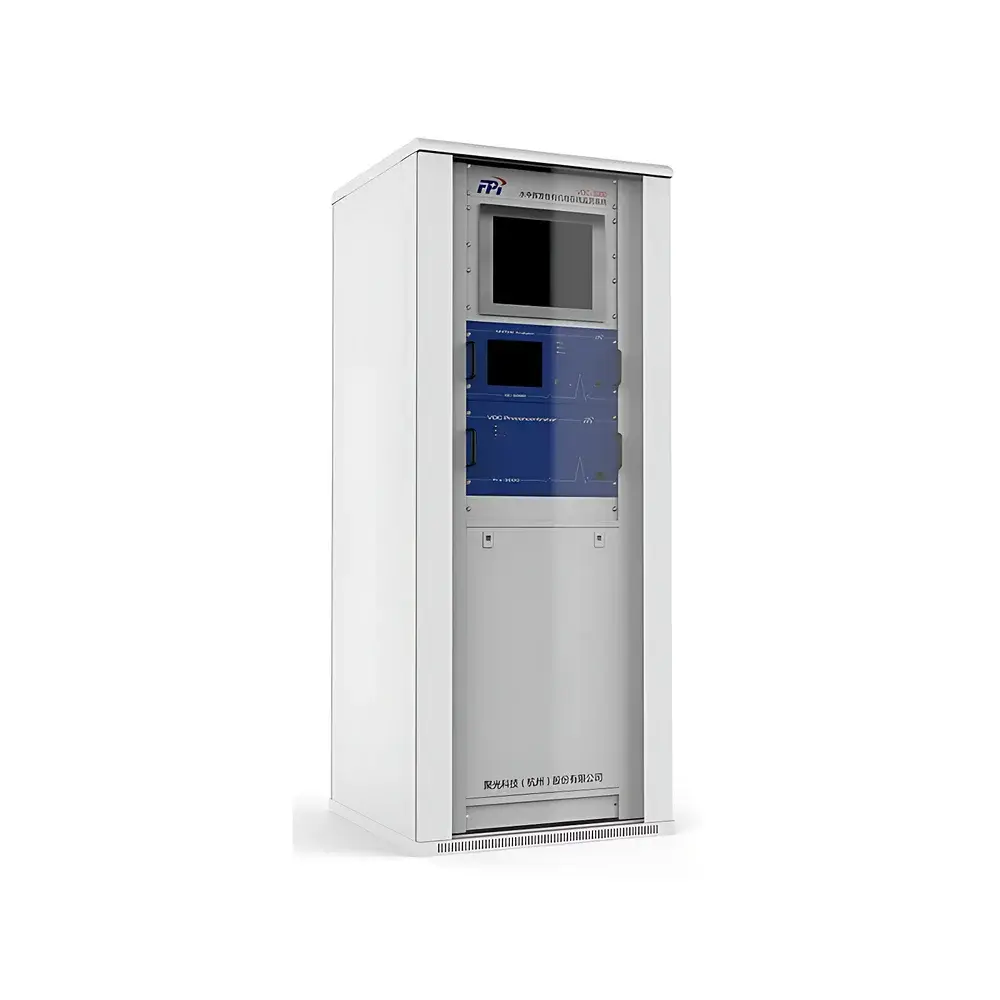
FPI VOC-3000 Online Waterborne Volatile Organic Compounds Analyzer
| Brand | FPI |
|---|---|
| Origin | Zhejiang, China |
| Manufacturer Type | Original Equipment Manufacturer (OEM) |
| Country of Origin | China |
| Model | VOC-3000 |
| Pricing | Upon Request |
Overview
The FPI VOC-3000 Online Waterborne Volatile Organic Compounds Analyzer is an integrated, fully automated analytical platform engineered for continuous, unattended monitoring of volatile organic compounds (VOCs) in surface water, raw drinking water sources, and wastewater effluents. It implements the internationally standardized purge-and-trap gas chromatography (P&T-GC) methodology—recognized by ASTM D5024, EPA Method 524.2, and ISO 15681-2—as its core measurement principle. The system sequentially performs sample aspiration, heated purge, moisture removal, cryogenic or ambient-temperature trapping, thermal desorption, capillary GC separation, and flame ionization detection (FID). Designed for long-term field deployment, the VOC-3000 operates with minimal operator intervention, delivering quantitative data on target VOCs—including BTEX (benzene, toluene, ethylbenzene, xylenes), chlorinated solvents (e.g., trichloroethylene, tetrachloroethylene), and low-molecular-weight aliphatics—with high reproducibility and trace-level sensitivity.
Key Features
- Compliant purge-and-trap–GC/FID architecture validated against regulatory reference methods for aqueous VOC analysis
- Constant-temperature purge module with optimized thermal control, ensuring >95% purge efficiency across 5–30 °C water temperature range
- Mass flow controller (MFC)-regulated inert purge gas delivery (helium or nitrogen), maintaining ±0.5% flow stability over extended operation
- Integrated cyclonic moisture removal and high-temperature foam suppression, reducing water vapor load to <10 ppm before trap introduction
- Self-cleaning fluidic pathways: automated rinsing of sample tubing, purge chamber, and transfer lines between analyses to minimize carryover and memory effects
- Multi-component sorbent trap using layered polymer–carbon composite media, enabling simultaneous capture of C2–C12 VOCs with breakthrough volumes >5 L at 40 mL/min purge flow
- Direct-resistive heating desorption system achieving ramp rates >100 °C/s, minimizing analyte band broadening and preserving chromatographic resolution
- FID with auto-ignition sequence and hydrogen safety interlock: real-time flame status monitoring, automatic H₂ shutoff upon flameout, and fail-safe pressure regulation
- Flexible acquisition modes: single-shot, time-scheduled, or event-triggered sampling; configurable cycle times from 30 min to 24 h
- Compressed-gas-only operation—no onboard gas generators required—reducing footprint, power demand, and maintenance complexity
Sample Compatibility & Compliance
The VOC-3000 accepts untreated natural waters including riverine, lacustrine, groundwater, and clarified wastewater influents with turbidity ≤100 NTU and total suspended solids (TSS) <50 mg/L. It complies with functional requirements outlined in China’s HJ 978–2018 standard for online VOC monitoring systems and aligns with technical expectations of EU WFD (Water Framework Directive) Annex VIII and US EPA Clean Water Act Section 304(h) for priority pollutant surveillance. All data handling routines support audit-ready metadata logging, including instrument status flags, calibration history, and environmental condition timestamps—facilitating GLP-compliant recordkeeping and optional 21 CFR Part 11–aligned electronic signature integration via external LIMS.
Software & Data Management
The embedded control software provides local HMI navigation, method configuration, and real-time chromatogram visualization. Remote access is enabled via secure HTTPS-based web interface supporting role-based user permissions (administrator, operator, viewer). Raw chromatographic data are stored in vendor-neutral .cdf (NetCDF) format compliant with ASTM E1947. Automated report generation includes daily summary tables, trend plots, exceedance alerts (configurable per compound and threshold), and QC flagging for retention time shifts (>0.05 min), peak area RSD (>15%), or baseline noise anomalies. Data export supports MODBUS TCP, OPC UA, and MQTT protocols for seamless integration into SCADA or central environmental data platforms.
Applications
- Real-time emission monitoring at industrial wastewater discharge points subject to national VOC discharge limits
- Transboundary river section surveillance for early detection of upstream contamination events
- Raw water intake monitoring at municipal drinking water treatment plants to inform coagulation and advanced oxidation process adjustments
- Source water protection zone assessment in reservoirs and karst aquifers vulnerable to hydrocarbon infiltration
- Emergency response deployment during chemical spill incidents requiring rapid VOC speciation and concentration tracking
FAQ
What VOC compounds can the VOC-3000 quantify?
The system is validated for ≥35 priority VOCs listed in EPA Method 524.2 and China’s HJ 639–2012, including benzene, vinyl chloride, chloroform, carbon tetrachloride, and 1,2-dichloroethane.
Does the system require daily manual maintenance?
No routine daily intervention is required; scheduled maintenance intervals are specified at 30-day (trap replacement), 90-day (FID jet cleaning), and 180-day (calibration verification) intervals.
Can the VOC-3000 operate in remote outdoor enclosures?
Yes—it is rated IP55 and designed for ambient operation between 5 °C and 40 °C, with optional thermostatic cabinet integration for sub-zero environments.
Is method validation documentation provided?
Yes, factory performance qualification (PQ) reports, system suitability test (SST) templates, and blank/spike recovery datasets are supplied with each unit.
How is data integrity ensured during transmission?
All communications use TLS 1.2 encryption; locally cached data persist through network outages and synchronize automatically upon restoration.







