
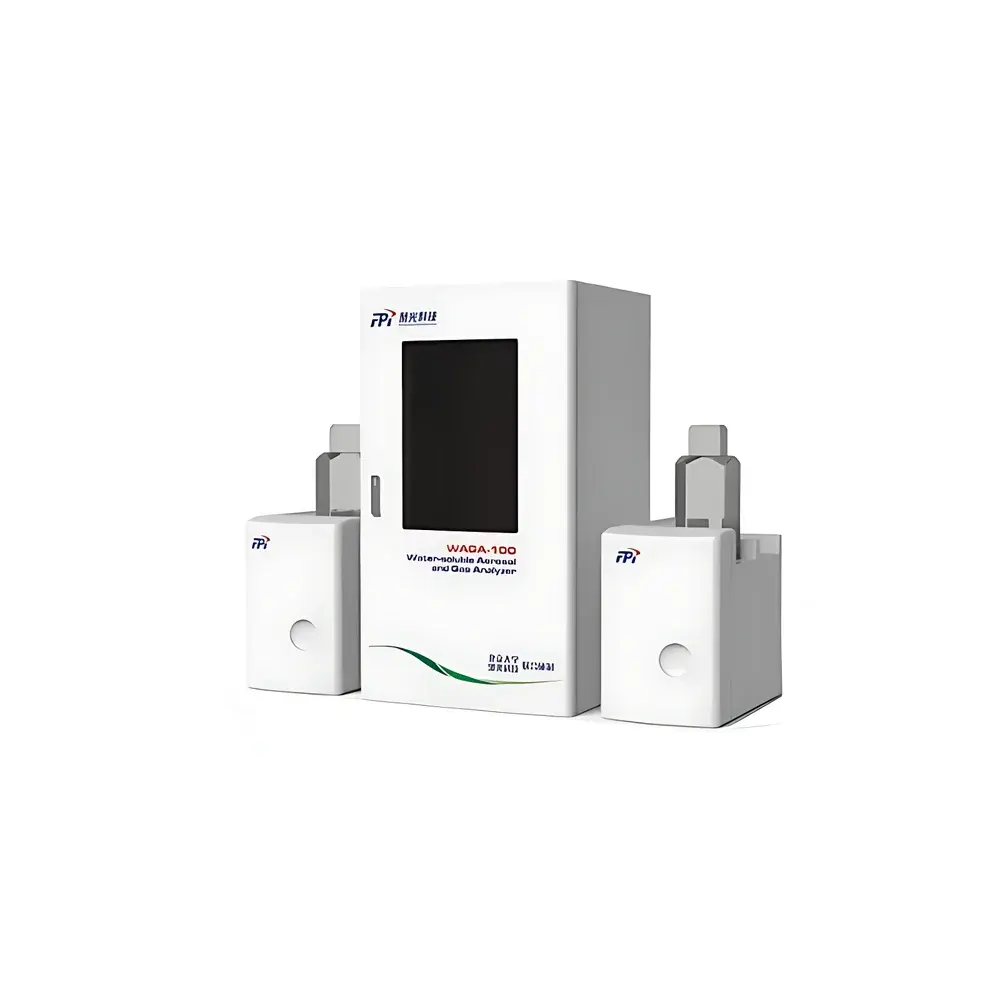
FPI WAGA Online Atmospheric Water-Soluble Ion Analyzer
| Brand | FPI |
|---|---|
| Origin | Zhejiang, China |
| Manufacturer Type | Original Equipment Manufacturer (OEM) |
| Country of Origin | China |
| Model | WAGA |
| Configuration | Online Continuous Monitoring System |
| Measurement Principle | Wet-Chemical Extraction Coupled with Ion Chromatography (IC) |
| Instrument Type | Online Multicomponent Aerosol Ion Analyzer |
| Compliance | Designed for ambient air quality monitoring per Chinese HJ 653–2013 and compatible with ISO 12884, EN 14902, and US EPA OTM-33A method frameworks |
Overview
The FPI WAGA Online Atmospheric Water-Soluble Ion Analyzer is an integrated, field-deployable system engineered for real-time, unattended quantification of major water-soluble inorganic ions—including sulfate (SO₄²⁻), nitrate (NO₃⁻), chloride (Cl⁻), ammonium (NH₄⁺), sodium (Na⁺), potassium (K⁺), calcium (Ca²⁺), and magnesium (Mg²⁺)—in atmospheric particulate matter (PM₂.₅ and PM₁₀). Unlike conventional filter-based offline methods, the WAGA employs a continuous wet-collection architecture: ambient air is drawn through a parallel-plate denuder followed by a high-efficiency particle dissolution chamber, where aerosols are captured and instantaneously dissolved in ultrapure water. The resulting aqueous extract is automatically delivered to an on-board microbore ion chromatograph for separation and conductivity detection. This hyphenated approach eliminates sample handling losses, minimizes artifact formation from volatile species (e.g., NH₃–HNO₃ recombination), and ensures trace-level reproducibility under variable humidity and temperature conditions typical of urban and regional monitoring sites.
Key Features
- Continuous online operation with fully automated sampling, extraction, separation, detection, and data reporting—requiring no manual intervention for ≥7 days
- Parallel-plate wet denuder design optimized for simultaneous gas-phase acidic/basic compound removal and particulate capture, minimizing co-adsorption interference
- High-efficiency particle dissolution module operating at controlled flow rate (16.7 L/min nominal) and residence time, ensuring >95% collection efficiency for PM₂.₅
- Integrated microbore ion chromatography system with suppressed conductivity detection, enabling sub-ppb (ng/m³) detection limits for all target anions and cations
- Embedded industrial-grade PLC and embedded Linux controller supporting remote diagnostics, firmware updates, and alarm-triggered event logging
- Ruggedized enclosure rated IP55, equipped with climate-controlled internal compartment (15–30 °C, ±1 °C stability) for chromatographic column and detector thermal management
Sample Compatibility & Compliance
The WAGA analyzer is validated for ambient air matrices across diverse environmental regimes—from coastal urban stations with high sea-salt loadings to inland industrial zones with elevated secondary inorganic aerosol (SIA) concentrations. It meets the functional requirements of China’s “Technical Specification for Ambient Air Quality Monitoring” (HJ 653–2013) for water-soluble ion measurement and aligns with international reference methodologies including ISO 12884 (ambient aerosol sampling), EN 14902 (ambient air—standardized measurement of inorganic ions), and US EPA OTM-33A (online ion analysis using mist chamber–IC coupling). Data output complies with GLP-aligned audit trails, including timestamped raw chromatograms, calibration verification records, and system pressure/flow logs—supporting regulatory reporting under national air quality networks and research-grade source apportionment studies.
Software & Data Management
The WAGA operates with FPI’s proprietary WAGA-IMS (Ion Monitoring System) software, deployed on an embedded industrial PC. The interface provides real-time chromatogram visualization, automatic peak integration using retention-time–matched templates, and dynamic baseline correction. All quantitative results are traceable to NIST-traceable ionic standard solutions (certified reference materials CRM-201–CRM-208). Data are stored locally in SQLite format with SHA-256 hashing for integrity verification and exported via secure FTP or MQTT to central environmental data platforms. The system supports 21 CFR Part 11–compliant user access control (role-based login), electronic signatures for calibration events, and immutable audit logs—including operator actions, instrument status transitions, and QC failure alerts.
Applications
- Long-term trend analysis of secondary inorganic aerosol (SIA) formation in regional haze episodes
- Source apportionment modeling using time-resolved ion ratios (e.g., NO₃⁻/SO₄²⁻, NH₄⁺/SO₄²⁻) to distinguish coal combustion, traffic emissions, and agricultural ammonia contributions
- Validation of chemical transport models (CTMs) such as CMAQ and WRF-Chem through high-temporal-resolution observational constraints
- Monitoring of ion dynamics during fog/cloud processing events and heterogeneous reaction pathways
- Compliance monitoring at national background, urban, and roadside air quality stations under China’s “Blue Sky Defense War” initiative
FAQ
What sample volume is required for a single analysis cycle?
Each 60-minute measurement cycle processes approximately 1 m³ of ambient air at standard temperature and pressure (STP), yielding sufficient analyte mass for robust IC detection without preconcentration.
Does the system require external compressed gas or vacuum sources?
No—the WAGA integrates a maintenance-free diaphragm pump and regulated air supply; only 220 VAC power and deionized water (≥18.2 MΩ·cm resistivity) are required for continuous operation.
How is calibration maintained during unattended operation?
A dual-calibration strategy is implemented: daily automated injection of multi-ion standard solution (traceable to NIST SRM 2783), plus weekly bracketing with field blanks and certified reference aerosols (e.g., NIST SRM 2786).
Can the WAGA be integrated into existing air quality monitoring networks?
Yes—it supports Modbus TCP, OPC UA, and custom JSON/HTTP API protocols for seamless integration with SCADA systems, national AQMS platforms (e.g., CNEMC), and third-party data dashboards.
Is the system suitable for mobile or temporary deployment?
The unit is designed for fixed-site installation but can be mounted in ISO container-based mobile labs; shock-mounted chassis and wide-temperature-range electronics enable operation from −20 °C to +45 °C.







