
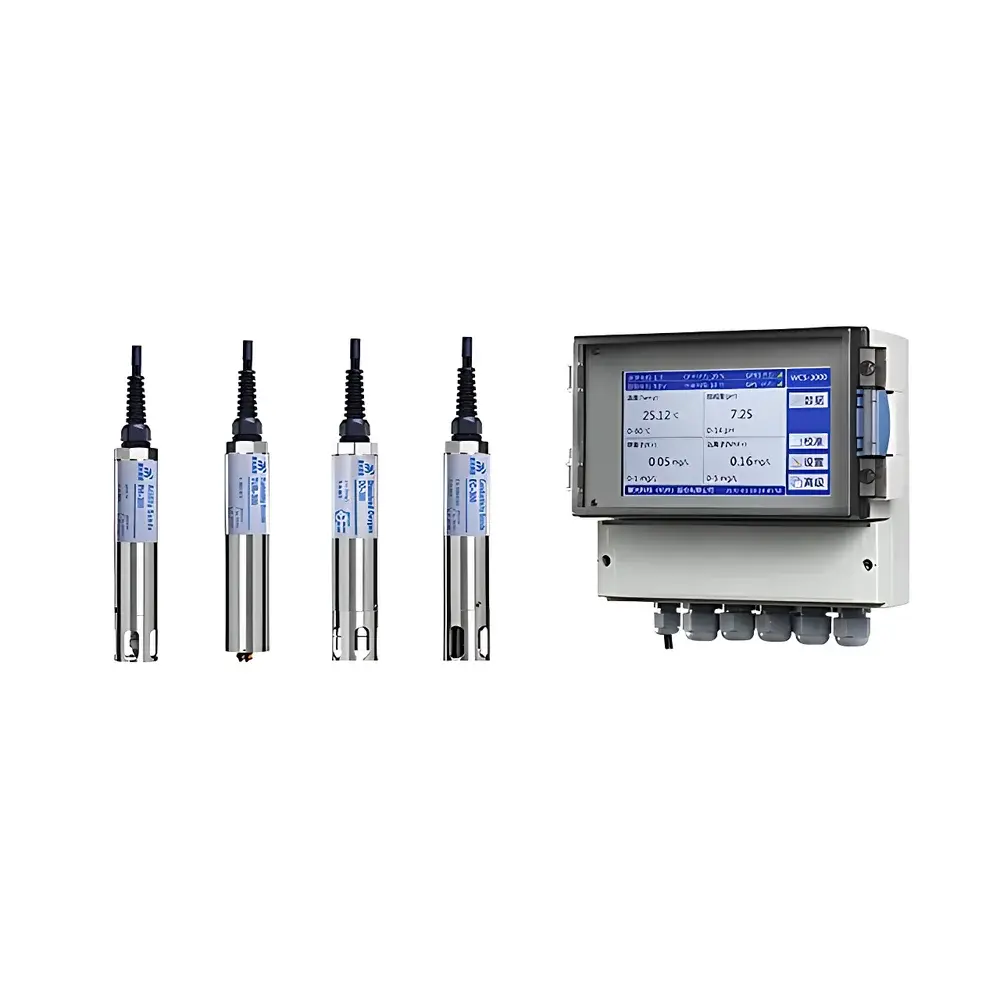
FPI WCS-3000 Online Five-Parameter Water Quality Monitoring System
| Brand | FPI (Fortune Photonics Instrumentation) |
|---|---|
| Origin | Zhejiang, China |
| Manufacturer Type | Original Equipment Manufacturer (OEM/ODM) |
| Model | WCS-3000 |
| Power Supply | 220 V AC |
| Operating Temperature | 5–45 °C |
| Relative Humidity | 0–95 % RH (non-condensing) |
| Enclosure Rating | IP65 |
| Impact Resistance | IK08 |
| Display | 7" TFT LCD touchscreen (800 × 480 resolution, LED backlight, 154 × 86 mm visible area) |
| Communication | RS485, Modbus RTU protocol |
| Data Storage | ≥1 year local history (timestamped, non-volatile) |
| Dimensions | 235 × 185 × 117 mm (W × H × D) |
| Housing Material | Flame-retardant polycarbonate (UL94-V0 certified) |
| Analog Outputs | None |
| Relay Outputs | None |
| Digital I/O | RS485 only |
| Expandable Probes | Optional integration of phycocyanin (blue-green algae), chlorophyll-a, and UV-absorbance-based COD estimation sensors |
Overview
The FPI WCS-3000 Online Five-Parameter Water Quality Monitoring System is an industrial-grade, fixed-station environmental analyzer engineered for continuous, unattended measurement of five core water quality parameters—dissolved oxygen (DO), pH, electrical conductivity (EC), turbidity (TUR), and temperature—in real time. Designed in accordance with ISO 5814, ISO 7888, ISO 7887, and ASTM D3370 standards for field-deployable water analyzers, the system employs proven electrochemical, optical, and thermal sensing principles to deliver high reproducibility under variable hydraulic and ambient conditions. Its modular architecture supports long-term deployment in surface water bodies, wastewater discharge points, municipal intake/outfall stations, and industrial process streams where regulatory compliance, trend analysis, and early anomaly detection are operationally critical.
Key Features
- Integrated 7-inch industrial-grade TFT touchscreen interface with intuitive navigation, multi-language support (English, Spanish, Portuguese preloaded), and context-sensitive help—designed for minimal operator training and rapid fault diagnosis.
- Turbidity sensor (TUR-300) equipped with a motor-driven self-cleaning brush that operates on user-defined intervals or triggered by signal drift, mitigating fouling-induced bias from biofilm, silt, or air bubbles in low-flow or stagnant applications.
- Multi-sensor calibration workflow accessible via on-device menu: single-point or two-point pH calibration; zero/span DO calibration using air-saturated water or nitrogen-purged solution; EC cell constant verification; turbidity validation with NIST-traceable formazin standards.
- Robust mechanical design: IP65-rated enclosure with UL94-V0 flame-retardant polycarbonate housing and IK08 impact resistance—validated for outdoor cabinet mounting or direct exposure in sheltered environments.
- Native Modbus RTU over RS485 enables seamless integration into SCADA, DCS, or PLC-based supervisory systems without protocol converters; all sensor data, diagnostic status, and calibration logs are addressable via standard function codes (03h, 04h, 06h).
- Local data logging stores timestamped readings at configurable intervals (1 min to 24 h), retaining ≥12 months of raw parameter records with checksum-verified integrity in embedded flash memory.
Sample Compatibility & Compliance
The WCS-3000 is validated for use in natural freshwater (rivers, lakes, reservoirs), treated effluent (secondary/tertiary discharge), potable water distribution networks, and recirculating industrial cooling water. It complies with Chinese HJ/T 96–2003 and HJ/T 97–2003 technical specifications for online water quality monitors and aligns with international reference methods: DO measured via luminescence quenching (ISO 5814); pH via glass electrode (ISO 10523); EC via two-electrode conductometric cell (ISO 7888); turbidity via 90° light scattering (ISO 7027-1); temperature via Pt1000 RTD (IEC 60751 Class B). The system supports GLP-compliant audit trails when connected to FPI’s optional cloud platform (requiring external secure gateway), including electronic signatures, calibration history, and change logs per FDA 21 CFR Part 11 Annex 11 requirements.
Software & Data Management
No proprietary desktop software is required for basic operation. Configuration, calibration, and diagnostics are fully managed via the onboard GUI. For centralized monitoring, FPI provides a free OPC UA server application (Windows/Linux) that maps Modbus registers to OPC tags, enabling interoperability with Ignition, Siemens WinCC, or Inductive Automation platforms. Historical data export is supported in CSV and XML formats with ISO 8601 timestamps. Firmware updates are delivered via USB stick or secure HTTPS endpoint (TLS 1.2+), with SHA-256 signature verification. All configuration changes are logged with user ID, timestamp, and pre-/post-values—enabling traceability during QA/QC reviews.
Applications
- Regulatory compliance monitoring at municipal wastewater treatment plant (WWTP) outfalls per national discharge permits.
- Early warning detection of algal bloom precursors through trending of pH, DO, and turbidity correlations—especially when extended with optional blue-green algae (phycocyanin) and chlorophyll-a probes.
- Industrial process water quality assurance in semiconductor fabs, pharmaceutical manufacturing (PW/DI water loops), and food & beverage production lines.
- Hydrological research campaigns requiring synchronized, multi-parameter profiling across distributed sensor nodes.
- Smart city infrastructure projects integrating water quality telemetry into unified urban operations centers.
FAQ
What maintenance schedule is recommended for long-term reliability?
Monthly visual inspection of sensor surfaces and cleaning brush mechanism; quarterly calibration verification using certified standards; annual replacement of DO membrane cap and pH reference electrolyte (if applicable).
Can the system operate on DC power or solar hybrid setups?
No—the WCS-3000 requires stable 220 V AC ±10 %, 50/60 Hz input. An external AC/DC converter with sufficient surge rating may be used, but is not supplied or validated by FPI.
Is remote firmware update capability available over cellular or Ethernet?
Firmware updates require physical media (USB) or secure HTTPS upload via local network. Remote over-the-air (OTA) updates are not supported in current firmware revision v3.2.1.
Does the turbidity sensor meet ISO 7027-1 for formazin equivalence?
Yes—the TUR-300 optical path and detector geometry are designed and factory-verified against ISO 7027-1 requirements for ratio-metric 90° scattered light detection, with NIST-traceable calibration certificates available upon request.
How is data security handled when transmitting to cloud platforms?
Data transmitted via optional FPI Cloud Gateway uses TLS 1.2 encryption, device-authenticated MQTT, and role-based access control (RBAC). Local storage remains isolated and never transmits without explicit user authorization.
Related Products







