
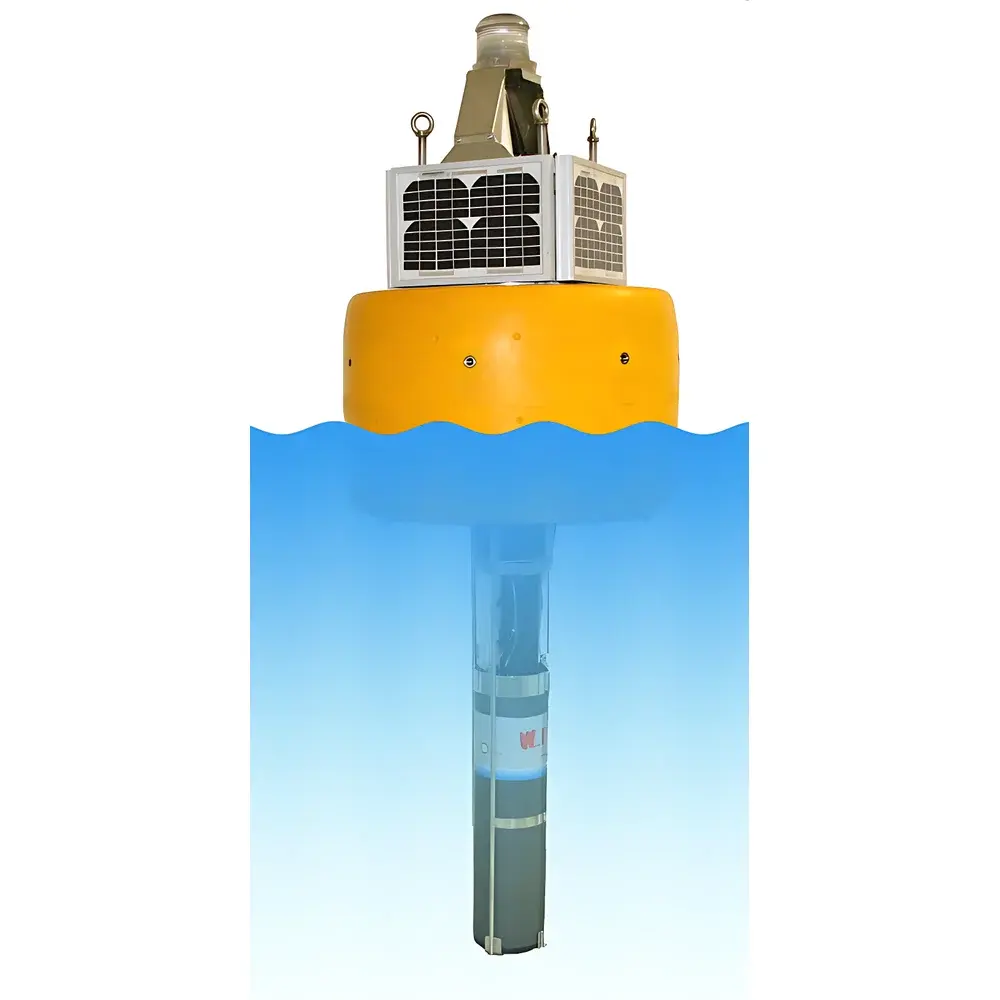
FPI WIZ Probe Online Multi-Parameter Water Quality Analyzer
| Brand | FPI |
|---|---|
| Origin | Zhejiang, China |
| Manufacturer Type | Original Equipment Manufacturer (OEM) |
| Product Category | Domestic |
| Model | WIZ Probe |
| Instrument Type | Online Water Quality Analyzer |
| Deployment Method | Buoy-Mounted In-Situ Monitoring System |
| Measurement Principle | Wet-Chemical Spectrophotometry (UV-Vis) + Fluorescence (for NH₃-N) |
| Configurable Parameters | NH₃-N, PO₄-P, NO₃⁻+NO₂⁻-N, NO₂⁻-N (standard) |
| Power Supply | Integrated Solar/Battery System via WIZbuoy Platform |
| Data Logging & Remote Access | WIZlog Data Logger with Cellular/GPRS or LoRaWAN Connectivity |
| Compliance Framework | Designed for ISO 5667 series (water sampling), ASTM D3370 (in-situ sampling), and compatible with EPA Method 353.2 (nitrate/nitrite), EPA 365.1 (phosphate), EPA 350.1 (ammonia), and EU WFD (Water Framework Directive) monitoring requirements |
Overview
The FPI WIZ Probe is an autonomous, buoy-deployable multi-parameter water quality analyzer engineered for continuous, in-situ measurement of key nutrient and contaminant species in surface water and marine environments. It operates on the principle of automated wet-chemical spectrophotometry—where reagent-based colorimetric reactions are optically quantified across defined UV-Vis wavelength ranges—and integrates a dedicated fluorescence detection module for ammonia nitrogen (NH₃-N) analysis using ortho-phthaldialdehyde (OPA) derivatization. This dual-method architecture ensures high selectivity and minimal interferences under variable field conditions. Unlike laboratory-based analyzers or single-parameter sensors, the WIZ Probe performs sequential, fully automated chemical analyses without manual reagent replenishment for up to 30 days per cartridge set. Its modular probe head mounts directly onto the WIZbuoy—a compact, solar-powered floating platform—enabling rapid deployment in lakes, reservoirs, estuaries, and coastal zones without requiring fixed infrastructure or shore-based power.
Key Features
- In-situ wet-chemical analysis architecture with integrated reagent cartridges, eliminating reliance on external calibration standards during operation
- Simultaneous or sequential measurement of up to four core parameters from a single probe head: NH₃-N (fluorescence), PO₄-P (molybdenum blue method), NO₃⁻+NO₂⁻-N (cadmium reduction + diazotization), and NO₂⁻-N (diazotization alone)
- Modular parameter expansion capability: optional configurations support total phosphorus (acid hydrolysis + ascorbic acid/molybdate), total nitrogen (persulfate oxidation + UV digestion + nitrate reduction), hexavalent chromium (1,5-diphenylcarbazide complexation), silicate (molybdenum yellow method), and transition metals including iron (ferrozine complexation)
- Self-contained power management via WIZbuoy: integrated monocrystalline solar panel, deep-cycle lithium battery bank, and intelligent charge regulation for year-round operation in temperate and subtropical climates
- Embedded WIZlog data logger with dual-mode telemetry: cellular (4G LTE-M/NB-IoT) for real-time cloud transmission and LoRaWAN for low-bandwidth regional mesh networks; local SD card backup supports GLP-compliant audit trails
- IP68-rated titanium-alloy probe housing with anti-fouling coating and replaceable optical windows; designed for long-term immersion in turbid, biofouling-prone waters
Sample Compatibility & Compliance
The WIZ Probe is validated for use with natural freshwater (pH 6.0–9.0, conductivity ≤ 2,000 µS/cm), brackish water (salinity ≤ 15 ppt), and seawater (salinity ≤ 35 ppt). Sample intake employs a low-shear peristaltic pump with programmable flow rate (15–60 mL/min) and automatic line-flushing cycles to prevent cross-contamination between measurements. All wetted components comply with USP Class VI biocompatibility standards and FDA 21 CFR Part 11–ready firmware architecture supports electronic signatures, user role-based access control, and immutable audit logs. The system adheres to ISO 5667-22 (field measurement of nutrients), ASTM D3370-20 (in-situ sampling practice), and aligns with analytical method equivalency frameworks referenced in the EU Water Framework Directive Annex V and China’s HJ 91.2-2022 standard for surface water monitoring.
Software & Data Management
FPI WIZlink software provides secure web-based configuration, remote diagnostics, and real-time visualization via HTTPS-encrypted dashboard. Each WIZ Probe generates timestamped, metadata-rich datasets compliant with OGC SensorML 2.0 and WaterML 2.0 schemas. Raw absorbance spectra (340–850 nm), fluorescence intensity values, reagent consumption logs, and environmental context (temperature, pressure, depth) are stored in HDF5 format with embedded checksums. The system supports scheduled report generation in PDF/CSV formats, configurable alert thresholds (SMS/email), and seamless integration with third-party SCADA platforms via MQTT or RESTful API. All firmware updates undergo cryptographic signature verification, and historical configuration changes are version-controlled with rollback capability.
Applications
- Long-term eutrophication monitoring in stratified reservoirs and mesotrophic lakes
- Nutrient flux tracking at riverine outfalls and wastewater treatment plant discharge points
- Coastal hypoxia early-warning systems integrating NH₃-N, NO₃⁻, and PO₄-P trends
- Regulatory compliance reporting for national surface water quality assessment programs (e.g., China’s National Surface Water Environmental Quality Standard GB 3838-2002)
- Research-grade process studies requiring high-temporal-resolution nutrient speciation (e.g., nitrification/denitrification kinetics in sediment-water interfaces)
- Mobile deployment on research vessels or unmanned surface vehicles (USVs) for spatially resolved transect surveys
FAQ
What maintenance intervals are required for unattended operation?
Reagent cartridges require replacement every 30 days under standard 4-parameter mode; optical windows should be inspected quarterly and cleaned manually if biofilm accumulation exceeds 10% transmittance loss. No routine calibration is needed between cartridge changes due to internal reference standards and dual-wavelength compensation algorithms.
Can the WIZ Probe operate in ice-covered water bodies?
No. The WIZbuoy platform is not rated for ice load or freeze-thaw cycling. For winter monitoring, deployment must be suspended or relocated to thermally stable zones such as spring-fed streams or heated effluent channels.
Is method validation documentation available for regulatory submissions?
Yes. FPI provides full method validation packages—including precision (RSD ≤ 5%), accuracy (recovery 92–105% across matrix spikes), limit of detection (LOD) tables per parameter, and inter-laboratory comparison reports aligned with ISO/IEC 17025 requirements—upon request under NDA.
How is data integrity ensured during network outages?
All measurements are buffered locally on the WIZlog’s industrial-grade microSD card (32 GB, rated for -40°C to +85°C) with cyclic overwrite protection. Upon connection restoration, queued data is transmitted with original timestamps and integrity hashes verified end-to-end.







