
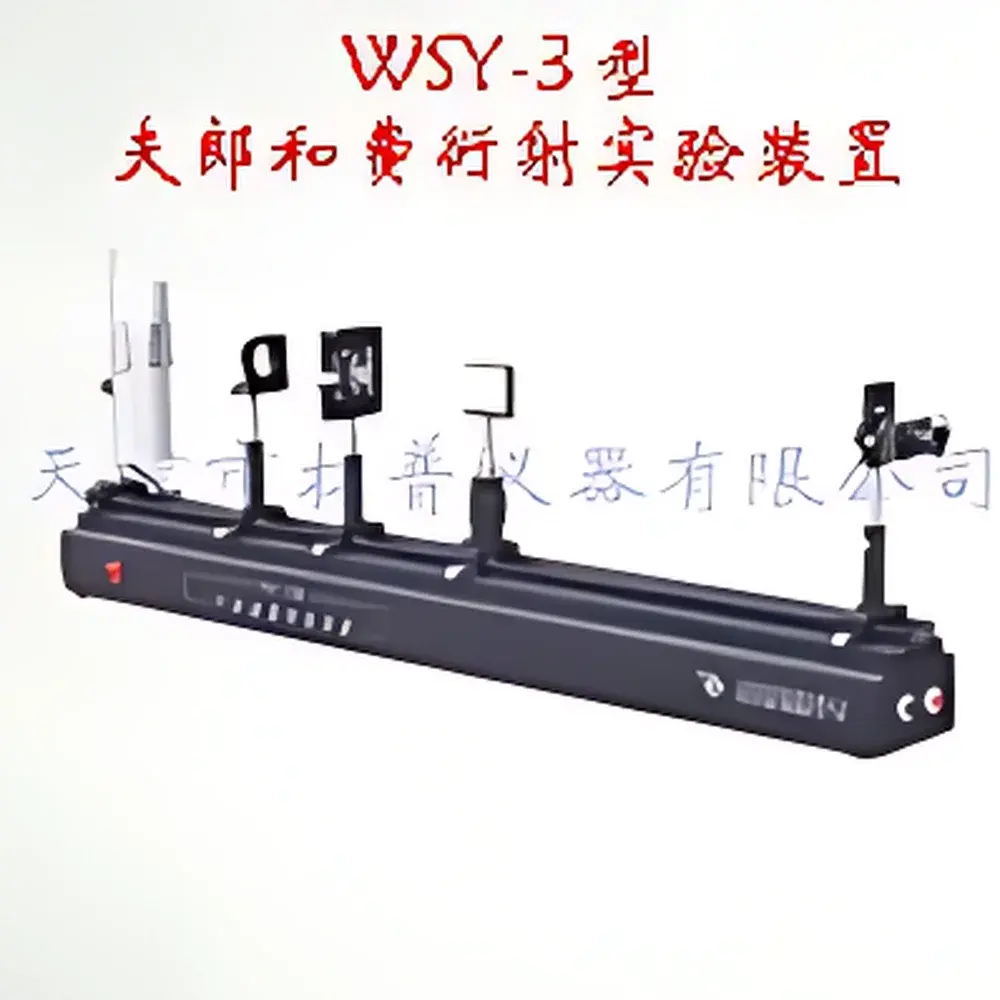
Fraunhofer Diffraction Experiment Setup WSY-3 by TOP
| Brand | TOP |
|---|---|
| Origin | Tianjin, China |
| Manufacturer Type | Direct Manufacturer |
| Country of Origin | China |
| Model | WSY-3 |
| Pricing | Available Upon Request |
Overview
The WSY-3 Fraunhofer Diffraction Experiment Setup is a precision optical teaching and research instrument engineered for undergraduate and graduate-level instruction in physical optics and wave physics. It implements the far-field (Fraunhofer) diffraction condition—where incident light is effectively collimated and observation occurs at a sufficiently large distance (or via Fourier-transform imaging through a converging lens)—to quantitatively analyze diffraction patterns generated by apertures with well-defined geometries. Designed around the principle of spatial frequency filtering and angular spectrum decomposition, the system enables direct visualization and measurement of intensity distributions governed by the Fourier transform of the aperture transmission function. This setup supports rigorous experimental verification of theoretical predictions from scalar diffraction theory, including the sinc² profile of single-slit diffraction and the Airy pattern of circular aperture diffraction.
Key Features
- Integrated modular architecture: Power supply unit, optical base plate, and adjustable component storage rack are co-located within a single compact chassis—minimizing cable clutter and optimizing lab bench space utilization.
- Optical rail system with calibrated linear scale (1000 mm length) and low-friction carriage motion, enabling repeatable positioning of optical elements to ±0.1 mm accuracy.
- Comprehensive component set: Includes three achromatic lenses (f = 100 mm, 200 mm, and 300 mm), a high-stability low-pressure sodium lamp (589.3 nm emission), a precision micrometer eyepiece with 0.01 mm vernier resolution, and a multi-aperture diffraction plate containing variable-width single slits, double slits, rectangular apertures, and circular apertures.
- Dedicated two-dimensional adjustment mounts with fine-thread micrometers (10 µm resolution per revolution) for angular alignment of slits and lenses—critical for achieving optimal collimation and minimizing aberration-induced pattern distortion.
- Robust mechanical construction using anodized aluminum optical rails and stainless-steel mounting hardware, ensuring long-term dimensional stability under repeated thermal cycling and mechanical handling.
Sample Compatibility & Compliance
The WSY-3 accommodates standard 25 mm × 25 mm optical components mounted on industry-compatible kinematic bases. Slit widths range from 0.1 mm to 2.0 mm in 0.1 mm increments; circular apertures span 0.2 mm to 1.5 mm diameter. All optical surfaces meet ISO 10110 surface quality specifications (scratch-dig 60–40). The system complies with IEC 61000-6-3 (EMC emission limits) and IEC 61000-6-2 (immunity to electrostatic discharge and radiated RF fields). While not certified for clinical or industrial QA/QC environments, its design adheres to pedagogical best practices outlined in the American Association of Physics Teachers (AAPT) Laboratory Guidelines and supports curriculum alignment with ISO/IEC 17025 clause 5.4.2 (validation of measurement methods in educational laboratories).
Software & Data Management
The WSY-3 operates as a standalone optical platform without embedded firmware or proprietary software. However, it is fully compatible with third-party image acquisition and analysis tools—including MATLAB Image Processing Toolbox, Python-based OpenCV pipelines, and NIH ImageJ/Fiji—enabling quantitative intensity profiling, full-width-at-half-maximum (FWHM) extraction, and comparison against analytical models. When paired with a CCD camera (e.g., Thorlabs DCC1545M), users can generate audit-ready datasets with timestamped metadata, supporting GLP-compliant documentation workflows. Optional digital readout modules (not included) may be retrofitted to provide real-time slit width feedback traceable to NIST-traceable calibrators.
Applications
- Undergraduate laboratory instruction in wave optics, Fourier optics, and coherence theory.
- Verification of Babinet’s principle through complementary aperture experiments.
- Quantitative study of diffraction-limited resolution and the Rayleigh criterion.
- Calibration reference for spatial frequency response characterization of imaging systems.
- Foundation for advanced experiments in optical filtering, holography, and structured illumination microscopy.
FAQ
Is the sodium lamp included with the system?
Yes—the WSY-3 includes a stabilized low-pressure sodium vapor lamp with integrated ballast and heat-sink assembly, delivering stable 589.3 nm output for >5,000 hours of operation.
Can the system be adapted for laser illumination?
Yes—users may substitute the sodium lamp with He–Ne (632.8 nm) or diode lasers (e.g., 532 nm or 650 nm) using the provided lens holder and beam alignment tools; collimation must be verified independently.
What is the maximum working distance between slit and observation plane?
When used in lens-based Fourier configuration, the effective observation distance corresponds to the back focal plane of the imaging lens—typically 100–300 mm depending on selected focal length.
Are calibration certificates available for individual components?
NIST-traceable calibration reports for slit widths and lens focal lengths are available upon request at additional cost and require lead time of 4–6 weeks.
Does the system support automated data capture?
No native automation is built-in; however, all mechanical adjustments are compatible with stepper motor retrofit kits (e.g., Zaber X-LRQ series), enabling programmable scanning and integration into LabVIEW or Python-controlled experimental sequences.





