
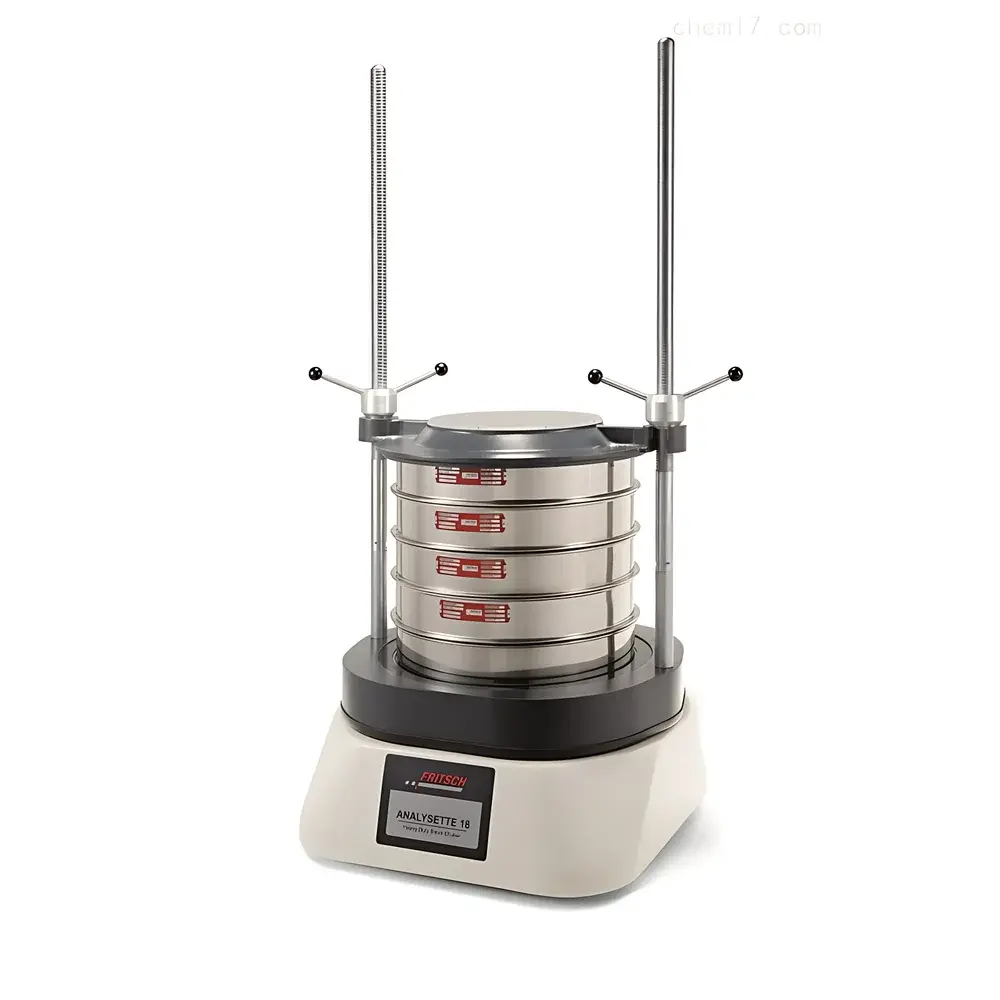
FRITSCH ANALYSETTE 18 Heavy-Duty Vibratory Sieve Shaker
| Brand | FRITSCH |
|---|---|
| Origin | Germany |
| Model | ANALYSETTE 18 |
| Voltage | 230 V, 1~ |
| Frequency | 50–60 Hz |
| Input Power | 480 W |
| Sieving Method | Dry Sieving |
| Sample Condition | Dry |
| Sieving Range (Dry) | 20 µm – 125 mm |
| Max. Sample Load | 6 kg |
| Sieving Time | 5–60 min |
| Dimensions (W×L×H) | 58 × 58 × 39 cm |
| Net Weight | 92 kg |
| Gross Weight | 129 kg |
| Motor Type | Two maintenance-free asymmetric motors |
| Motion Type | Simultaneous horizontal and vertical oscillation |
| Compliance | ISO 3310-1, ASTM E11-95, ISO 9000 traceable calibration |
Overview
The FRITSCH ANALYSETTE 18 Heavy-Duty Vibratory Sieve Shaker is a precision-engineered dry-sieving instrument designed for reproducible particle size distribution analysis of bulk granular and powdered materials under high-load operational conditions. Based on the principle of vibratory sieving—where controlled mechanical oscillation induces particle stratification and passage through calibrated mesh apertures—the ANALYSETTE 18 delivers high-fidelity separation across an exceptionally wide dynamic range (20 µm to 125 mm). Its dual asymmetric motor architecture generates a complex, multi-directional motion profile combining horizontal circular displacement with vertical lift, ensuring efficient particle reorientation and consistent bed agitation without compaction or blinding. This kinematic design enables rapid, statistically robust fractionation even for challenging materials such as agglomerated powders, irregularly shaped aggregates, or high-density mineral feeds—making it suitable for routine quality control in mining, construction aggregates, pharmaceutical excipient processing, ceramics, and metallurgical feedstock laboratories.
Key Features
- Robust cast-iron frame and reinforced base structure engineered for continuous operation at full 6 kg sample load capacity.
- Dual maintenance-free asymmetric motors delivering stable, low-vibration oscillation with precise amplitude control and long-term torque consistency.
- Simultaneous horizontal and vertical motion profile optimized to maximize particle mobility and minimize sieve clogging during extended runs (5–60 min).
- Modular stack configuration supporting up to seven nested sieves (diameters: 350 mm, 400 mm, 450 mm, or 12″, 16″, 18″) with universal support and quick-lock clamping mechanism.
- Full compatibility with standardized test sieves conforming to ISO 3310-1 and ASTM E11-95 specifications—including wire mesh, perforated plate, and electroformed meshes.
- Traceable calibration capability aligned with ISO 9000 quality management system requirements for documented metrological integrity.
- Integrated safety interlock system preventing operation when lid is unsecured or stack misaligned.
Sample Compatibility & Compliance
The ANALYSETTE 18 is validated exclusively for dry-sieving applications; no liquid dispersion or wet classification functionality is supported. It accommodates free-flowing, moderately cohesive, and slightly abrasive particulates—including crushed ores, sand, cement clinker, polymer granules, ground spices, and ceramic raw materials. The instrument meets essential mechanical and electrical safety standards per EN 61000-6-2 (EMC immunity) and EN 61000-6-4 (EMC emission), and its structural design complies with ISO 5725 (accuracy of measurement methods) for repeatability-driven particle sizing workflows. While not intrinsically rated for ATEX environments, its sealed motor housings and non-sparking components permit safe use in general laboratory and industrial QC settings adhering to IEC 60079-0 guidelines.
Software & Data Management
The ANALYSETTE 18 operates as a standalone hardware platform without embedded microprocessor control or digital interface. All operational parameters—including duration, motor activation, and stack configuration—are manually set and monitored. For regulatory compliance in GLP/GMP environments, users integrate the instrument into validated laboratory workflows using external documentation systems. Sieve weight data (pre- and post-sieving) are recorded manually or imported into LIMS-compatible spreadsheets. Calibration certificates for individual sieves—including aperture verification reports per ISO/IEC 17025-accredited providers—must be maintained separately as part of equipment qualification (IQ/OQ/PQ) packages. No firmware, cloud connectivity, or FDA 21 CFR Part 11-compliant audit trail is natively provided; such functionality requires third-party integration via validated electronic lab notebooks (ELNs) or chromatography/data systems.
Applications
- Quality assurance of aggregate gradation in civil engineering and asphalt production (ASTM C136/C136M).
- Particle size release testing of pharmaceutical granules prior to tablet compression (USP <786>).
- Routine monitoring of cement fineness (Blaine equivalent correlation via sieve residue at 45 µm and 90 µm).
- Classification validation of recycled construction debris and slag fractions.
- Feedstock screening in additive manufacturing powder handling protocols (e.g., ASTM F3049).
- Mineral processing plant circuit optimization through feed, overflow, and underflow size distribution profiling.
FAQ
Is the ANALYSETTE 18 suitable for wet sieving?
No. It is strictly configured for dry-sieving applications only; liquid introduction may damage motors and compromise structural integrity.
Can I use non-FRITSCH sieves with this shaker?
Yes—provided they conform dimensionally (350/400/450 mm or 12″/16″/18″ diameters) and mechanically (ISO 3310-1 or ASTM E11-95 compliance), and are secured using the universal locking system.
What is the recommended maintenance schedule?
The asymmetric motors are maintenance-free; however, periodic inspection of clamp bolts, sieve stack alignment, and vibration-dampening feet is advised every 500 operating hours.
Does FRITSCH provide ISO/IEC 17025 calibration services for the ANALYSETTE 18 itself?
No—the instrument is a mechanical shaker and does not require calibration; instead, traceable calibration applies to the sieves used with it, which FRITSCH offers via accredited partners.
How is reproducibility ensured across multiple operators?
Through strict adherence to standardized operating procedures (SOPs) defining sample preparation, loading homogeneity, stack sequence, and timing—validated per ISO 5725-2 for intermediate precision assessment.



