
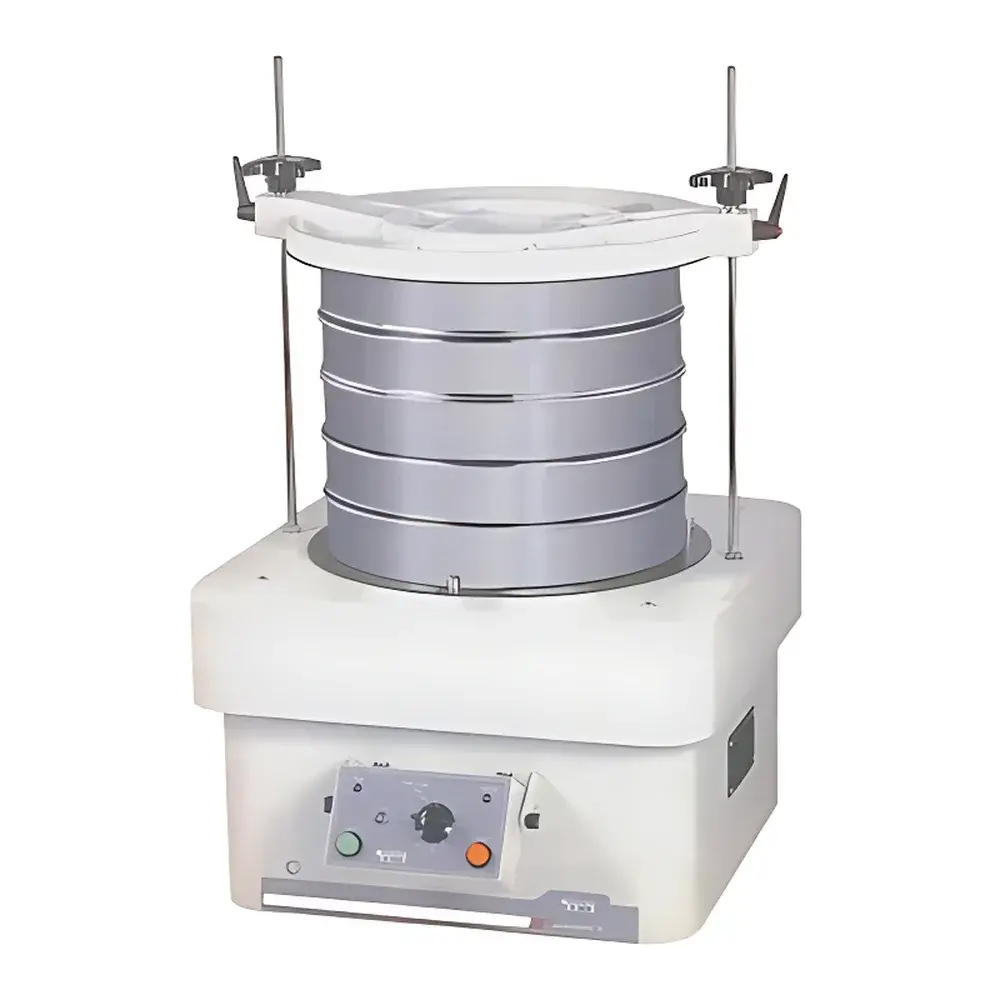
FRITSCH Analysette 18 Heavy-Duty Vibratory Sieve Shaker
| Brand | FRITSCH |
|---|---|
| Origin | Germany |
| Model | Analysette 18 |
| Measurement Principle | Dry Mechanical Vibratory Sieving |
| Max. Sample Capacity | 15 kg (standard), up to 25 kg with optional large-diameter sieve stack |
| Sieve Aperture Range | 20 µm – 125 mm |
| Max. Sieve Diameter | 450 mm (18") |
| Sieving Time | 5–60 min |
| Drive System | Dual Asymmetric Counter-Rotating Motors |
| Compliance | ISO 2591-1, ISO 9276-1, ASTM E11, USP <786> |
| Software | AUTOSIEVE v5.x (FDA 21 CFR Part 11 compliant audit trail & user access control) |
Overview
The FRITSCH Analysette 18 Heavy-Duty Vibratory Sieve Shaker is an industrial-grade dry sieving instrument engineered for high-mass, high-reproducibility particle size distribution analysis of granular, fibrous, and coarse-textured materials. Unlike benchtop vibratory shakers designed for R&D-scale samples, the Analysette 18 employs a robust dual-motor excitation system that generates controlled, three-dimensional vibration—simultaneously accelerating particles in vertical, horizontal, and rotational vectors. This kinematic profile ensures rapid stratification and efficient particle passage through stacked sieves, minimizing blinding, agglomeration, and segregation artifacts common in low-energy or unidirectional shakers. Its design conforms to fundamental principles of mechanical sieving as defined in ISO 2591-1 (determination of particle size distribution by sieving) and supports traceable, GLP-compliant workflows in QC laboratories, pilot plants, and raw material certification facilities.
Key Features
- Heavy-duty cast-iron base and reinforced steel frame engineered for continuous operation under load; vibration isolation feet minimize transmission to laboratory infrastructure.
- Dual asymmetric counter-rotating motors mounted at fixed angular orientation beneath the sieve stack—enabling precise phase synchronization and programmable deceleration to zero RPM at end-of-cycle, eliminating post-sieving particle migration.
- Modular sieve stack configuration supporting up to 12 sieves (450 mm diameter, DIN/ISO standard frames); accommodates both woven wire mesh and perforated plate sieves per ISO 3310-1 and ISO 3310-2.
- Programmable digital timer (1 s–99 h 59 min) with real-time elapsed time display and automatic motor shutdown; adjustable amplitude (0–3 mm peak-to-peak) and frequency (400–3600 rpm) via integrated frequency converter.
- Integrated safety interlock system: automatic motor inhibition when lid is open or sieve stack misaligned; CE-marked per Machinery Directive 2006/42/EC and EMC Directive 2014/30/EU.
Sample Compatibility & Compliance
The Analysette 18 is validated for dry sieving of non-cohesive and moderately cohesive powders, crushed ores, recycled aggregates, pharmaceutical granules, foodstuffs (e.g., flour, sugar, spices), ceramics, catalysts, and soil fractions. It excludes samples requiring wet dispersion or ultrasonic deagglomeration. All operational parameters—including sieve calibration certificates, mass balance verification protocols, and repeatability studies—are documented per ISO/IEC 17025 requirements. The system meets ASTM E11 specifications for test sieve construction and is routinely employed in compliance with USP for particle size evaluation of solid oral dosage forms. When operated with AUTOSIEVE software, full 21 CFR Part 11 compliance is achieved—including electronic signatures, audit trails, role-based permissions, and data integrity safeguards required for FDA-regulated environments.
Software & Data Management
AUTOSIEVE software (v5.x) provides full instrument control, real-time monitoring, and automated calculation of cumulative undersize/oversize distributions, D10/D50/D90 values, and graphical reporting (log-probability, Rosin-Rammler, or histogram formats). Raw mass data per sieve fraction is captured directly from analytical balances via RS232 or USB interface, eliminating manual transcription errors. All measurement sessions are timestamped, user-logged, and archived in encrypted SQLite databases with SHA-256 checksum validation. Export options include CSV, PDF (with embedded metadata), and XML formats compatible with LIMS integration. Software validation documentation (IQ/OQ/PQ templates) and 21 CFR Part 11 configuration guides are supplied with each system.
Applications
- Quality control of bulk raw materials in mining, construction, and metallurgy—e.g., classification of crushed limestone, slag, or foundry sand.
- Batch release testing of pharmaceutical excipients and final blend uniformity assessment prior to tableting.
- Particle size specification verification for battery cathode/anode powders and additive manufacturing feedstocks.
- Research into granulation kinetics, attrition behavior, and flow function correlation in powder processing lines.
- Environmental sediment analysis per ISO 11277 for soil texture classification (sand/silt/clay fractions).
FAQ
What is the maximum recommended sample mass for routine ISO-compliant sieving?
For traceable results aligned with ISO 2591-1, the recommended maximum is 15 kg using the standard 450 mm sieve stack; 25 kg operation requires optional heavy-load support brackets and extended cycle validation.
Can the Analysette 18 be used with non-standard sieve diameters or custom mesh configurations?
Yes—adapter rings enable use of 200 mm and 300 mm DIN-standard sieves; custom perforated plates (e.g., square-hole, slotted) may be installed provided they meet ISO 3310-2 flatness and tension specifications.
Is AUTOSIEVE software validated for GMP environments?
AUTOSIEVE v5.x includes built-in 21 CFR Part 11 functionality and is supplied with vendor-validated IQ/OQ protocols; site-specific PQ must be executed per internal SOPs and risk assessment.
How often does the motor alignment require recalibration?
The dual-motor mounting geometry is factory-set and mechanically locked; no field recalibration is required unless subjected to impact damage or structural modification.
Does the system support automated sieve cleaning between runs?
No—manual cleaning (brushing, air jet, or ultrasonic bath) is required per ISO 2591-1; FRITSCH offers optional sieve cleaning stations (Model CLEANSIEVE) for high-throughput labs.
Related Products



