
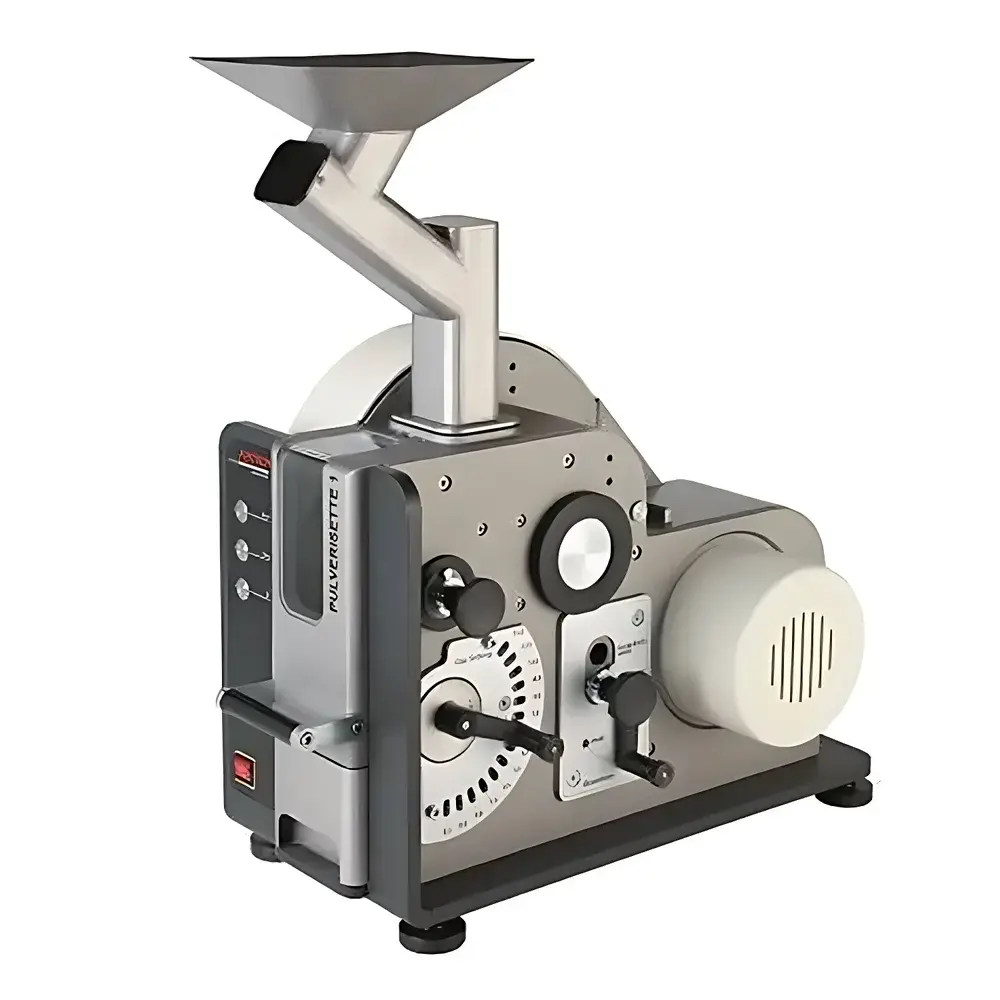
FRITSCH PULVERISETTE 1 Premium Heavy-Duty Jaw Crusher
| Brand | FRITSCH |
|---|---|
| Origin | Germany |
| Model | PULVERISETTE 1 Premium (Type I / Type II) |
| Max. Feed Size | 60 mm (Type I) / 95 mm (Type II) |
| Min. Sample Volume | 20 mL |
| Max. Throughput | 140 kg/h (Type I) / 250 kg/h (Type II) |
| Final Particle Size | 0.3–15 mm |
| Motor Power | 1.1 kW (Type I) / 3.0 kW (Type II) |
| Net Weight | 305 kg (Type I) / 320 kg (Type II) |
| Dimensions (W × L × H) | 55 × 90 × 106 cm |
Overview
The FRITSCH PULVERISETTE 1 Premium Heavy-Duty Jaw Crusher is a laboratory-scale primary comminution instrument engineered for reproducible, controlled size reduction of brittle, medium-hard to hard materials—including minerals, ores, ceramics, construction materials, and geological samples. Based on the classic Blake-type jaw crusher principle, it operates via oscillating compression between a fixed and a movable jaw plate, generating high compressive forces to fracture bulk material along natural cleavage planes. Designed and manufactured in Germany to DIN ISO 9001-certified quality standards, the PULVERISETTE 1 Premium integrates mechanical robustness with operational safety and process repeatability—making it suitable for routine sample preparation in geochemical laboratories, cement QA/QC facilities, mining R&D centers, and accredited environmental testing labs.
Key Features
- Two configurable variants: Type I (1.1 kW motor, 60 mm max. feed size, 140 kg/h throughput) and Type II (3.0 kW motor, 95 mm max. feed size, 250 kg/h throughput), enabling scalability across sample volume and hardness requirements.
- Monolithic welded steel frame and reinforced housing provide exceptional mechanical stability during high-load operation, minimizing vibration transmission and ensuring long-term alignment integrity.
- Precision-adjustable jaw gap with 14 discrete settings (millimeter-accurate), allowing fine-tuned control over output particle size distribution without recalibration or tooling changes.
- Dual-use reversible jaw plates—hardened and wear-resistant—extend service life by up to 100% compared to single-direction configurations.
- Integrated conical feed hopper with anti-clogging geometry and deflection channel design prevents material backflow and ensures consistent gravitational feeding—even for irregular or slab-like specimens.
- Three preconfigured crushing modes (coarse, medium, fine) are selectable via mechanical linkage; jaw gap remains unchanged, preserving calibration while altering stress application profile for improved homogeneity.
- Interlocked safety system: Operation initiates only when both the collection drawer and grinding chamber cover are fully engaged and mechanically latched—compliant with EN 61000-6-2 and EN 61000-6-4 electromagnetic compatibility directives.
- Modular grinding chamber with tool-free access enables rapid disassembly; all wetted parts—including jaws, liners, and hopper—are removable for thorough cleaning and cross-contamination mitigation.
Sample Compatibility & Compliance
The PULVERISETTE 1 Premium accommodates a broad spectrum of inorganic and organic solids with Mohs hardness ≤ 6.5. Compatible sample types include limestone, basalt, slag, fly ash, clinker, brick, concrete aggregates, coal, phosphate rock, and dried biological matrices. Optional jaw plate materials—including tempered steel, stainless steel, chromium-free steel, manganese steel, tungsten carbide, zirconium oxide, aluminum, and polyamide—allow selection based on chemical inertness, wear resistance, or regulatory constraints (e.g., avoiding Fe/Ni leaching in trace-metal analysis). The instrument meets CE marking requirements and supports GLP-compliant workflows through documented maintenance logs, traceable calibration records, and operator-accessible service diagnostics.
Software & Data Management
While the PULVERISETTE 1 Premium operates as a standalone electromechanical system without embedded firmware or touchscreen interface, its design facilitates integration into digital lab infrastructures. All mechanical adjustments (gap setting, mode selection) are physically indexed and repeatable—enabling SOP-driven documentation in LIMS or ELN platforms. Optional accessories—including the FRITSCH PULVERISETTE 13 Rotational Disk Mill—enable seamless two-stage comminution (primary jaw crushing followed by secondary disk milling to ≤1 mm), with standardized transfer protocols minimizing manual handling. Dust extraction is managed via an integrated port compatible with central vacuum systems or standalone cyclonic extractors; activation/deactivation is synchronized with crusher power state via front-panel controls, supporting OSHA and EU Directive 2004/37/EC (carcinogens and mutagens) exposure limits.
Applications
- Geochemical sample preparation prior to XRF, ICP-OES, or fusion bead analysis.
- Homogenization of heterogeneous bulk materials for ASTM C114 (cement chemical analysis) and ISO 6874 (concrete aggregate grading).
- Routine size reduction in mining exploration labs adhering to ALS or SGS-certified sampling protocols.
- Preparation of reference materials under ISO Guide 35 and ISO/IEC 17025-accredited conditions.
- Particle size distribution studies requiring representative subsampling from coarse feedstocks (e.g., USP <788> particulate matter testing support).
FAQ
What safety certifications does the PULVERISETTE 1 Premium hold?
It carries CE marking per Machinery Directive 2006/42/EC, EMC Directive 2014/30/EU, and RoHS Directive 2011/65/EU. Full compliance documentation—including risk assessment reports and type examination certificates—is provided with each unit.
Can the crusher be used for moisture-sensitive or hygroscopic samples?
Yes—provided samples are pre-dried to ≤1% moisture content. Optional stainless steel or zirconium oxide jaw sets minimize reactivity; however, prolonged exposure to ambient humidity during processing is discouraged.
Is remote monitoring or IoT connectivity supported?
No native IoT capability exists; however, external current sensors or vibration monitors may be retrofitted for predictive maintenance logging in accordance with ISO 13374-1 condition monitoring standards.
How often must jaw plates be replaced under typical use?
Under continuous operation with medium-hard limestone (Mohs 3–4), jaw plates typically last 300–500 operating hours before requiring reversal or replacement—dependent on feed size distribution and throughput consistency.
Does FRITSCH provide validation documentation for GMP environments?
Yes—IQ/OQ documentation packages, including installation checklists, operational performance tests, and traceable calibration procedures, are available upon request for regulated pharmaceutical or food-grade applications.



