
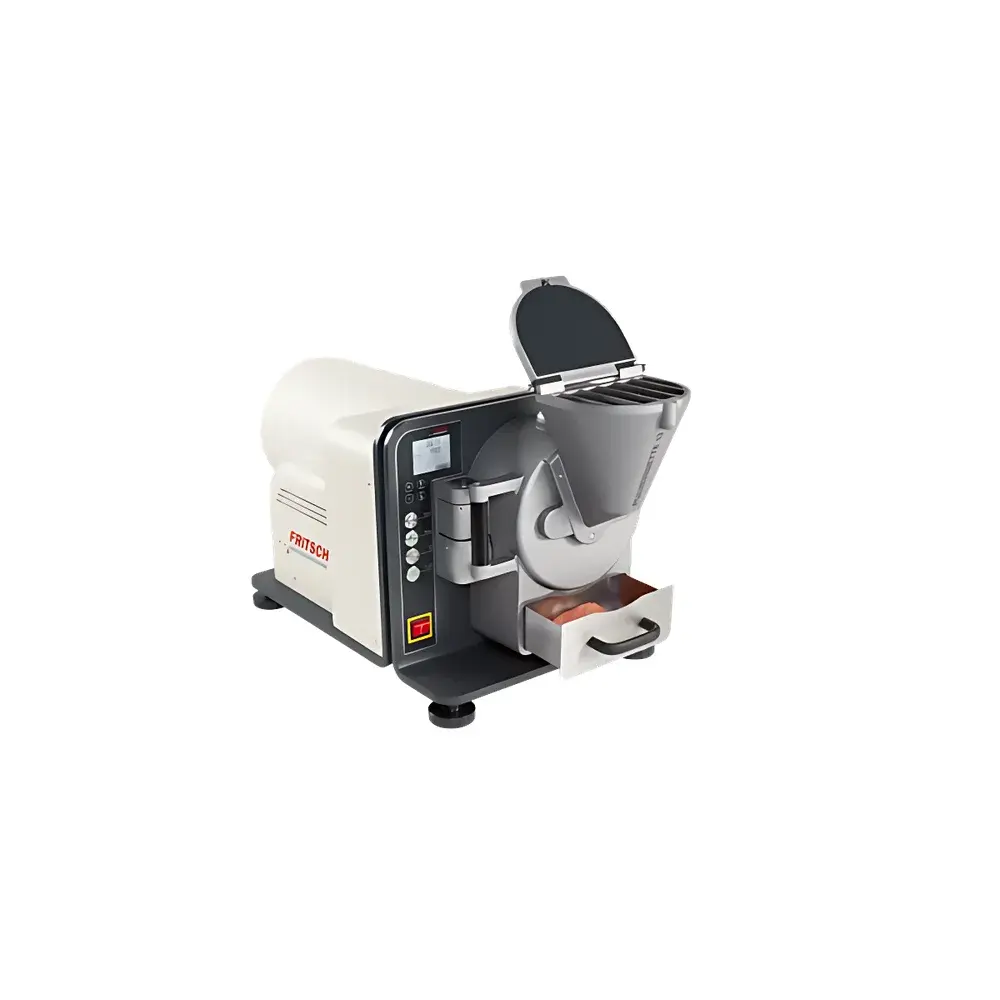
FRITSCH PULVERISETTE 13 Premium Disc Mill
| Brand | FRITSCH |
|---|---|
| Origin | Germany |
| Model | PULVERISETTE 13 |
| Max. Feed Size | 20 mm |
| Max. Throughput | 150 kg/h |
| Final Particle Size Range | 0.05–12 mm |
| Disc Rotation Speed | 440 rpm |
| Electrical Supply | 400 V / 3~ / 50–60 Hz / 1830 W |
| Net Weight | 240 kg |
| Gross Weight | 275 kg |
| Dimensions (W × H × D) | 52 × 105 × 63 cm |
| Grinding Gap Adjustment Precision | ±0.05 mm |
| Compliance | CE |
Overview
The FRITSCH PULVERISETTE 13 Premium Disc Mill is a high-capacity, precision-engineered laboratory disc mill designed for reproducible coarse to medium grinding of brittle, fibrous, and moderately hard materials. Operating on the principle of shear and compressive forces between two counter-rotating, parallel grinding discs — one fixed and one adjustable — the instrument delivers controlled particle size reduction through precisely regulated gap geometry and consistent rotational dynamics. Its robust cast-iron frame, thermally stable disc mounting system, and optimized airflow management ensure minimal thermal load during extended operation, preserving sample integrity for downstream analytical workflows such as XRD, SEM, or chemical assay preparation. Designed for integration into regulated laboratory environments, the PULVERISETTE 13 supports traceable, auditable grinding protocols aligned with GLP and ISO/IEC 17025 requirements.
Key Features
- High-precision digital LED display enabling real-time monitoring and adjustment of grinding gap (resolution ±0.05 mm) and grinding time — critical for method transfer and inter-laboratory reproducibility.
- Large-diameter feed hopper with hinged, splash-proof lid and wide opening (≥180 mm) facilitating rapid manual loading of irregular or bulky samples up to 20 mm in diameter.
- Automatic zero-point calibration function ensures repeatable disc alignment after maintenance or disc replacement, minimizing operator-induced variability.
- Reversible disc rotation (clockwise or counterclockwise) allows strategic wear distribution across grinding surfaces — extending disc service life and maintaining dimensional consistency over thousands of cycles.
- Tool-free, modular disassembly of grinding chamber, feed funnel, and dust extraction interface enables full access for cleaning, inspection, and validation — essential for cross-sample contamination control in QA/QC labs.
- Integrated, adjustable dust extraction system coupled with a sealed, slide-out collection drawer prevents airborne particulate escape and complies with OSHA PEL and EU Directive 2004/37/EC (carcinogens and mutagens) exposure limits.
Sample Compatibility & Compliance
The PULVERISETTE 13 accommodates a broad spectrum of inorganic and organic feedstocks including minerals, ores, ceramics, coal, slag, limestone, gypsum, pharmaceutical excipients, and dried botanicals. Four interchangeable disc material options — stainless steel (X5CrNi18-10), manganese steel (1.3505), tungsten carbide (WC-Co), and yttria-stabilized zirconia (YSZ) — permit optimization for abrasiveness, contamination sensitivity, and chemical resistance. All configurations conform to CE marking requirements under the Machinery Directive 2006/42/EC and Electromagnetic Compatibility Directive 2014/30/EU. Optional documentation packages support FDA 21 CFR Part 11-compliant electronic record retention when paired with FRITSCH’s optional LabSoft 3.0 software module.
Software & Data Management
While the base unit operates via standalone tactile controls, optional LabSoft 3.0 software provides centralized method storage, parameter logging (gap setting, runtime, disc speed), and export of timestamped grinding reports in CSV or PDF format. Audit trails include user ID, date/time stamps, and modification history — fulfilling ALCOA+ data integrity criteria. The system supports networked deployment across multi-instrument laboratories and integrates with LIMS via standard OPC UA or Modbus TCP protocols for automated workflow handoff.
Applications
- Preparation of homogenized reference materials for geochemical analysis (e.g., ASTM D5630, ISO 18332).
- Size reduction of cement clinker and supplementary cementitious materials prior to Blaine surface area testing (EN 196-6).
- Grinding of pharmaceutical granules and tablets for content uniformity assessment (USP ).
- Routine sample conditioning for metallurgical assay labs requiring sub-1 mm feed for fusion bead preparation (ISO 12987).
- Feedstock preparation for laser diffraction particle size analyzers (e.g., Malvern Mastersizer) where narrow PSD reproducibility is mandatory.
FAQ
What safety certifications does the PULVERISETTE 13 hold?
It carries full CE certification per EU Machinery Directive 2006/42/EC and EMC Directive 2014/30/EU, including conformity with EN 61000-6-2 (immunity) and EN 61000-6-4 (emissions).
Can this mill be validated for GMP environments?
Yes — with documented IQ/OQ protocols, calibration records for gap adjustment, and optional LabSoft 3.0 with 21 CFR Part 11 functionality, it meets core GMP Annex 15 and EU GMP Chapter 4 requirements.
Is it compatible with upstream crushers like the P-1 jaw crusher?
Yes — the PULVERISETTE 13 accepts feed directly from the P-1 jaw crusher output conveyor, enabling a fully integrated 2-stage comminution process down to ≤1 mm final particle size.
How frequently must the grinding discs be replaced?
Service life depends on feed hardness and throughput; under typical quartz sand grinding at 100 kg/h, tungsten carbide discs last ≥1,200 operating hours before requiring resurfacing or replacement.
Does the instrument support remote diagnostics or predictive maintenance?
Not natively — however, analog voltage outputs (0–10 V) for motor current and temperature sensors are available for third-party SCADA integration, enabling condition-based monitoring.



