
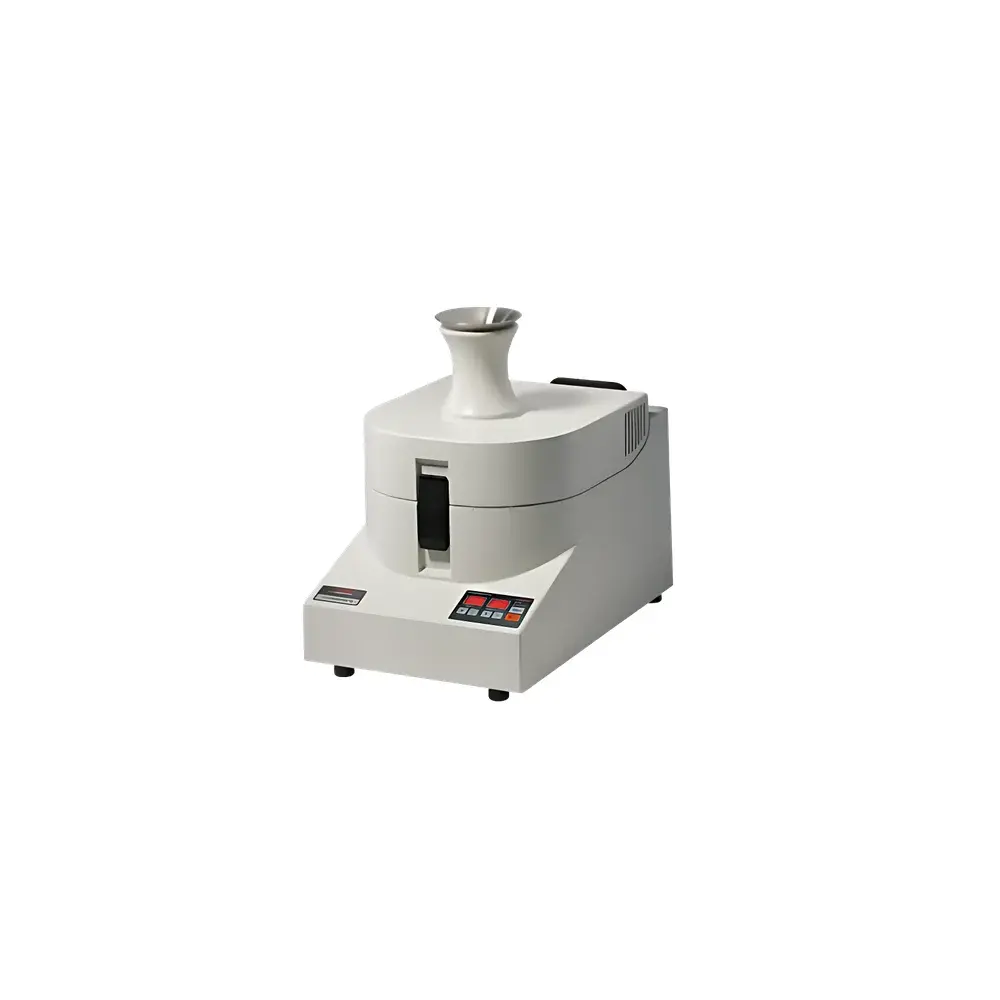
FRITSCH PULVERISETTE 14 Classic Variable-Speed High-Speed Rotor Mill
| Brand | FRITSCH |
|---|---|
| Origin | Germany |
| Model | PULVERISETTE 14 Classic |
| Max. Feed Size | <10 mm |
| Throughput | 0.05–5 L/h |
| Final Particle Size | 0.08–6 mm |
| Rotational Speed | 6,000–20,000 rpm |
| Motor Power | 550 W (VDE 0530 / EN 60034 compliant) |
| Electrical Supply | 200–240 V, 1-phase, 50–60 Hz |
| Rated Power Input | 1150 W |
| Net Weight | 23 kg |
| Gross Weight | 25 kg |
| Dimensions (W×H×D) | 31×48×47 cm |
| Rotor Material Options | Hardened Tool Steel, Titanium, Tungsten Carbide |
| Compliance | RoHS-conformant grinding configurations available |
Overview
The FRITSCH PULVERISETTE 14 Classic is a high-speed rotor mill engineered for rapid, reproducible size reduction of dry, brittle, and fibrous materials in laboratory and quality control environments. Operating on the principle of high-velocity impact and shear forces generated by a rotating rotor striking stationary stator elements, this instrument delivers consistent particle size distribution across diverse sample matrices — from pharmaceutical excipients and mineral ores to polymer granules and agricultural feedstocks. Its variable-speed drive enables precise kinetic energy modulation, allowing users to tailor comminution intensity to material hardness, thermal sensitivity, and desired fineness. Designed and manufactured in Germany to stringent DIN and ISO 9001 quality standards, the PULVERISETTE 14 Classic integrates robust mechanical architecture with intuitive operational logic, making it suitable for routine analysis in GLP-compliant laboratories, R&D facilities, and production QA/QC labs.
Key Features
- Variable rotational speed control (6,000–20,000 rpm) via front-panel push-button interface for real-time adjustment of impact energy and throughput.
- Heavy-duty rotor constructed from hardened tool steel as standard; optional rotors in pure titanium or tungsten carbide ensure contamination-free processing per RoHS Directive 2011/65/EU requirements.
- Modular grinding chamber design accommodates interchangeable sieves (aperture range: 0.08–6 mm), enabling precise endpoint control of final particle size without post-processing classification.
- Integrated filter bag system supports continuous operation at maximum throughput (up to 5 L/h), minimizing manual handling and cross-contamination risk during high-volume batch processing.
- Ergonomic housing with quick-release clamps and smooth internal surfaces facilitates tool-free disassembly, thorough cleaning, and residue-free maintenance — critical for multi-sample workflows under ISO/IEC 17025 or FDA 21 CFR Part 11-aligned documentation protocols.
- Motor conforms to VDE 0530 and EN 60034 safety and performance standards; full electrical insulation and thermal overload protection ensure stable long-term operation.
Sample Compatibility & Compliance
The PULVERISETTE 14 Classic accepts feed particles up to 10 mm in diameter and processes materials with Mohs hardness ≤6.5, including ceramics, coal, limestone, dried plant tissue, plastics, and composite powders. It is not intended for wet, oily, or highly elastic samples. All contact parts are certified non-reactive and trace-metal-free when configured with titanium or tungsten carbide components. The instrument meets CE marking requirements and supports compliance with ASTM D297–19 (rubber compounding), ISO 13320:2020 (laser diffraction particle sizing method validation), and USP particulate matter testing preparation protocols. Optional audit trail logging modules (via external FRITSCH software integration) support GMP-relevant data integrity requirements.
Software & Data Management
While the PULVERISETTE 14 Classic operates as a standalone benchtop unit with analog speed control, it is fully compatible with FRITSCH’s optional EASY MILL software suite for digital parameter logging, method recall, and export of grinding metadata (speed, duration, sieve ID, operator ID). When connected to a PC via RS-232 or USB-to-serial adapter, the system generates timestamped CSV reports compliant with ALCOA+ principles (Attributable, Legible, Contemporaneous, Original, Accurate, Complete, Consistent, Enduring, Available). Audit trail functionality satisfies FDA 21 CFR Part 11 electronic record/electronic signature (ER/ES) criteria when deployed with validated user access controls and electronic signatures.
Applications
- Preparation of homogenized reference standards for XRF, ICP-OES, and SEM-EDS elemental analysis.
- Routine particle size reduction prior to sieve analysis (ISO 9276-1), tap density measurement (ASTM D4781), or BET surface area determination.
- Homogenization of heterogeneous geological samples for geochemical assay reproducibility.
- Pharmaceutical blend uniformity testing sample conditioning per USP .
- Recycling industry feedstock characterization (e.g., shredded e-waste, battery cathode scrap).
- Academic research in materials science requiring controlled mechanical activation of catalyst precursors or ceramic powders.
FAQ
What is the recommended maintenance interval for the rotor bearings?
FRITSCH recommends bearing inspection every 1,000 operating hours or annually — whichever occurs first — using manufacturer-supplied torque specifications and OEM replacement kits.
Can the PULVERISETTE 14 Classic be used for cryogenic grinding?
No. This model lacks liquid nitrogen jacketing or low-temperature motor rating; cryogenic applications require the FRITSCH CryoMill PULVERISETTE 23.
Is calibration required before regulatory submission of particle size data?
While the instrument itself does not require periodic metrological calibration, sieve aperture verification per ISO 3310-1 and documented preventive maintenance logs are essential for method validation under ISO/IEC 17025.
How does rotor material selection affect analytical accuracy in trace metal analysis?
Titanium and tungsten carbide rotors eliminate Fe, Cr, Ni, and Mo leaching into samples, preventing spectral interference in ICP-MS and ensuring sub-ppq detection limits in environmental and clinical matrices.



