
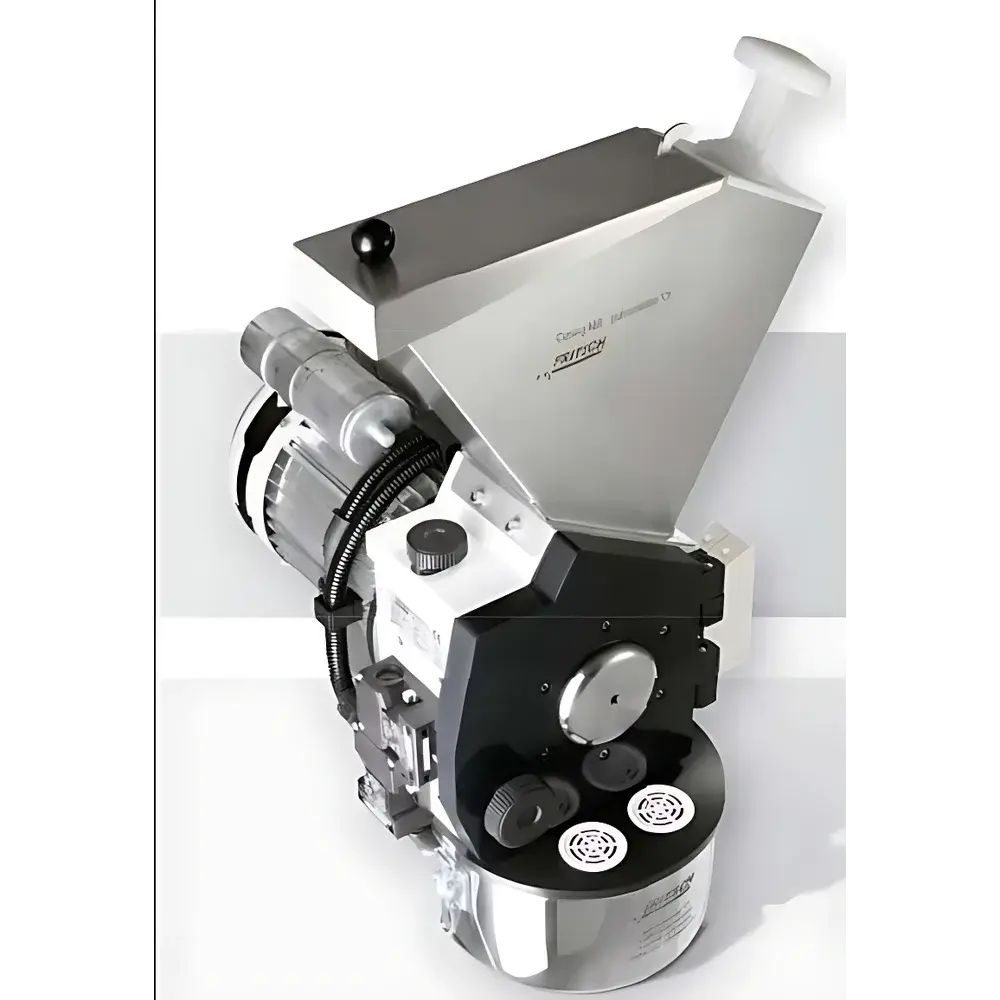
FRITSCH Pulverisette 15 Cutting Mill
| Brand | FRITSCH |
|---|---|
| Origin | Germany |
| Model | Pulverisette 15 |
| Input Power | 2000 W |
| Rotor Speed | 2800–3400 rpm |
| Final Particle Size Range | 0.25–6 mm (dependent on interchangeable sieve inserts) |
| Max. Feed Size | 60 mm |
| Throughput | up to 50 L/h |
| Dimensions (W×D×H) | 42 × 48 × 69 cm |
| Net Weight | 42 kg |
| Gross Weight | 72 kg |
| Grinding Principle | High-speed cutting with rotating and fixed knives |
| Compliance | CE-marked |
| Warranty | 1 year |
Overview
The FRITSCH Pulverisette 15 Cutting Mill is a precision-engineered laboratory cutting grinder designed for the reproducible size reduction of soft to medium-hard, dry, fibrous, or elongated materials. Operating on the principle of high-speed mechanical cutting—rather than impact, compression, or shear—the instrument employs a robust rotor equipped with four rotating stainless-steel knives that engage three stationary counter-knives within a fully enclosed grinding chamber. This configuration ensures controlled, low-heat comminution ideal for thermally sensitive or structurally anisotropic samples. Unlike hammer or disc mills, the Pulverisette 15 maintains sample integrity by minimizing overgrinding and particle agglomeration, delivering consistent particle size distributions suitable for downstream analytical workflows—including elemental analysis, proximate analysis, homogenization prior to spectroscopy (e.g., FTIR, XRF), or preparation for regulatory-compliant testing (e.g., ASTM D3172, ISO 18894, or EN 15403 for biomass characterization).
Key Features
- High-efficiency cutting geometry: Four hardened stainless-steel rotor knives and three fixed knives operate in precise opposition, enabling clean sectioning of long, narrow, or fibrous feedstocks (e.g., stems, leather strips, plastic rods, tobacco leaves).
- Externally adjustable cutting gap: Enables fine-tuning of initial cut aggressiveness without disassembly—critical for method development and inter-laboratory reproducibility.
- Tool-free access: The grinding chamber opens fully via a single-button actuated hinged lid secured by only two knurled screws—facilitating rapid inspection, cleaning, or knife replacement between batches.
- Dual-material feed system: Includes a 2 L stainless-steel funnel with integrated polymer pusher, ensuring safe, hands-free feeding of irregular or cohesive materials while maintaining operator safety and dust containment.
- Interchangeable sieve inserts: Square- or trapezoidal-perforated stainless-steel inserts (sold separately) define final particle size; available in nominal apertures from 0.25 mm to 6 mm per ISO 3310-1 tolerances.
- Modular mounting: Configurable for benchtop use (via anti-slip feet) or rigid floor-standing operation using optional support frames—supporting ergonomic integration into QA/QC labs, feed mills, or pharmaceutical R&D suites.
- Robust thermal management: 2000 W motor with continuous-duty rating and integrated thermal cut-off ensures stable 2800–3400 rpm operation across variable load conditions (frequency-dependent: 50 Hz standard).
Sample Compatibility & Compliance
The Pulverisette 15 accommodates a broad spectrum of organic and inorganic dry matrices—including rubber, leather, paperboard, textiles, wood chips, dried herbs, cereal grains, malt, animal feed, pharmaceutical tablets, bone fragments, cork, straw, and metal swarf—provided feed dimensions do not exceed 60 mm in length or cross-section. Its design conforms to EU Machinery Directive 2006/42/EC and carries CE marking for safety, electromagnetic compatibility (EMC), and low-voltage compliance. While not intrinsically rated for explosive atmospheres (ATEX), it may be deployed in non-hazardous zones under ISO/IEC 17025-accredited quality systems. Routine maintenance logs, calibration of sieve inserts (traceable to NIST-traceable standards), and operational records align with GLP and GMP documentation requirements when integrated into validated workflows.
Software & Data Management
The Pulverisette 15 operates as a standalone electromechanical instrument without embedded firmware or digital interfaces. However, its deterministic mechanical behavior—consistent rotor speed, fixed cutting geometry, and repeatable sieve-based sizing—enables full traceability within LIMS or ELN environments. Users document batch parameters (sieve insert ID, feed mass, run duration, ambient temperature) manually or via barcode-scanned SOP templates. For laboratories requiring audit-ready data, third-party digital timers with USB export or industrial PLC-integrated start/stop triggers may be deployed to capture timestamped operational metadata compliant with FDA 21 CFR Part 11 when paired with appropriate electronic signature protocols.
Applications
- Preparation of homogeneous subsamples for calorific value determination (ASTM D5865, ISO 1928)
- Size reduction of feedstock prior to near-infrared (NIR) spectral calibration modeling
- Homogenization of botanical materials for pesticide residue analysis (EN 15662)
- Conditioning of recycled polymer flakes for melt flow index (MFI) testing (ISO 1133)
- Routine QC grinding of pharmaceutical excipients and tablet blends prior to dissolution or content uniformity testing (USP <701>)
- Processing of lignocellulosic biomass for enzymatic hydrolysis assays or anaerobic digestion feed studies
FAQ
Is the Pulverisette 15 suitable for wet or oily samples?
No. It is strictly intended for dry, free-flowing, or fibrous solid materials. Moisture or oil content above 1% w/w risks clogging, knife corrosion, and inconsistent throughput.
Are sieve inserts included with the base unit?
No. The standard delivery includes a 3.5 L collection pan only. All square- and trapezoidal-perforated stainless-steel sieve inserts must be ordered separately.
Can the cutting knives be resharpened in-house?
Yes. The hardened stainless-steel knives feature symmetrical geometry and are designed for multiple regrinds using standard toolroom equipment—extending service life beyond 500 operational hours under typical loading conditions.
What electrical supply is required?
A dedicated 230 V / 50 Hz / 16 A circuit is recommended. Voltage fluctuations exceeding ±5% may affect rotor speed stability and torque consistency.
How is particle size distribution verified post-grinding?
Users perform sieve analysis per ISO 9276-2 using certified test sieves matching the installed insert aperture—or employ laser diffraction (e.g., Malvern Mastersizer) for volumetric PSD quantification where regulatory methods permit.



