
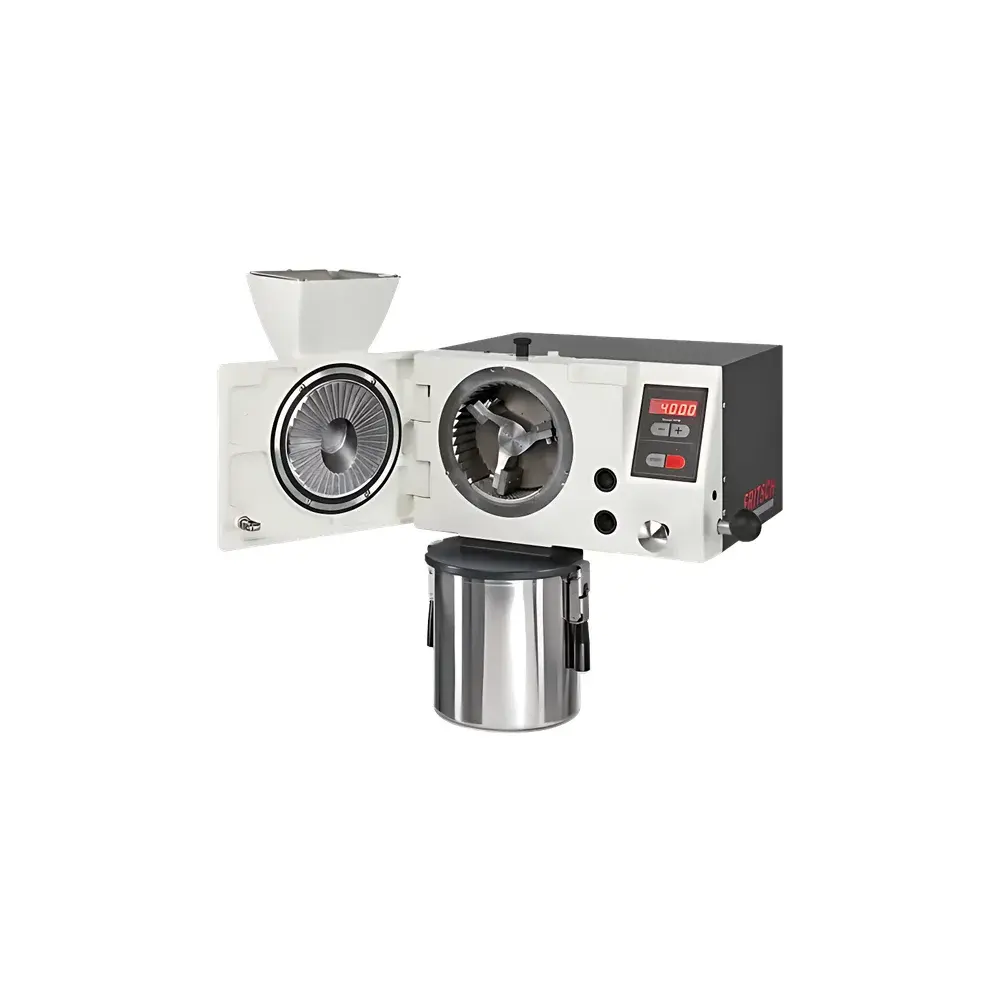
FRITSCH PULVERISETTE 16 Cross Beater Mill
| Brand | FRITSCH |
|---|---|
| Origin | Germany |
| Model | PULVERISETTE 16 |
| Max. Feed Size | 25 mm |
| Max. Throughput | 80 L/h |
| Final Particle Size | < 100 µm |
| Motor Speed | 2,000–4,000 rpm |
| Power Supply | 230 V AC, 1~ , 50 Hz |
| Rated Power | 1,500 W |
| Net Weight | 45 kg |
| Gross Weight | 83 kg |
| Dimensions (W × D × H) | 50 × 50 × 58 cm |
| Sound Pressure Level (LpA,eq) | 85 dB(A) |
| Construction | Stainless Steel Housing with Interchangeable Trapezoidal & Round-Perforated Sieves |
| Mounting Options | Benchtop or Floor-Standing via Adjustable Support Frame |
| Integrated Air Filter | Prevents Sieve Clogging and Ensures Sample Integrity |
| Overload Protection | Built-in Thermal Cut-off |
Overview
The FRITSCH PULVERISETTE 16 Cross Beater Mill is a high-performance, laboratory-scale impact grinding instrument engineered for rapid, reproducible size reduction of dry, brittle, and moderately hard materials. Operating on the principle of centrifugal impact comminution, the mill utilizes a rotating cross-beater rotor that accelerates feed material against fixed counter-plates and sieve walls—generating repeated collisions that fracture particles through kinetic energy transfer. Unlike planetary ball mills or jaw crushers, the PULVERISETTE 16 delivers continuous throughput without batch limitations, making it especially suitable for preparatory grinding prior to X-ray fluorescence (XRF), X-ray diffraction (XRD), or elemental analysis workflows where representative sub-sampling and minimal contamination are critical. Its design adheres to DIN EN 61000-3-2 (electromagnetic compatibility) and conforms to CE machinery safety directives (2006/42/EC), ensuring compliance in regulated academic, industrial QC, and contract testing laboratories across Europe and North America.
Key Features
- Stainless steel housing and interchangeable sieves (trapezoidal and round-perforated) enable rapid adaptation to varying fineness requirements while minimizing cross-contamination between samples.
- Variable-speed motor (2,000–4,000 rpm) allows precise control over impact energy—critical for balancing throughput and particle size distribution (PSD) reproducibility across heterogeneous feedstocks such as minerals, ceramics, pharmaceutical excipients, and recycled electronic components.
- Dual mounting configuration: secure benchtop installation using integrated clamping brackets or stable floor-standing operation via an adjustable support frame—optimized for ergonomic access and vibration damping in shared lab environments.
- Integrated air filtration system maintains consistent airflow dynamics during operation, preventing sieve blinding and preserving sample integrity—particularly essential when processing hygroscopic or electrostatic-prone materials like graphite or polymer powders.
- Thermal overload protection automatically interrupts power supply under sustained high-load conditions, extending motor service life and supporting unattended operation within validated protocols.
Sample Compatibility & Compliance
The PULVERISETTE 16 accepts feed particles up to 25 mm in maximum dimension and is routinely employed for materials classified as “brittle” or “medium-hard” per Mohs scale (e.g., limestone, feldspar, coal ash, dried plant tissue, and sintered oxides). It is not recommended for fibrous, elastic, or highly ductile substances (e.g., rubber, thermoplastics, or metals > HRB 60) due to limited shearing action. The instrument complies with ISO 13320:2020 (laser diffraction particle size analysis—sample preparation guidance), supports GLP-aligned documentation practices, and meets mechanical safety requirements outlined in ASTM D7429-22 (standard practice for preparation of solid waste samples for particle size analysis). All stainless steel wetted parts are electropolished to Ra ≤ 0.8 µm, facilitating cleaning validation per FDA-recommended residue limits.
Software & Data Management
While the PULVERISETTE 16 operates via analog speed control (no embedded microprocessor), its mechanical interface is fully compatible with external digital logging systems. Lab managers may integrate rotational speed, runtime, and ambient temperature data into LIMS or ELN platforms using optional analog signal output modules (0–10 V DC or 4–20 mA) paired with certified DAQ hardware. Full traceability—including operator ID, date/time stamp, sieve identification, and feed mass—is maintained through standardized SOP templates aligned with ISO/IEC 17025:2017 clause 7.7 (results reporting) and supports audit readiness for ISO 9001 or GMP Annex 11 assessments.
Applications
- Routine homogenization of geological core samples prior to geochemical assay (ICP-OES/MS).
- Preparation of certified reference materials (CRMs) for inter-laboratory proficiency testing.
- Particle size conditioning of catalyst supports (e.g., γ-Al₂O₃, SiO₂) before BET surface area measurement.
- Grinding of pharmaceutical granules for content uniformity testing per USP <905>.
- Size reduction of spent battery cathode materials (LiCoO₂, NMC) for recycling process development.
FAQ
What types of materials are unsuitable for the PULVERISETTE 16?
Materials exhibiting high elasticity, toughness, or thermal sensitivity—such as raw rubber, polyethylene pellets, or freeze-dried proteins—are not recommended due to insufficient shear force and potential heat-induced degradation.
Can the mill be used under inert atmosphere conditions?
No—the standard configuration lacks gas-tight sealing or purge ports; however, custom modifications including glovebox-integrated feed hoppers and nitrogen-flushed housings are available through FRITSCH’s OEM engineering division.
How often should the sieve be replaced?
Sieve lifetime depends on abrasive load and operational frequency; typical replacement intervals range from 200–500 operating hours for quartz-rich feeds, verified by laser micrometer inspection of aperture geometry per ISO 3310-1.
Is routine calibration required?
Speed calibration is traceable to national standards (e.g., PTB Germany) using certified tachometers; no periodic recalibration is mandated, though annual verification is recommended for GLP-compliant labs.
Does the instrument meet FDA 21 CFR Part 11 requirements?
As a stand-alone mechanical device without electronic record generation, it does not fall under Part 11 scope—but its integration-ready analog outputs support compliant data capture when paired with validated third-party acquisition systems.



