
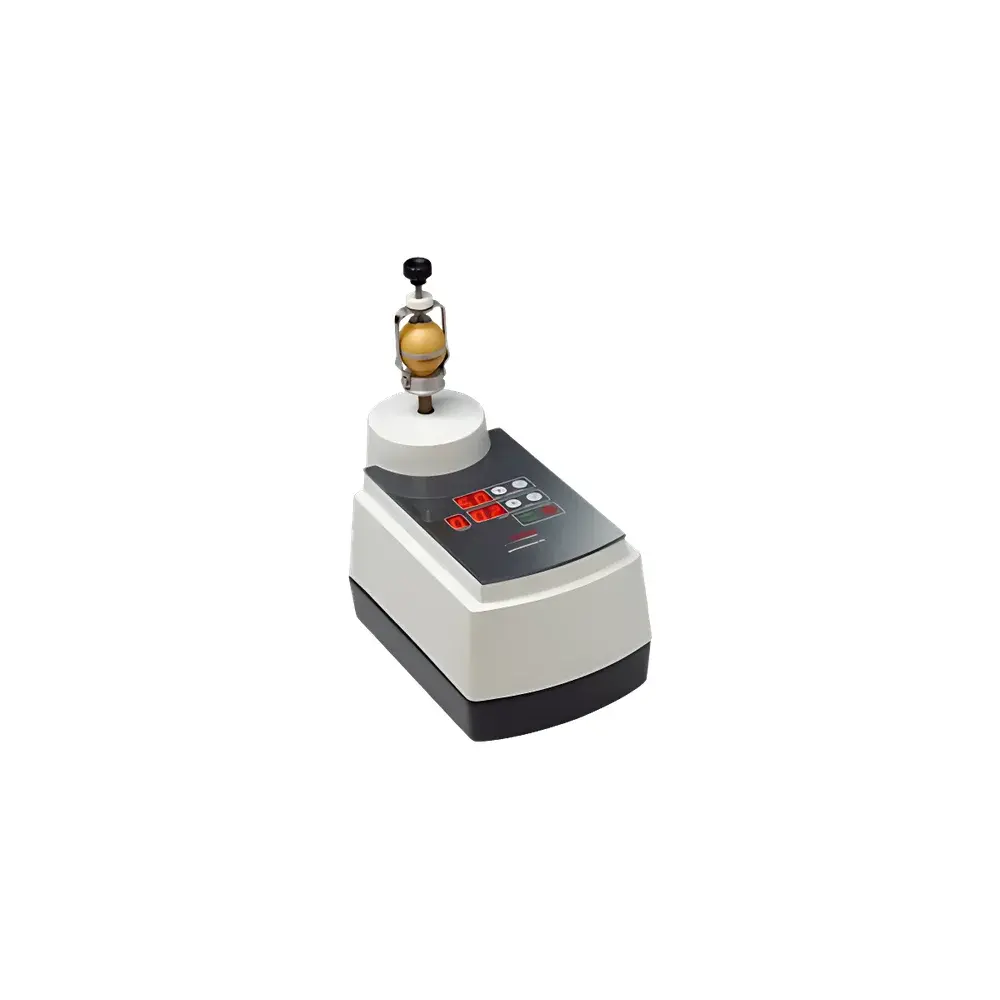
FRITSCH PULVERISETTE 23 Micro Ball Mill
| Brand | FRITSCH |
|---|---|
| Origin | Germany |
| Model | PULVERISETTE 23 |
| Instrument Type | Micro Ball Mill |
| Grinding Principle | Planetary Ball Milling |
| Application Scope | Batch-wise Dry & Wet Grinding of Small Sample Quantities (0.1–50 mL) |
| Grinding Vessel Materials | Stainless Steel, Tungsten Carbide, Zirconium Oxide, Agate, PTFE-Lined |
| Max Rotational Speed | 2,200 rpm |
| Effective Grinding Energy | High-energy planetary motion with centrifugal acceleration up to 22 g |
| Compliance | CE-marked, Designed in Accordance with DIN EN ISO 9001 and Machinery Directive 2006/42/EC |
Overview
The FRITSCH PULVERISETTE 23 Micro Ball Mill is a high-precision, benchtop planetary ball mill engineered for reproducible, controlled comminution of small-volume laboratory samples. Operating on the principle of high-energy planetary grinding—where grinding jars rotate eccentrically around a sun wheel while simultaneously rotating on their own axes—the instrument generates intense impact, shear, and friction forces essential for efficient particle size reduction. Unlike conventional shaker or vibratory mills, the PULVERISETTE 23 delivers superior energy transfer per unit volume, enabling rapid attainment of sub-micron particle distributions from as little as 0.1 mL up to 50 mL of sample material. Its compact footprint, integrated safety interlock system, and low-noise operation make it especially suitable for shared laboratory environments, QC labs, and academic research settings where space, repeatability, and operator safety are critical.
Key Features
- Planetary drive mechanism delivering centrifugal accelerations up to 22 g for high-efficiency particle breakage
- Programmable digital control panel with adjustable speed (100–2,200 rpm), time (1 s–99 h 59 min), and pause intervals
- Automatic lid locking and rotational stop upon jar removal—fully compliant with EN 61000-6-2 (EMC) and EN 61000-6-4 (emission)
- Interchangeable grinding vessels (0.5–50 mL capacity) in multiple materials: stainless steel (1.4404), tungsten carbide, zirconium oxide, agate, and PTFE-lined stainless steel—ensuring chemical compatibility and minimal contamination
- Integrated cooling fan and optional external cooling interface (e.g., chilled water circulation) for temperature-sensitive samples (e.g., polymers, pharmaceutical actives, biological tissues)
- Low-vibration design with rubber-damped base and precision-balanced drive shafts for long-term mechanical stability
Sample Compatibility & Compliance
The PULVERISETTE 23 accommodates diverse sample classes including brittle minerals, metallic alloys, ceramics, pharmaceutical tablets, plant tissues, polymers, and freeze-dried biological matrices. Both dry grinding and wet grinding (using solvents such as ethanol, isopropanol, or aqueous surfactant solutions) are supported, with optimized dispersion achievable via bead-assisted homogenization. All grinding components meet EU Regulation (EC) No. 1935/2004 for materials intended to come into contact with foodstuffs. The instrument is CE-certified and conforms to the European Machinery Directive 2006/42/EC, EN ISO 12100 (risk assessment), and EN 60204-1 (electrical safety). For regulated environments—including GLP-compliant laboratories and pharmaceutical development labs—the device supports audit-ready documentation when paired with FRITSCH’s optional LabSuite software (see Software & Data Management).
Software & Data Management
While the PULVERISETTE 23 operates independently via its built-in touchscreen controller, it is fully compatible with FRITSCH LabSuite—a validated, PC-based software platform supporting method storage, parameter logging, and electronic signature functionality aligned with FDA 21 CFR Part 11 requirements. LabSuite enables full traceability of grinding protocols—including speed profiles, duration, vessel ID, operator ID, and timestamped event logs—facilitating compliance with ISO/IEC 17025, USP , and internal SOPs. Export options include CSV and PDF reports suitable for inclusion in analytical method validation dossiers or regulatory submissions.
Applications
- Preparation of homogeneous powders for X-ray fluorescence (XRF) and X-ray diffraction (XRD) analysis
- Rapid milling of API-excipient blends prior to dissolution testing or tablet compression trials
- Size reduction of geological core fragments for geochemical assay preparation
- Homogenization of composite materials (e.g., battery cathode precursors, catalyst supports) prior to SEM-EDS or BET surface area analysis
- Cell disruption and nucleic acid extraction support in molecular biology workflows (when used with cryo-grinding adapters)
- Production of nanoscale suspensions for colloidal stability studies or rheological characterization
FAQ
What is the minimum sample volume required for effective grinding?
Typical effective processing starts at 0.1 mL (e.g., 20–50 mg solid), though optimal results are achieved with ≥0.5 mL to ensure sufficient mass for uniform energy distribution.
Can the PULVERISETTE 23 be used for cryogenic grinding?
Yes—when equipped with optional liquid nitrogen-cooled grinding jars and cryo-adapters, it supports embrittlement and milling of thermolabile materials down to –196 °C.
Is method transfer between PULVERISETTE 23 and larger FRITSCH mills (e.g., PULVERISETTE 6 or 7) feasible?
Scalable parameters (e.g., specific impact energy, ball-to-powder ratio, and grinding time) can be correlated using FRITSCH’s scale-up guidelines, though empirical re-optimization is recommended for critical applications.
Does the instrument support GMP documentation requirements?
With LabSuite software enabled and properly configured, the system supports electronic records, user access controls, and audit trails meeting Annex 11 and ALCOA+ data integrity principles.
What maintenance is required for long-term performance?
Routine checks include torque verification of jar clamps, inspection of drive belt tension (if applicable), and periodic calibration of speed and timer functions using certified tachometry—typically performed annually or per internal QA schedule.



