
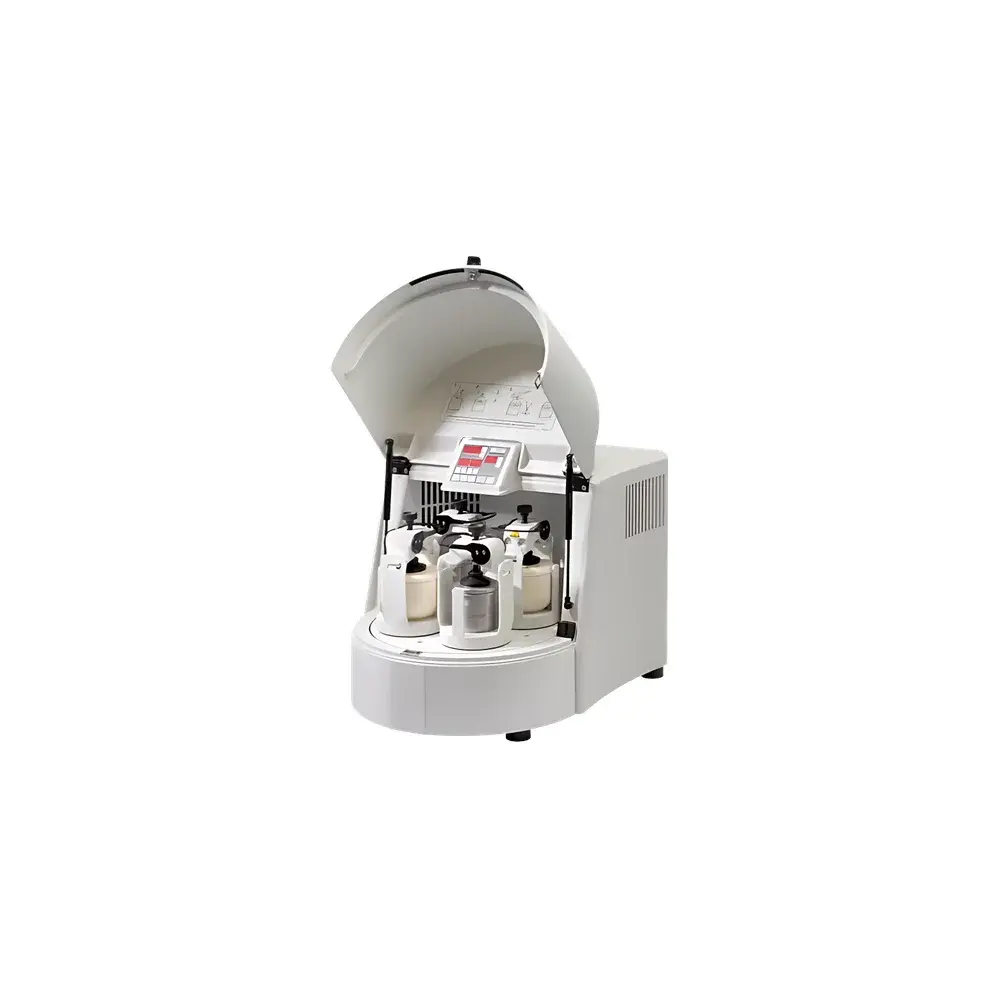
FRITSCH PULVERISETTE 5 Classic Planetary Micro Mill
| Brand | FRITSCH |
|---|---|
| Origin | Germany |
| Model | PULVERISETTE 5 Classic |
| Maximum Feed Size | < 10 mm |
| Maximum Sample Volume | 4 × 225 mL |
| Final Particle Size | < 1 µm |
| Simultaneous Sample Capacity | 8 |
| Grinding Bowl Volumes | 80 mL, 250 mL, 500 mL |
| Grinding Ball Diameters | 3, 5, 10, 15, 20, 30, 40 mm |
| Grinding Modes | Dry & Wet |
| Inert Atmosphere Compatibility | Yes |
| Power Supply | 100–120 / 200–240 V, 1–, 50–60 Hz |
| Power Consumption | 880 W |
| Net Weight | 120 kg |
| Gross Weight | 180 kg |
| Dimensions (W×H×D) | 58 × 67 × 57 cm |
| Sound Pressure Level (250 mL bowl, 10 mm balls) | ~70 dB(A) |
| Optional GTM System | Yes (real-time grinding chamber gas temperature & pressure monitoring) |
Overview
The FRITSCH PULVERISETTE 5 Classic Planetary Micro Mill is a high-energy laboratory ball mill engineered for reproducible, contamination-controlled size reduction and mechanochemical processing of solid materials. Operating on the planetary grinding principle—where grinding bowls rotate in the opposite direction to the sun wheel at precisely controlled speed ratios—the instrument generates centrifugal accelerations up to 22 g, enabling efficient particle fracture, alloying, amorphization, and solid-state reaction initiation. Designed for rigorous R&D and quality control environments, it supports both dry and wet grinding protocols and accommodates inert atmosphere operation (e.g., Ar or N₂) via sealed grinding bowls with gas inlet/outlet ports—critical for air-sensitive compounds, pyrophoric metals, or oxidation-prone nanomaterials. Its robust cast-iron frame, precision-machined drive system, and thermally stable gear train ensure long-term mechanical consistency across thousands of operational cycles.
Key Features
- Simultaneous processing of up to eight independent samples using matched bowl/ball sets—ideal for comparative studies, parameter screening, or parallel batch preparation.
- Seven certified grinding material options: agate, silicon nitride, aluminum oxide, zirconium oxide, stainless steel, tempered steel, and tungsten carbide—selected based on hardness, chemical inertness, and density requirements per application.
- Precision programmable control of grinding time (1 s resolution), pause intervals, rotational speed (rpm), and direction reversal—enabling strict protocol adherence for GLP-compliant workflows.
- Integrated cooling interface compatible with external chillers or Peltier modules; optional FRITSCH GTM (Grinding Temperature Monitoring) system provides real-time, in-situ measurement of internal gas temperature and pressure inside the sealed grinding bowl during operation—essential for thermal safety assessment and reaction kinetics analysis.
- Modular bowl design with three standardized volumes (80 mL, 250 mL, 500 mL) and seven ball diameters (3–40 mm), allowing fine-tuned energy input optimization for diverse material classes—from brittle ceramics to ductile alloys.
- Compliance-ready architecture: meets CE directives (2014/30/EU EMC, 2014/35/EU LVD); electrical safety certified per IEC 61000-6-2/-6-4; suitable for installation in ISO 17025-accredited laboratories performing particle size method validation per ISO 13320.
Sample Compatibility & Compliance
The PULVERISETTE 5 Classic processes a broad spectrum of inorganic, organic, and composite feedstocks—including oxides, metals, polymers, pharmaceutical actives, catalysts, and battery electrode materials—with feed sizes up to 10 mm. Its ability to achieve final particle sizes below 1 µm (verified by laser diffraction or SEM image analysis) supports applications requiring high surface-area-to-volume ratios. All grinding components are manufactured to DIN EN ISO 9001-certified production standards. When operated with agate or zirconia media under inert gas, it fulfills ASTM E2904-21 requirements for contamination-minimized sample preparation in trace elemental analysis. The system supports audit-trail-capable operation when integrated with FRITSCH’s optional LabSolutions software, aligning with FDA 21 CFR Part 11 data integrity expectations for regulated industries.
Software & Data Management
LabSolutions software (optional) enables centralized method storage, remote instrument control, automated report generation (PDF/CSV), and electronic signature support. Each grinding run logs timestamped parameters—including actual rpm, torque load, elapsed time, and (if GTM-equipped) real-time T/P profiles—stored with SHA-256 hash integrity verification. Exported datasets comply with ASTM E2500-22 guidelines for analytical instrument data handling and are structured for direct import into LIMS or statistical process control platforms (e.g., JMP, Minitab). Audit trails record user ID, method version, calibration status, and any parameter overrides—fully traceable for regulatory inspections.
Applications
- Mechanochemical synthesis of metal–organic frameworks (MOFs), perovskites, and solid electrolytes.
- High-energy milling for amorphization of crystalline APIs to enhance solubility and bioavailability.
- Preparation of nanostructured electrode materials (e.g., Si/C composites, LiFePO₄) for battery R&D.
- Homogenization and dispersion of nanocomposites prior to TEM or XRD characterization.
- Standardized sample preparation for XRF, ICP-MS, and XRD quantitative phase analysis per ISO 21047 and ASTM E1361.
- Accelerated solid-state reaction studies under controlled thermal and atmospheric conditions.
FAQ
What is the maximum recommended continuous operating time per grinding cycle?
Continuous operation is limited to 99 hours 59 minutes per program; however, thermal management and mechanical fatigue considerations recommend ≤ 60 min uninterrupted grinding for high-energy protocols—intermittent cycles with active cooling are advised for extended processing.
Can the PULVERISETTE 5 Classic be validated for GMP environments?
Yes—when paired with IQ/OQ documentation packages, calibrated torque sensors, and LabSolutions with 21 CFR Part 11 mode enabled, it supports full GMP validation per Annex 15 and USP .
Is there a difference between the Classic and Premium versions beyond GTM compatibility?
The Classic model features manual lid locking and analog speed control interface; the Premium includes motorized lid actuation, digital touchscreen HMI, and built-in Ethernet for SCADA integration.
How is cross-contamination prevented between sequential runs?
All grinding bowls and lids are autoclavable or solvent-rinsable; FRITSCH recommends post-run cleaning with ultrasonic bath + isopropanol, followed by gravimetric residue check (< 0.1 mg) before reuse in trace analysis.
Does FRITSCH provide application-specific method development support?
Yes—application engineers offer remote or on-site method optimization services, including energy input modeling (Eₘ = ½·m·v²), ball-to-powder ratio selection, and inert gas purge protocol design per material reactivity profile.



