
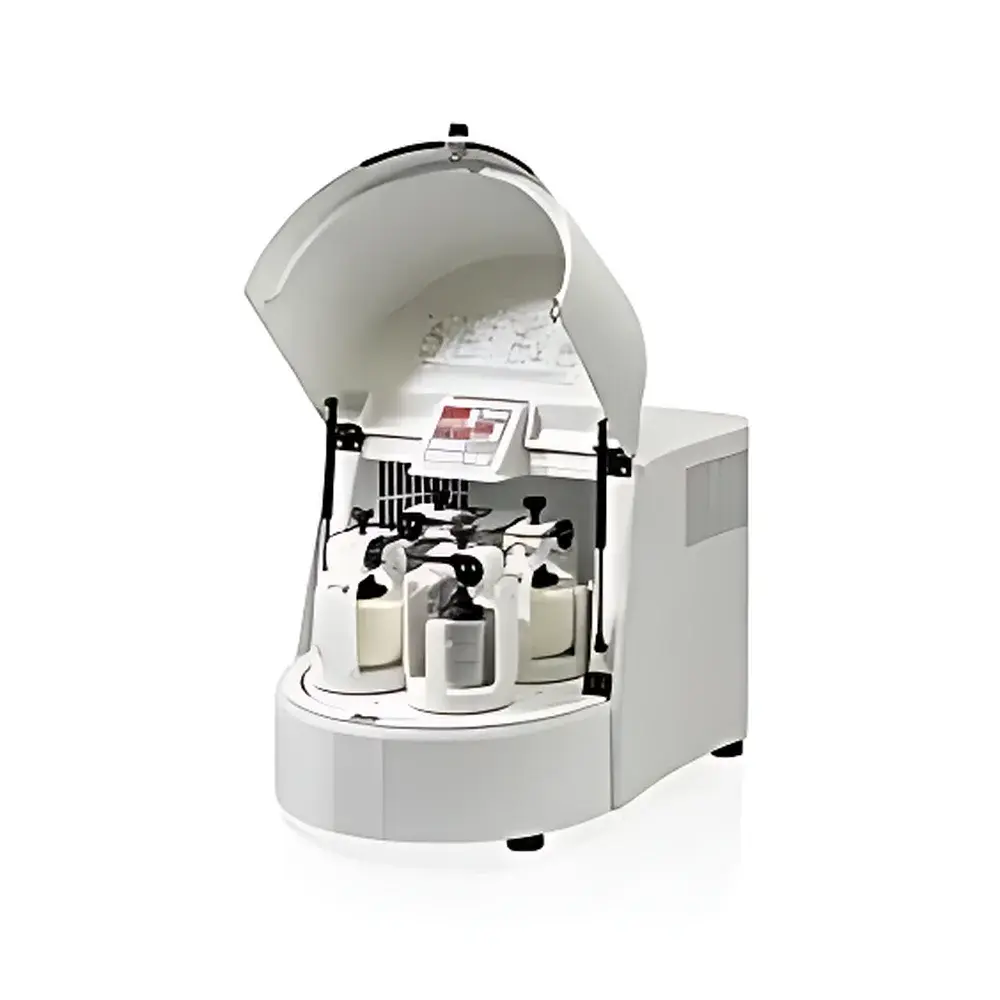
Fritsch Pulverisette 5 Premium Line Planetary Micro Mill
| Brand | Fritsch |
|---|---|
| Origin | Germany |
| Model | Pulverisette 5 |
| Type | Planetary Ball Mill |
| Sample Type | Hard, brittle, fibrous, or temperature-sensitive materials |
| Max. Feed Size | < 10 mm |
| Final Particle Size | < 1 µm |
| Batch Capacity | 4 × 225 mL (900 mL total) |
| Grinding Bowl Volume Options | 80, 250, 500 mL |
| Grinding Media Diameters | 10–40 mm |
| Power Supply | 100–120 / 200–240 V, 1~ , 50–60 Hz |
| Motor Output | 0.37 kW (VDE 0530 / EN 60034 compliant) |
| Weight | 120 kg (net), 180 kg (gross) |
| Dimensions (L×W×H) | 58 × 67 × 57 cm |
| Noise Level | ~70 dB(A) (measured with 250 mL bowl + 10 mm balls) |
Overview
The Fritsch Pulverisette 5 Premium Line Planetary Micro Mill is a high-energy laboratory ball mill engineered for reproducible, ultra-fine comminution of hard, brittle, and temperature-sensitive materials. Based on the planetary grinding principle—where grinding bowls rotate on their own axes while simultaneously revolving around a central sun wheel—the instrument generates intense centrifugal and Coriolis forces. These forces accelerate grinding media (balls) along precisely defined trajectories, enabling efficient impact, shear, and friction-based size reduction. The system operates under controlled mechanical energy input, making it suitable for analytical sample preparation, mechanochemical synthesis, homogenization of suspensions, and emulsification of turbid liquids. Its robust architecture supports both dry grinding and wet grinding in sealed environments, including inert gas atmospheres—critical for oxidation-sensitive or reactive samples.
Key Features
- Microprocessor-controlled drive with programmable speed (up to 800 rpm), direction reversal, and precise time resolution (1-second increments) for grinding and cooling intervals.
- Integrated acoustic and thermal management: sound-dampened grinding chamber with active ventilation control to maintain stable thermal conditions during extended operation.
- Energy-efficient standby mode with automatic overload protection and real-time motor load monitoring.
- TÜV-certified safety compliance (CE marking per Machinery Directive 2006/42/EC and Low Voltage Directive 2014/35/EU).
- Modular design supporting up to eight independent grinding bowls (four positions × two bowls per station) for parallel processing—ideal for comparative studies or high-throughput screening.
- Optional GTM (Gas Temperature & Pressure Monitoring) system: wireless real-time acquisition of internal bowl pressure and temperature profiles during operation, logged directly into Excel-compatible files and graphical plots.
Sample Compatibility & Compliance
The Pulverisette 5 accommodates a broad spectrum of sample types—including metals, ceramics, minerals, polymers, pharmaceuticals, and biological tissues—provided feed particles are ≤10 mm. Final particle distributions routinely achieve d90 < 1 µm, with sub-100 nm results attainable using optimized parameters and high-density grinding media (e.g., zirconia or tungsten carbide). For regulated environments, the mill supports GLP/GMP-aligned workflows: its digital control interface enables audit-trail-capable parameter logging (time-stamped start/stop, speed, duration), and inert-gas purging via Fritsch’s patented sealing lid system ensures compatibility with ISO 8502-3 (surface cleanliness), ASTM E2906 (mechanochemical reaction protocols), and USP particulate matter testing prerequisites.
Software & Data Management
While the Pulverisette 5 operates via an intuitive membrane-touch interface, optional PC connectivity enables advanced data governance. The GTM system transmits synchronized pressure/temperature datasets via RF transmission to proprietary software, generating timestamped CSV exports and dynamic trend charts. All operational parameters—including rotational frequency, directional sequence, pause intervals, and cumulative runtime—are stored locally with non-volatile memory retention. When integrated into networked lab infrastructures, the device complies with FDA 21 CFR Part 11 requirements through third-party validated electronic log solutions that enforce user authentication, electronic signatures, and immutable audit trails.
Applications
- Preparation of XRD, SEM, and TEM specimens requiring sub-micron homogeneity and minimal amorphization.
- Mechanochemical synthesis of metal-organic frameworks (MOFs), solid-state battery cathodes, and catalytic nanocomposites.
- Homogenization of pharmaceutical blends prior to dissolution testing (USP ) or content uniformity analysis (USP ).
- Reduction of geological core samples for geochemical assay (ICP-MS/OES), ensuring representative sub-sampling without elemental fractionation.
- Disintegration of composite materials for failure analysis or recycling feasibility assessment.
FAQ
What grinding media materials are available, and how do they affect contamination risk?
Fritsch offers nine certified grinding media compositions—including agate, silicon nitride, alumina (85–90% and 99.7%), yttria-stabilized zirconia, stainless steel, hardened steel, tungsten carbide, and polymer-coated steel—each traceably documented for elemental leaching profiles. Selection is guided by sample hardness, required purity class (e.g., semiconductor-grade vs. routine QC), and chemical compatibility.
Can the Pulverisette 5 be used under inert atmosphere, and what modifications are required?
Yes. A dedicated gas-tight bowl lid with rapid-connect purge valves and interlocked glovebox integration enables continuous N2, Ar, or He purging. The GTM system concurrently monitors internal pressure decay and thermal drift to validate seal integrity and process stability.
Is the instrument compatible with regulatory audit requirements for pharmaceutical labs?
When paired with validated data acquisition software and configured with user access controls, the system meets ALCOA+ principles (Attributable, Legible, Contemporaneous, Original, Accurate) and supports 21 CFR Part 11 compliance through external electronic record systems.
What maintenance routines ensure long-term performance stability?
Routine verification includes torque calibration of bowl clamping mechanisms, periodic inspection of gear train lubrication, and validation of temperature sensor drift using NIST-traceable reference probes—procedures outlined in Fritsch’s GLP-compliant maintenance SOPs (Document No. PM-P5-EN-2023).



