
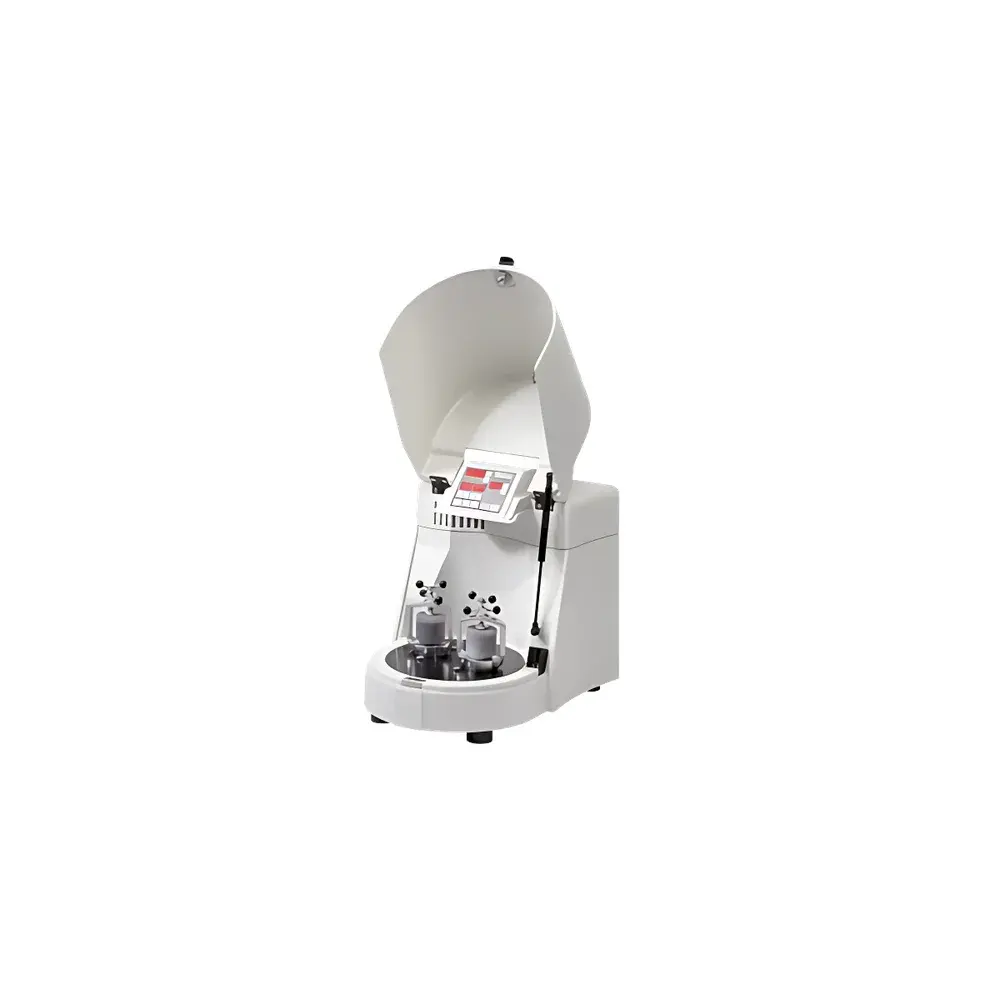
FRITSCH PULVERISETTE 7 Classic Planetary Micro Mill
| Brand | FRITSCH |
|---|---|
| Origin | Germany |
| Model | PULVERISETTE 7 Classic |
| Instrument Type | Planetary Ball Mill |
| Max. Feed Size | < 10 mm |
| Max. Sample Volume | 2 × 20 mL |
| Final Fineness | < 1 µm |
| Simultaneous Samples | 2 |
| Grinding Bowl Volumes | 12 mL, 45 mL |
| Grinding Ball Diameters | 3 mm, 5 mm, 10 mm, 15 mm |
| Grinding Modes | Dry & Wet |
| Voltage | 100–120 V / 200–240 V, 1–, 50–60 Hz |
| Power Consumption | 880 W |
| Dimensions (W×H×D) | 37 × 53 × 50 cm |
| Net Weight | 35 kg |
| Gross Weight | 55 kg |
| Material Options | Agate, Silicon Nitride, Alumina, Zirconia, Stainless Steel, Hardened Steel, Tungsten Carbide, Polypropylene (disposable bowls) |
| Timer Resolution | 1-second precision for grinding & cooling intervals |
Overview
The FRITSCH PULVERISETTE 7 Classic Planetary Micro Mill is a high-precision laboratory ball mill engineered for reproducible, contamination-controlled size reduction of solid materials to sub-micron particle sizes. Based on planetary grinding mechanics—where grinding bowls rotate in the opposite direction to the sun wheel at precisely controlled speeds—the instrument generates centrifugal and Coriolis forces up to 95 g, enabling efficient mechanical alloying, homogenization, colloidal dispersion, and ultra-fine comminution. Designed for analytical laboratories requiring trace-level purity and strict process repeatability, the PULVERISETTE 7 Classic supports both dry and wet grinding protocols and is widely employed in materials science, geochemistry, pharmaceutical development, and nanomaterial synthesis.
Key Features
- Capable of achieving final fineness down to < 1 µm under optimized conditions, validated via laser diffraction or electron microscopy analysis.
- Programmable digital control interface with second-level resolution for grinding time, pause duration, and cooling intervals—critical for thermally sensitive samples.
- Dual-grinding station design allows simultaneous processing of two independent samples using interchangeable bowls (12 mL or 45 mL), minimizing cross-contamination and maximizing throughput.
- Eight certified grinding material options—including agate (for ultra-low metal contamination), zirconia (high wear resistance), silicon nitride (non-magnetic, inert), tungsten carbide (for hard alloys), and disposable polypropylene bowls (for single-use, GMP-aligned workflows).
- Integrated safety interlocks prevent operation when lids are unsecured; automatic motor shutdown occurs upon overheating or imbalance detection.
- Modular bowl-and-ball configuration supports systematic method development: grinding ball diameters (3 mm, 5 mm, 10 mm, 15 mm) allow precise tuning of impact energy and shear intensity.
Sample Compatibility & Compliance
The PULVERISETTE 7 Classic accommodates brittle, fibrous, amorphous, and crystalline solids—including oxides, metals, polymers, ceramics, and biological tissues—provided feed particles are ≤10 mm. Its compatibility with wet grinding (using solvents such as ethanol, isopropanol, or aqueous surfactant solutions) extends utility to dispersion stabilization and reactive milling. All wet-capable components meet ISO 8502-3 surface cleanliness standards. The instrument conforms to IEC 61000-6-2 (EMC immunity) and IEC 61000-6-4 (EMC emission) requirements. Optional documentation packages support GLP-compliant validation per ASTM E2656 and ISO/IEC 17025 internal audit frameworks.
Software & Data Management
While the Classic model operates via standalone front-panel controls, it supports full traceability through optional FRITSCH LabSuite™ data logging (available as retrofit). This module records timestamped parameters—including rotational speed, total grinding cycles, real-time temperature trends (via external probe input), and operator ID—for 21 CFR Part 11–compliant electronic records. Audit trails are exportable in CSV or PDF format, facilitating integration into LIMS environments and supporting FDA inspection readiness.
Applications
- Preparation of homogeneous reference materials for XRF, XRD, and SEM-EDS analysis.
- Mechanochemical activation of catalysts and battery electrode precursors (e.g., LiFePO₄ synthesis).
- Particle size reduction of pharmaceutical APIs prior to dissolution testing (aligned with USP & Ph. Eur. grinding guidance).
- Production of nanostructured composites via high-energy ball milling.
- Routine quality control grinding of geological core samples for geochemical assay preparation.
- Homogenization of heterogeneous environmental matrices (soils, sediments, fly ash) prior to heavy metal extraction.
FAQ
What is the maximum recommended sample volume per grinding bowl?
The instrument supports up to 20 mL of sample mass per bowl—equivalent to ~30–40% filling ratio depending on material density—to ensure optimal energy transfer and avoid overloading.
Can the PULVERISETTE 7 Classic be used for cryogenic grinding?
Yes, when equipped with stainless steel or tungsten carbide bowls and compatible cryo-cooling accessories (e.g., liquid nitrogen jacketed holders), though manual pre-cooling of samples and bowls is required due to absence of integrated refrigeration.
Is method transfer between Classic and Premium models straightforward?
Grinding parameters (rpm, time, ball-to-powder ratio) are directly transferable; however, the Premium model’s active cooling and vibration monitoring require recalibration of thermal profiles for equivalent endpoint consistency.
How frequently should grinding bowls and balls be inspected for wear?
Visual and dimensional inspection is recommended after every 50 hours of cumulative operation—or per batch in regulated environments—to verify surface integrity and dimensional tolerance, particularly for agate and ceramic components.
Does FRITSCH provide IQ/OQ documentation for this model?
Yes, factory-verified Installation Qualification (IQ) and Operational Qualification (OQ) protocols are available upon request, aligned with ISO 9001:2015 and GAMP5 principles for laboratory equipment validation.



