
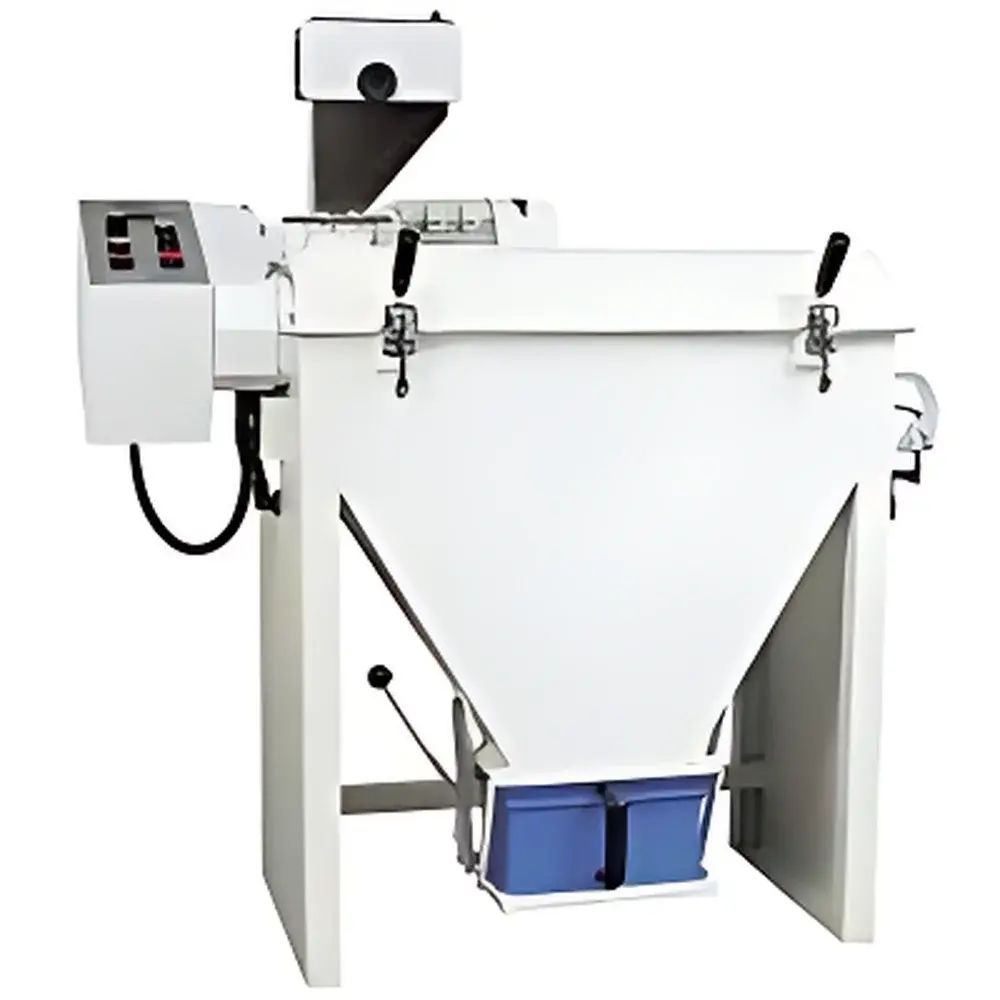
Fritsch Pulverisette 8 Soil Separator
| Brand | Fritsch |
|---|---|
| Origin | Germany |
| Model | Pulverisette 8 |
| Weight (net/gross) | 100 kg / 235 kg |
| Dimensions (W×D×H) | 120 × 50 × 120 cm |
| Maximum feed size | 30 mm |
| Final particle size | < 2 mm |
| Batch capacity | 2 L |
| Rotation speed | 400 rpm |
| Input power | 1240 W |
| Voltage/frequency | 400 V / 3~ / 50–60 Hz |
| Grinding media materials | Nylon, stainless steel, structural steel |
| Sample type suitability | Medium-hard and brittle materials |
| Compliance | CE-marked |
| Warranty | 1 year |
Overview
The Fritsch Pulverisette 8 Soil Separator is a robust, industrial-grade mechanical separation system engineered for rapid, reproducible size reduction of dry, cohesive soil aggregates in compliance with standardized environmental and geochemical testing protocols. Unlike conventional grinders or mills, the Pulverisette 8 operates on a dual-action principle combining controlled centrifugal oscillation and shear-based mechanical impact—enabling efficient disaggregation without thermal degradation or excessive fines generation. Its design adheres to the functional requirements of DIN 19683 (soil sampling and preparation for chemical analysis) and supports sample conditioning workflows aligned with ISO 11464:2023 (soil quality — pretreatment of samples for physico-chemical analyses). The instrument is not a pulverizer in the classical sense but a high-integrity soil fractionation device optimized for preserving representative particle-size distribution while achieving consistent ≤2 mm output—critical for subsequent extraction, leaching, or elemental analysis steps.
Key Features
- Centrifugal oscillation drive at precisely regulated 400 rpm, delivering uniform mechanical energy input across heterogeneous soil matrices
- Integrated rotating nylon brush system for continuous self-cleaning of the sieve surface during operation, minimizing cross-contamination and downtime
- Standard stainless-steel trapezoidal sieve plate with 2 mm aperture (included), compliant with DIN 19683 and German wastewater sludge sampling guidelines
- Optional St 37 structural steel sieve plates available for enhanced durability under abrasive conditions (ordered separately)
- Full-material throughput capability: all processed sample passes through the sieve—no bypass or loss of fine fractions
- Dust extraction port compatible with standard laboratory vacuum or centralized fume hood systems (ISO 14644-1 Class 8 cleanroom-compatible interface)
- CE-certified safety architecture including interlocked access guards, overload protection, and emergency stop circuitry
- Modular construction facilitating tool-free disassembly of grinding chamber, brush assembly, and sieve holder for GLP-compliant cleaning validation
Sample Compatibility & Compliance
The Pulverisette 8 is validated for medium-hard and brittle soil types—including clay-loam aggregates, calcareous nodules, and weathered volcanic soils—without requiring pre-drying beyond ambient moisture equilibrium. It excludes plastic, fibrous, or highly organic samples (e.g., peat, root-mat composites) that may clog the 2 mm aperture or impair brush functionality. Regulatory alignment includes support for EPA Method 1311 (TCLP) sample prep prerequisites, ASTM D422-16 (particle-size analysis of soils), and EU Council Directive 2009/128/EC (sustainable use of pesticides) soil monitoring workflows. All mechanical components comply with RoHS 2011/65/EU and REACH SVHC screening thresholds. Device documentation satisfies audit requirements for ISO/IEC 17025:2017 accredited laboratories, including traceable calibration records for rotational speed and electrical safety testing.
Software & Data Management
The Pulverisette 8 is a standalone electromechanical instrument with no embedded firmware or digital control interface. Operational parameters are set manually via rotary selector switch and monitored using analog tachometer and thermal cut-off indicators. This architecture ensures electromagnetic compatibility (EMC Directive 2014/30/EU) in sensitive analytical environments and eliminates cybersecurity or software validation burdens under FDA 21 CFR Part 11 or EU Annex 11. For laboratories requiring electronic recordkeeping, optional external time-stamped operation logs can be generated via PLC-integrated relay outputs (available upon request), supporting GMP-aligned batch documentation where mechanical process consistency—not digital control—is the critical quality attribute.
Applications
- Preparation of soil sub-samples for ICP-OES/MS multi-element quantification per ISO 11885
- Homogenization of field-collected cores prior to pH, EC, and CEC determination (ISO 10390, ISO 11265)
- Generation of <2 mm fractions for TCLP and SPLP leaching tests (EPA SW-846 Methods 1311 & 1312)
- Conditioning of contaminated site samples for XRF screening and speciation analysis
- Standardized processing of agricultural soils in accordance with FAO Guidelines for Soil Description (2006)
- Supporting EN 12457-2 compliance for waste characterization and landfill acceptance testing
FAQ
Is the Pulverisette 8 suitable for wet or frozen soil samples?
No. The instrument is strictly designed for air-dried or oven-dried (≤40 °C) soil samples. Moisture content above 15 wt% may cause agglomeration and screen blinding.
Can the 2 mm sieve be replaced with other aperture sizes?
The standard configuration includes only 2 mm stainless-steel trapezoidal sieves. Custom apertures (e.g., 1 mm or 4 mm) are not supported due to mechanical resonance constraints at 400 rpm.
Does Fritsch provide IQ/OQ documentation for GMP environments?
Yes—Factory-issued Installation Qualification (IQ) and Operational Qualification (OQ) protocols are available as optional add-ons, including torque verification of drive coupling, sieve aperture metrology reports, and vibration amplitude certification.
What maintenance intervals are recommended for routine use?
Brush wear inspection every 200 operating hours; full lubrication of oscillation bearings every 1,000 hours; sieve integrity check before each analytical batch per ISO/IEC 17025 clause 6.4.6.
Is the unit compatible with nitrogen-purged gloveboxes?
Yes—electrical ingress protection rating IP54 permits integration into inert-atmosphere enclosures, provided dust extraction lines are routed externally to maintain positive pressure integrity.



