
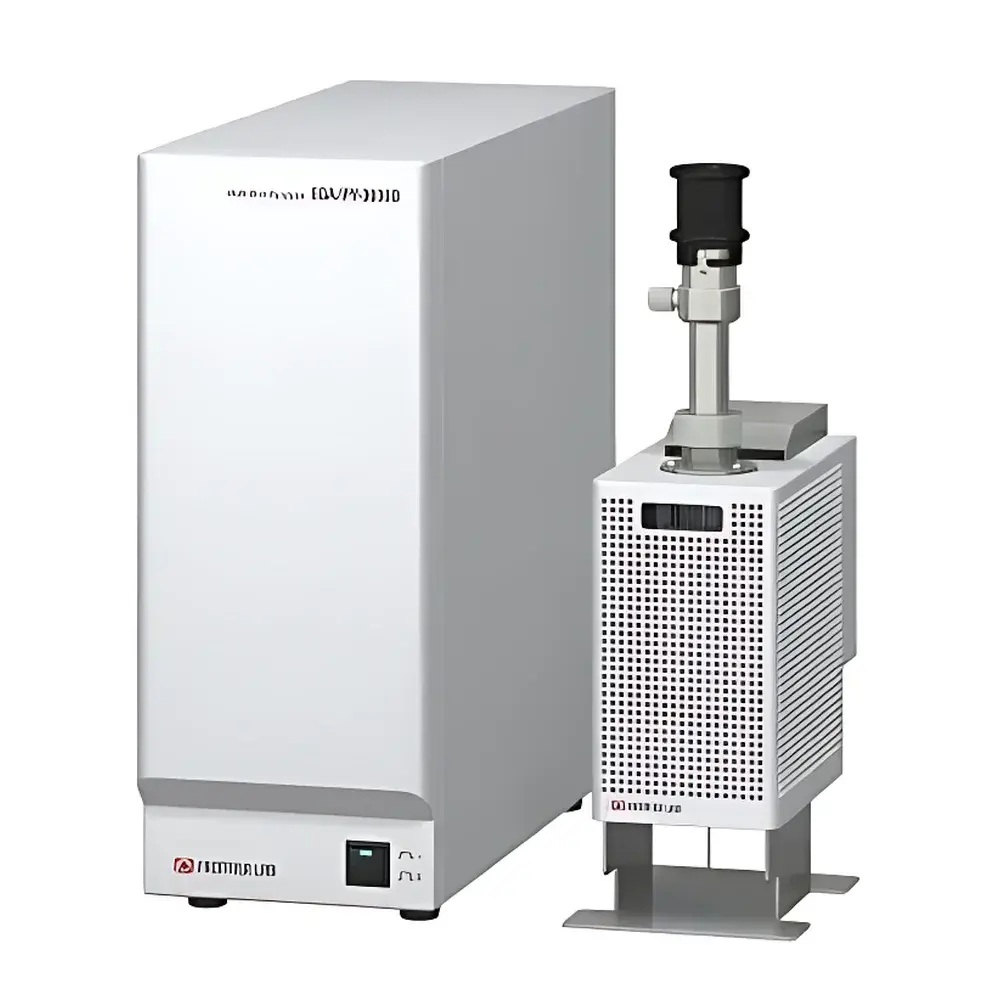
Frontier EGA/PY3030D Evolutionary Gas Analysis / Dual-Stage Pyrolyzer
| Brand | Frontier |
|---|---|
| Origin | Japan |
| Model | EGA/PY3030D |
| Pyrolyzer Type | Microfurnace-based Tubular Pyrolyzer |
| Temperature Range | 10 °C above ambient to 1050 °C (0.1 °C resolution) |
| Heating Rate | Programmable up to 600 °C/min (8-step temperature program) |
| Hold Time & Pyrolysis Time | 0.1–999.9 min (0.1 min step) |
| Cooling | Liquid nitrogen or liquid air |
| Interface Temperature Control (ITF) | 40–450 °C (1 °C step) |
| Reproducibility | RSD < 2% (GC-FID, certified per ASTM D7260 and ISO 17253) |
| Application Modes | EGA, TD, Single-shot Py, TD/PY Double-shot, Heart-cut Release Gas Analysis |
| Sample Introduction Options | Liquid injector, Dual-shot injector, Thermal Desorption (TD) module, Derivatization reactor, UV-assisted pyrolysis injector |
Overview
The Frontier EGA/PY3030D is a high-precision, microfurnace-based evolutionary gas analysis and dual-stage pyrolyzer engineered for rigorous thermal characterization of complex organic and polymeric materials. Unlike conventional wire-heated or Curie-point pyrolyzers—whose thermal gradients and uncontrolled heating dynamics compromise quantitative fidelity—the EGA/PY3030D employs a conical fused-silica pyrolysis chamber coupled with real-time, closed-loop temperature monitoring at the sample zone. This architecture ensures isothermal accuracy, minimal thermal lag, and exceptional control over decomposition kinetics. The system operates on the principle of controlled thermal volatilization followed by online transfer to GC-MS or GC-FID, enabling direct correlation between thermal events (e.g., depolymerization, cross-link cleavage, additive release) and chromatographic/mass spectral signatures. Its design meets the analytical demands of polymer science, forensic chemistry, environmental forensics, and pharmaceutical excipient profiling where reproducibility, trace-level sensitivity, and method traceability are mandated.
Key Features
- Microfurnace architecture with integrated thermocouple feedback at the sample position—enabling true real-time temperature verification and eliminating thermal overshoot.
- Programmable 8-step temperature ramping (1–600 °C/min) with independent hold and pyrolysis time control (0.1–999.9 min, 0.1 min increments).
- Dual-stage operation: seamless transition between thermal desorption (TD) and pyrolysis (PY) within a single run—critical for sequential analysis of volatile residues and non-volatile matrix fragments.
- Conical quartz pyrolysis tube geometry optimized for uniform heat distribution, reduced wall adsorption, and minimized carryover—validated per ASTM D7260 Annex A2.
- Certified reproducibility: RSD < 2% (n = 10, GC-FID detection), the only commercially published repeatability specification among pyrolyzer manufacturers.
- Modular interface temperature control (40–450 °C, 1 °C step) compatible with standard GC inlet liners and low-bleed capillary columns (including Frontier’s proprietary superalloy GC columns).
- Integrated cryogenic cooling system (liquid N₂ or LN₂ substitute) achieving 800 °C → 50 °C in ≤30 min—enabling high-throughput screening without thermal memory effects.
Sample Compatibility & Compliance
The EGA/PY3030D accommodates solid powders, films, fibers, gels, resins, biological tissues, and liquid samples via five dedicated introduction modules: liquid syringe injector, dual-shot auto-injector, thermal desorption cartridge holder, derivatization reaction cell, and UV-assisted photopyrolysis unit. All hardware components comply with ISO 9001-certified manufacturing protocols and meet mechanical safety requirements per IEC 61010-1. Data acquisition and method storage adhere to FDA 21 CFR Part 11-compliant audit trail functionality when operated with Frontier’s Pyrolyzer Control Software v5.x. System validation documentation supports GLP/GMP environments and satisfies ISO/IEC 17025 clause 5.4.2 for instrument qualification.
Software & Data Management
Frontier Pyrolyzer Control Software provides full method development, sequence automation, and real-time thermal event logging. It supports synchronized acquisition with Agilent, Thermo Fisher, Shimadzu, and JEOL GC-MS platforms via IEEE-488 or Ethernet interfaces. Raw data files (.raw, .cdf) include embedded metadata: furnace temperature profile, ITF setpoint history, gas valve timing, and cooling cycle timestamps—ensuring full analytical traceability. Batch processing tools enable automated peak integration across EGA thermograms and comparative spectral library matching (NIST MS Search, Wiley, and custom polymer libraries). Audit logs record user actions, parameter changes, and calibration events with electronic signature capability.
Applications
- Quantitative thermal degradation profiling of synthetic polymers (e.g., PET, PVC, polyolefins) per ASTM D3418 and ISO 11358.
- Identification of plasticizers, flame retardants, and stabilizers in recycled plastics using heart-cut EGA-GC/MS.
- Forensic analysis of paint chips, adhesives, and composite materials through TD/PY double-shot workflows.
- Characterization of natural macromolecules—including lignin, cellulose, and humic substances—in soil and sediment matrices.
- Stability assessment of pharmaceutical formulations under accelerated aging conditions (ICH Q1A).
- Release gas analysis of battery electrode materials during thermal runaway simulation.
FAQ
What distinguishes the EGA/PY3030D from single-shot pyrolyzers?
It integrates two independent thermal stages—thermal desorption and pyrolysis—within one platform, allowing sequential or simultaneous analysis of volatiles and thermally labile residues without manual intervention or column reconditioning.
Is the system compatible with third-party GC-MS instruments?
Yes—standardized GC interface dimensions, analog/digital I/O ports, and vendor-agnostic trigger protocols ensure plug-and-play integration with all major GC-MS platforms.
How is temperature accuracy validated during routine use?
Frontier supplies NIST-traceable calibration certificates for both furnace and interface zones; users may perform in-situ verification using certified melting point standards (e.g., indium, tin) inserted directly into the quartz tube.
Can the system support regulated environments such as pharmaceutical QC labs?
When deployed with validated software, electronic signatures, and full audit trail logging, it fulfills 21 CFR Part 11 and EU Annex 11 requirements for computerized system validation.
What maintenance intervals are recommended for optimal performance?
Quartz tube replacement every 500 runs (or per visual inspection); furnace insulation inspection annually; ITF seal replacement every 2 years—documented in the included Preventive Maintenance Logbook.





