
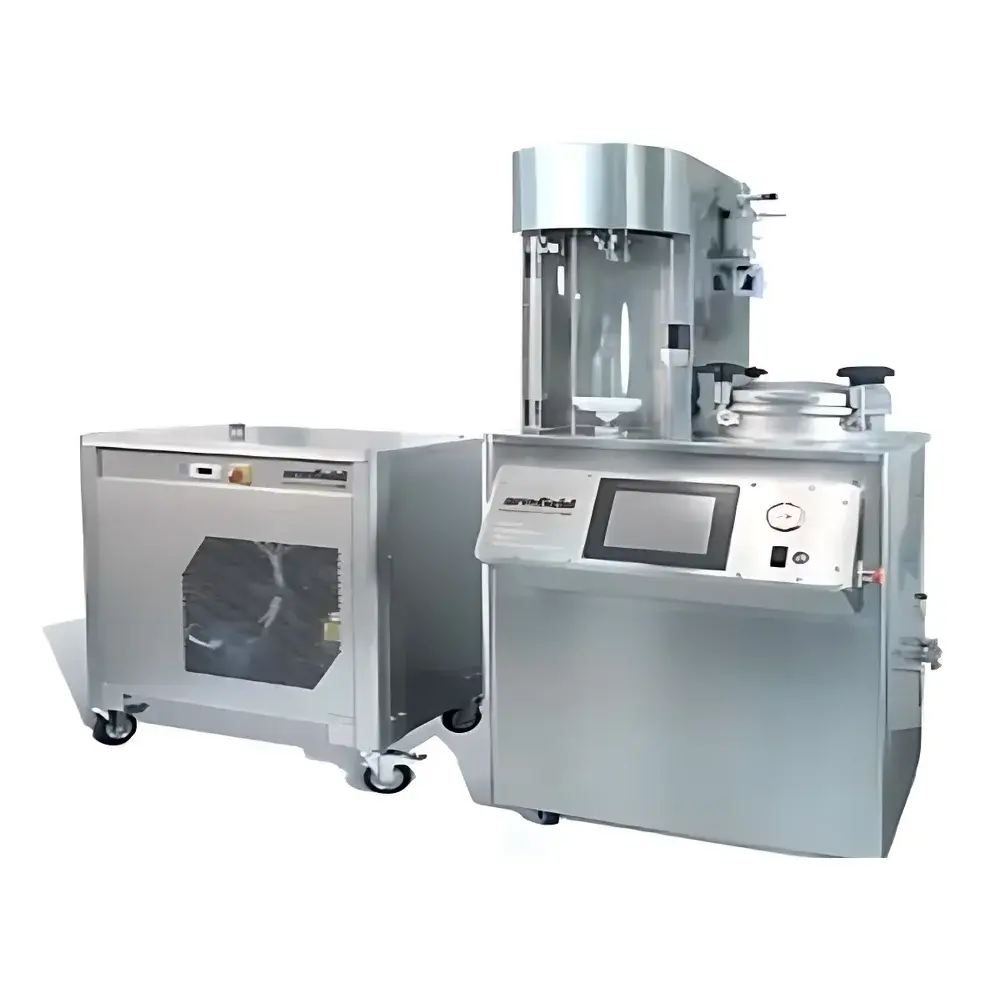
FT102X Carbonation and Filling Bench (Back-Pressure Filling Station)
| Brand | Armfield |
|---|---|
| Origin | United Kingdom |
| Model | FT102X, FT104X |
| Capacity | 60 L/h (for 2 L bottles) |
| Processing Vessel | 30 L |
| Bottle Volume Range | 0.15–2.0+ L |
| CO₂ Solubility | >10 g/L |
| Operating Temperature | 4–20 °C |
| Filling Modes | Pre-mix and Post-mix |
| Gas Options | CO₂ (primary), N₂ (inert blanketing) |
| Control Interface | Full-color touchscreen with embedded help system |
| Preset Programs | 32 |
| Compliance Support | Designed for GLP-aligned lab-scale process development |
| Cleaning | Enhanced CIP routines for heater and nozzle assemblies |
| Dual-mode operation | Batch and continuous |
| Optional Integration | FT104X capping/filling module |
Overview
The Armfield FT102X Carbonation and Filling Bench is a precision-engineered back-pressure filling station designed for controlled carbonation, quantitative liquid dosing, and integrated closure application in academic, R&D, and pilot-scale food & beverage laboratories. It operates on the principle of pressurized saturation—maintaining elevated CO₂ partial pressure above the liquid phase during both dissolution and transfer—to ensure reproducible gas incorporation without foaming or degassing losses. Unlike atmospheric or vacuum-based systems, the FT102X sustains vessel headspace pressure throughout the entire process chain: from CO₂ sparging and thermal equilibration (4–20 °C) to metered dispensing under regulated back pressure. When coupled with the Armfield FT74 UHT/HTST platform, it enables end-to-end simulation of commercial beverage manufacturing—including thermal processing, carbonation, sterile filling, and mechanical sealing—within a compact, benchtop footprint. Its architecture supports both pre-mix (gas dissolved prior to filling) and post-mix (gas injected inline during fill) configurations, accommodating formulations ranging from low-viscosity soft drinks to highly foaming functional beverages.
Key Features
- 30 L stainless steel processing vessel mounted at ergonomic working height for operator accessibility and integration with auxiliary equipment
- Independent control of CO₂ mass flow, headspace pressure, and liquid temperature to achieve CO₂ concentrations exceeding 10 g/L with high inter-batch reproducibility
- Back-pressure filling mechanism that eliminates CO₂ loss during transfer by maintaining constant overpressure across the fill nozzle and bottle neck
- Integrated in-vessel pressure transducer enabling real-time monitoring and automated depressurization sequences for consistent nucleation control
- Dual cooling strategy—primary chilling of bulk liquid followed by secondary jacketed nozzle cooling—prevents localized warming and bubble nucleation at the point of discharge
- Modular design supporting seamless addition of the FT104X capping module for simultaneous crown or screw-cap application during filling
- Full-color HMI touchscreen interface with 32 user-configurable process programs, contextual help menus, and audit-ready parameter logging
- Standard nitrogen blanketing port for inert gas overlay during non-carbonated product runs or oxygen-sensitive formulations
- Enhanced Clean-in-Place (CIP) protocol covering heater elements, sparge ring, and fill nozzles—validated for repeated use with dairy, acidic, and high-sugar matrices
Sample Compatibility & Compliance
The FT102X accommodates containers from 150 mL vials to 2.0+ L PET bottles and aluminum cans, with mechanical adaptability for customer-supplied packaging via custom fixture evaluation services. Its materials of construction—316L stainless steel wetted parts, FDA-compliant elastomers, and IP65-rated electronics—meet EC 1935/2004 and 2023/2006 requirements for food contact surfaces. While not a GMP-certified production line, the system’s programmable logic controller (PLC) architecture, timestamped event logging, and password-protected parameter access align with GLP documentation standards. Data export (CSV/Excel) supports traceability for method validation studies compliant with ISO 22000, Codex Alimentarius, and internal QC protocols. The FT102X is routinely deployed in university food science departments, contract research organizations, and innovation labs conducting shelf-life trials, sensory panel preparation, and regulatory submission batches.
Software & Data Management
Process execution is governed by an embedded real-time operating system with deterministic cycle timing and non-volatile memory retention. All critical parameters—including CO₂ mass flow rate (kg/h), vessel pressure (bar), liquid temperature (°C), fill volume (mL), and cap torque (N·cm when FT104X is installed)—are sampled at 10 Hz and stored with UTC timestamps. The HMI provides live trend plots, alarm history (with cause codes), and configurable export triggers (e.g., per batch, per program, or on error). Raw data files are structured for direct import into statistical analysis platforms (JMP, Minitab) or LIMS environments. Audit trail functionality records user login/logout events, parameter modifications, and program launches—supporting compliance with FDA 21 CFR Part 11 where electronic signatures and role-based access controls are implemented via network authentication.
Applications
- Carbonation optimization studies for novel beverage formulations (e.g., kombucha, cold-brew coffee, plant-based sodas)
- Stability testing of CO₂ retention under varying storage conditions (temperature cycling, light exposure, container permeability)
- Development and validation of post-mix carbonation strategies for high-solids or viscous functional drinks
- Pre-commercial scale-up trials for new packaging formats (aluminum cans, glass bottles, pouches) including leak testing and headspace analysis
- Training platform for food engineering students on mass transfer kinetics, Henry’s law modeling, and aseptic process design
- Regulatory sample preparation for microbiological challenge tests, nutritional labeling verification, and sensory evaluation panels
FAQ
Can the FT102X carbonate viscous or particulate-laden beverages without clogging?
Yes—the system supports post-mix carbonation with adjustable sparge geometry and low-shear fill nozzles. Particulate tolerance depends on particle size distribution; evaluation of customer-specific formulations is recommended prior to extended operation.
Is nitrogen blanketing available as a factory-installed option?
N₂ connection is standard; dedicated nitrogen supply regulation and flow control require optional accessories (Armfield PN: FT102X-N2KIT).
Does the FT102X meet hygiene standards for dairy applications?
It complies with EHEDG Guideline Doc. 8 for cleanable design and supports validated CIP cycles using caustic and acid solutions at temperatures up to 85 °C.
How is calibration traceability maintained for volumetric dispensing?
Each unit ships with a certificate of conformance referencing gravimetric calibration against NIST-traceable standards; annual recalibration services are available through Armfield’s UK service center.
Can the system be operated remotely via Ethernet or USB?
Ethernet connectivity enables remote monitoring and data retrieval via Modbus TCP; full remote control requires additional licensing and firewall configuration per site security policy.





