
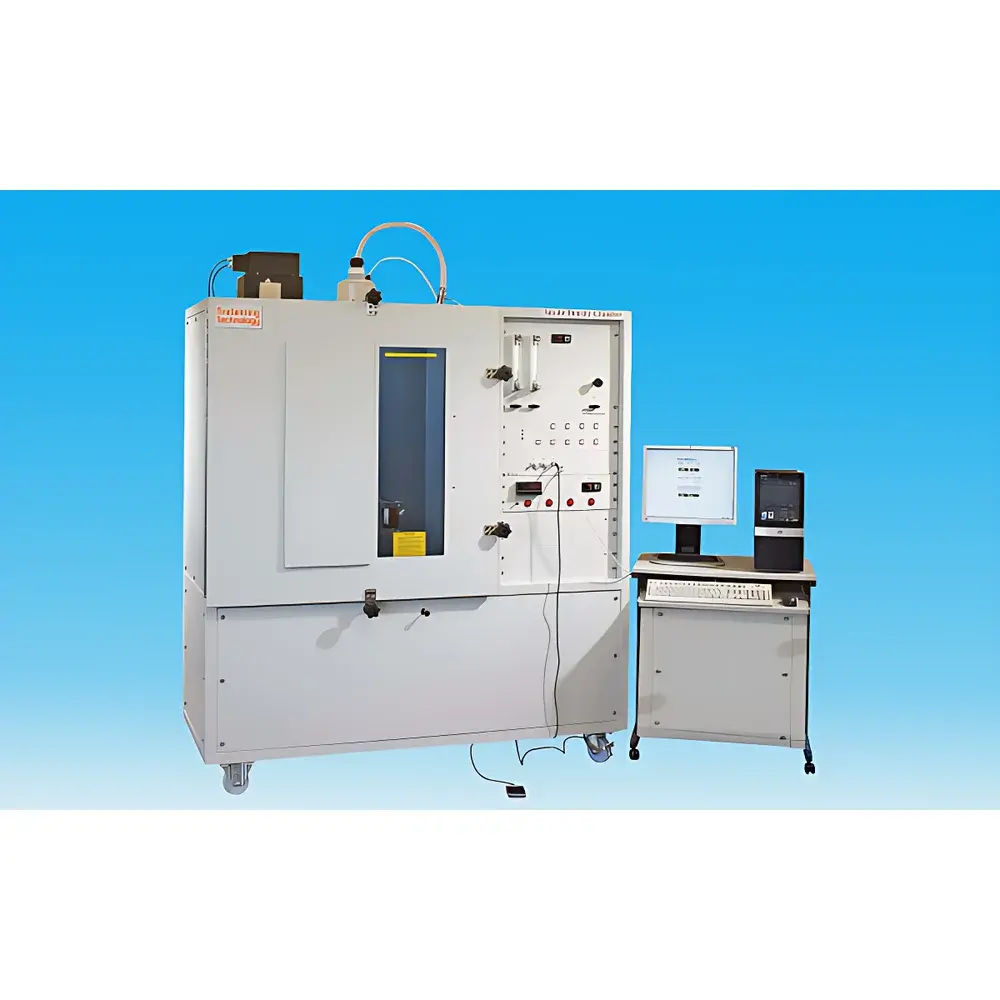
FTT NBS Smoke Density Chamber
| Brand | FTT |
|---|---|
| Origin | United Kingdom |
| Model | NBS |
| Compliance | ASTM E662, ASTM F814, ISO 5659-2, NFPA 258, BS 6401, GB/T 8323, IMO FTPC Part 2, NES 711 |
| Chamber Dimensions | 914 mm × 914 mm × 610 mm (L×H×W) |
| Radiant Heat Flux Range | 10–50 kW/m² (calibrated at 25 kW/m² ±1 kW/m²) |
| Optical System | 6.5 V Tungsten Lamp + S-4 Spectral Response Photomultiplier Tube (dark current <10⁻⁹ A) |
| Light Beam Transmission Accuracy | 0.01% |
| Optical Density Resolution | 0.01 |
| Mass Loss Measurement Accuracy | ±0.1% |
| Timer Resolution | 0.1 s |
| Cone Heater Power | 2600 W |
| Thermocouples | Dual K-type armored (Cu/Alumel) |
| Heat Flux Meter | Thermopile-based, calibrated to ±1 kW/m² at 25 & 50 kW/m² |
| Ignition | Horizontal single-flame burner (30 mm ±5 mm), spark-ignited without chamber opening |
Overview
The FTT NBS Smoke Density Chamber is a precision-engineered instrument designed for quantitative assessment of smoke obscuration generated during the controlled combustion of solid materials under defined radiant heat flux conditions. Based on the foundational methodology developed by the U.S. National Bureau of Standards (now NIST), this system implements the standardized optical attenuation principle: incident light from a calibrated tungsten source passes through a defined optical path within a sealed, refractory-lined test chamber; smoke particles generated from vertically oriented specimens scatter and absorb light, resulting in measurable reduction of transmitted intensity. The photomultiplier tube—configured with S-4 spectral response and sub-nanoampere dark current—converts attenuated luminous flux into an electrical signal proportional to optical density (Ds), enabling high-fidelity temporal tracking of smoke development. The chamber operates per internationally harmonized fire-test protocols including ASTM E662 (Standard Test Method for Specific Optical Density of Smoke Generated by Solid Materials), ISO 5659-2 (Plastics — Smoke Generation — Part 2: Determination of Optical Density by a Single-Chamber Test), and NES 711 (Naval Engineering Standard for Smoke Density of Non-Metallic Materials). Its design prioritizes metrological traceability, thermal stability, and repeatability across laboratory environments subject to GLP or ISO/IEC 17025 accreditation requirements.
Key Features
- Robust stainless-steel radiation cone assembly (2600 W nominal power) delivering stable, uniform radiant flux between 10–50 kW/m², with calibration traceable to national standards at 25 kW/m² ±1 kW/m².
- Optically isolated 914 mm × 914 mm × 610 mm test chamber fabricated from chemically resistant laminated panels, featuring borosilicate observation window with motorized opaque shutter and integrated explosion-relief panel with stainless steel mesh guard.
- High-sensitivity photometric subsystem comprising a 6.5 V tungsten lamp, precision collimating lens (51 mm aperture), and low-noise photomultiplier tube ensuring linear transmittance response and optical density resolution of 0.01.
- Dual K-type armored thermocouples mounted adjacent to specimen surface for real-time temperature monitoring during exposure.
- Integrated mass loss measurement via high-resolution balance (±0.1% accuracy) synchronized with optical data acquisition for concurrent analysis of decomposition kinetics and smoke yield.
- Modular interface ports supporting optional integration with Fourier Transform Infrared (FTIR) spectrometers and Dräger gas detection tubes for concurrent smoke toxicity profiling per aviation (e.g., ABD0031, ATS 1000.001) and maritime regulatory frameworks.
- Comprehensive control and acquisition system logging time-stamped parameters including Ds(t), specific optical density (Ds), mass loss rate (%/min), radiant flux, chamber temperature, and airflow settings at 0.1 s resolution over ≥60 min duration.
Sample Compatibility & Compliance
The FTT NBS Smoke Density Chamber accommodates flat, rigid or semi-rigid specimens up to 25 mm thick, cut to standard dimensions of 100 mm × 100 mm. Specimens are mounted vertically in a fixed holder within the chamber’s central plane, exposed to a calibrated radiant heat flux—typically 25 kW/m²—with or without piloted ignition using a horizontally oriented 30 mm flame. The system fully complies with test condition requirements specified in ASTM E662, ISO 5659-2, NFPA 258, BS 6401, and GB/T 8323. Optional configurations support extended compliance with IMO FTP Code Part 2 (for marine applications), NES 711 (UK Ministry of Defence), and aerospace standards such as ABD0031 (Airbus) and ATS 1000.001 (Boeing). All hardware components—including thermopile heat flux meters, photometric calibration fixtures, and gas sampling interfaces—are validated against relevant ISO/IEC 17025 calibration procedures and documented in accordance with FDA 21 CFR Part 11–compliant audit trails where configured with electronic signature-enabled software.
Software & Data Management
Data acquisition and instrument control are managed via FTT’s proprietary Windows-based software platform, compliant with IEC 62443 cybersecurity principles and supporting 21 CFR Part 11 electronic record and signature functionality when deployed in regulated environments. The software provides real-time visualization of optical density curves, mass loss profiles, and thermal histories; enables automated calculation of peak Ds, time to peak Ds, and average Ds over user-defined intervals (e.g., 4-min average per ASTM E662). Raw datasets are exported in CSV and XML formats compatible with LIMS integration. Calibration logs, operator entries, and system diagnostic reports are stored with immutable timestamps and user authentication metadata. Firmware updates maintain alignment with evolving editions of ASTM, ISO, and CEN standards—reflecting FTT’s direct participation in working groups responsible for fire-test methodology revision.
Applications
This instrument serves critical fire safety evaluation needs across multiple regulated sectors. In polymer science, it quantifies smoke generation potential of flame-retarded plastics used in consumer electronics enclosures and building interiors. Within rail transport, it validates compliance of interior linings, seat foams, and cable jackets per EN 45545-2 R22/R23 classifications. For marine engineering, it supports IMO FTP Code certification of bulkheads, insulation, and deck coverings. Aerospace material qualification leverages its compatibility with FTIR coupling to assess hydrogen cyanide, carbon monoxide, and volatile organic compound (VOC) yields alongside optical density—meeting ABD0031 toxicity thresholds. Cable manufacturers apply it to assess smoke density of jacketing compounds under bundled or single-wire configurations, informing UL 1685 and IEC 60332-3 test correlations. Research laboratories utilize its high signal-to-noise optical path for fundamental studies on soot nucleation kinetics and radiative extinction coefficients of engineered nanocomposites.
FAQ
What standards does the FTT NBS Smoke Density Chamber support out-of-the-box?
ASTM E662, ASTM F814, ISO 5659-2, NFPA 258, BS 6401, and GB/T 8323 are fully supported with pre-configured test templates and reporting formats. Additional standards—including IMO FTPC Part 2, NES 711, ABD0031, and ATS 1000.001—require optional hardware modules and software license activation.
Can the system measure toxic gas concentrations during smoke generation?
Yes—via standardized gas sampling ports compatible with Dräger detector tubes (semi-quantitative) or FTIR spectrometers (quantitative speciation and concentration), enabling simultaneous determination of CO, HCN, HCl, HF, SO₂, and VOCs per aviation and naval toxicity protocols.
Is the optical density measurement traceable to national metrology institutes?
Yes—the photometric subsystem undergoes annual verification using NIST-traceable neutral density filters and calibrated light sources; full calibration certificates include uncertainty budgets per ISO/IEC 17025 requirements.
What specimen geometries and thicknesses are permissible?
Flat specimens measuring 100 mm × 100 mm, with maximum thickness of 25 mm. Thickness variations must be documented, and surface orientation (e.g., grain direction for wood composites) must be reported in test records.
Does the system support remote operation and data export for quality management systems?
Yes—software includes OPC UA server capability for SCADA/LIMS integration, automated PDF report generation with digital signatures, and encrypted cloud backup options compliant with ISO 27001 information security controls.



