
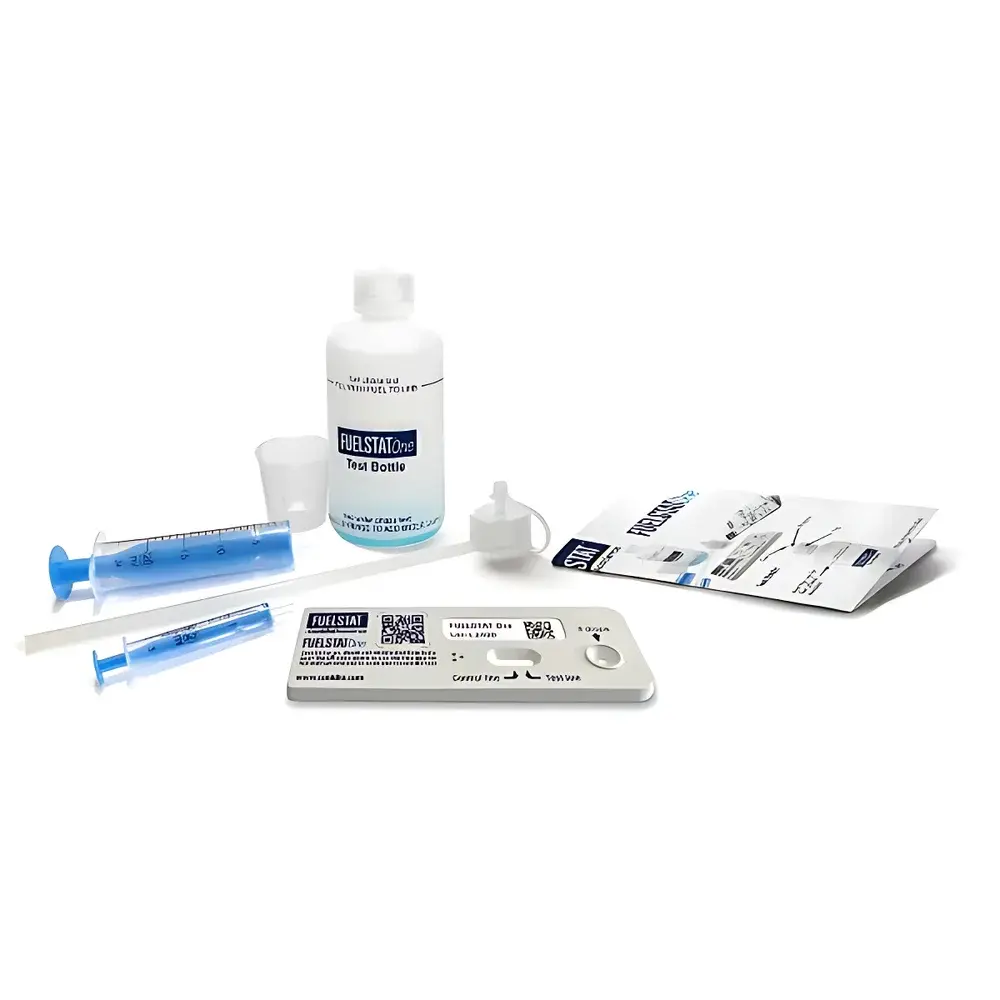
FUELSTAT® One Single-Well Fuel Microbial Rapid Test Kit
| Brand | FUELSTAT |
|---|---|
| Origin | United Kingdom |
| Manufacturer Type | Authorized Distributor |
| Origin Category | Imported |
| Model | FUELSTAT® One |
| Detection Throughput | 1 sample per test |
Overview
FUELSTAT® One is a field-deployable, lateral-flow immunoassay-based rapid test kit engineered for the quantitative detection of microbial contamination—specifically Pseudomonas aeruginosa, Cladosporium resinae, and other fuel-associated hydrocarbon-utilizing microorganisms—in aviation turbine fuel (Jet A/A-1), diesel, biodiesel blends (B5–B20), marine distillates, and kerosene. Unlike culture-dependent methods governed by ASTM D6469, ISO 11737-1, or USP <61>, which require ≥72 hours of incubation under controlled laboratory conditions, FUELSTAT® One employs antibody-conjugated gold nanoparticles to detect microbial enzymes (e.g., ATPase, oxidoreductases) and cell-surface antigens directly in extracted fuel samples. This immunochromatographic principle enables on-site, tank-in situ analysis without sample dilution, enrichment, or sterile handling—delivering objective, quantitative optical density (OD) readings correlated to colony-forming unit (CFU) equivalents per millilitre (CFU/mL) within 20–30 minutes.
Key Features
- True in-tank testing capability: Designed for direct sampling from fuel storage tanks, pipelines, filters, and dispensers—eliminating transport delays, cross-contamination risks, and lab submission costs.
- Quantitative lateral-flow assay: Delivers numerical CFU/mL results—not binary “pass/fail”—via calibrated optical scanning, supporting trend analysis and root-cause investigation.
- No ancillary equipment required: Self-contained single-use kit includes extraction reagent, lateral-flow strip, pipette tips, and desiccant vial—no centrifuge, incubator, or laminar flow hood needed.
- ASTM D6469-compliant workflow: Meets the standard’s requirement for microbial assessment within 24 hours of sample collection, enabling real-time compliance documentation for aviation refuelling operations and marine bunkering audits.
- Ruggedized field performance: Validated across temperature ranges of −20 °C to +50 °C and high-humidity environments; resistant to particulate interference, water-in-fuel emulsions, and common fuel additives.
Sample Compatibility & Compliance
FUELSTAT® One is validated for use with hydrocarbon-based fuels meeting ASTM D1655 (Jet A/A-1), ASTM D975 (diesel), EN 590, and ISO 8217 (RMG/RMA grades). It detects viable and metabolically active microbes—including bacteria, yeasts, and filamentous fungi—without cross-reactivity to non-microbial contaminants (e.g., rust, sediment, glycol). The assay conforms to Good Laboratory Practice (GLP) data integrity principles and supports audit-ready documentation for ISO 9001, AS9120B, and IATA Ground Handling Manual (AHM 521) compliance. While not a replacement for regulatory-grade sterility testing per USP <71>, it serves as a validated screening tool aligned with industry best practices for fuel system integrity management (FSIM) and microbial corrosion mitigation per NACE SP0164.
Software & Data Management
The complimentary FUELSTAT® Results mobile application (iOS/Android) provides secure, offline-capable test execution support. It delivers step-by-step video-guided protocols, automated image capture and OD calibration, real-time result interpretation against configurable alert thresholds (e.g., “Low”, “Elevated”, “Critical”), and generation of tamper-evident PDF certificates containing metadata: date/time stamp, GPS coordinates (optional), operator ID, fuel grade, and batch number. All reports are exportable via email or cloud sync (AES-256 encrypted), with local storage retention supporting FDA 21 CFR Part 11–aligned audit trails when paired with enterprise identity management systems.
Applications
- Airline and airport fuel quality assurance programs (pre-flight fuel sampling)
- Marine bunker fuel acceptance testing at port terminals and onboard vessels
- Defense logistics depots monitoring JP-8 and F-76 stability during long-term storage
- Renewable diesel and hydrotreated esters and fatty acids (HEFA) biocompatibility verification
- Preventive maintenance for fuel filtration systems and API RP 1621–compliant storage tanks
- Root-cause analysis of microbiologically influenced corrosion (MIC) in underground storage tanks (USTs)
FAQ
How does FUELSTAT® One differ from ATP bioluminescence assays?
It targets microbial-specific antigens and enzymatic activity—not total ATP—yielding higher specificity for fuel-degrading organisms and reduced false positives from abiotic ATP sources.
Is calibration or user training required before first use?
No instrument calibration is needed. Minimal operator training (<15 minutes) suffices; the app-guided workflow ensures procedural consistency across untrained personnel.
Can results be integrated into existing LIMS or CMMS platforms?
Yes—PDF reports include machine-readable QR codes and structured metadata fields compatible with common LIMS import templates and CMMS work order triggers.
What is the shelf life and storage condition for unopened kits?
24 months from manufacture when stored at 2–30 °C in original foil pouch; no refrigeration required.
Does FUELSTAT® One comply with military fuel specifications such as DEF STAN 91-87?
While not formally certified to DEF STAN 91-87, its detection sensitivity (≥10² CFU/mL) and field validation align with the standard’s microbial control thresholds for operational readiness assessments.



