
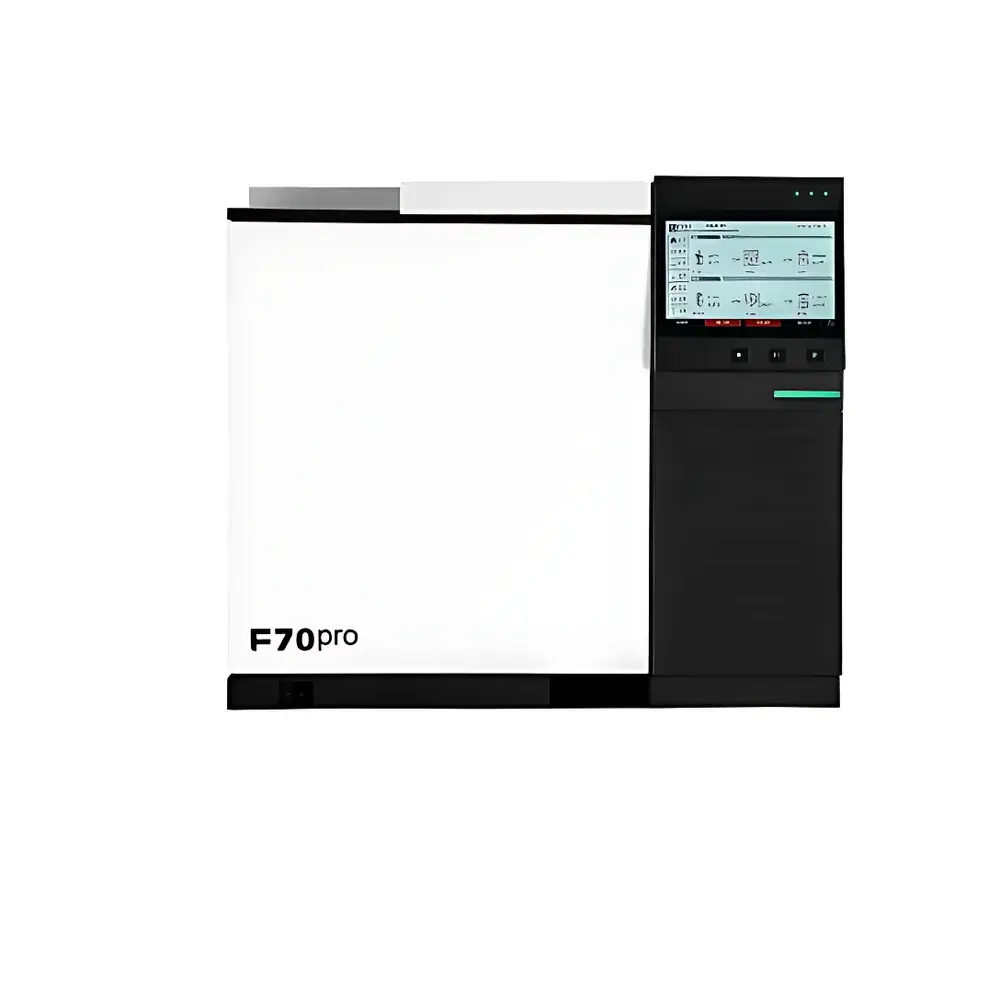
Fulit F70pro Laboratory Gas Chromatograph
| Brand | Fulit |
|---|---|
| Origin | Zhejiang, China |
| Model | F70pro |
| Instrument Type | Laboratory Gas Chromatograph |
| Application Scope | General-purpose |
| Oven Temperature Range | 6 °C to 400 °C |
| Maximum Ramp Rate | 120 °C/min |
| Cooling Rate | <3.0 min from 200 °C to 100 °C |
| Carrier Gas Flow Range & Control | 0–450 mL/min with Electronic Pressure Control (EPC) for carrier gas and Automatic Flow Control (AFC) for auxiliary gases |
| Carrier Gas Pressure Range & Control | 0–100 psi with EPC |
| pressure control resolution | 0.001 psi |
| Injector Maximum Operating Temperature | 400 °C |
| Injector Pressure Setting Range | 0–100 psi |
| Injector Total Flow Setting Range | 0–450 mL/min |
Overview
The Fulit F70pro is a high-performance, general-purpose laboratory gas chromatograph engineered for precision, stability, and operational efficiency in routine and moderately complex analytical workflows. Built upon the proven architecture of the F70 platform, the F70pro integrates advanced electronic pneumatic control systems to deliver robust retention time reproducibility, accurate peak integration, and consistent method transfer across instruments. Its core separation mechanism relies on partitioning of volatile and semi-volatile analytes between a mobile phase (inert carrier gas) and a stationary phase coated inside a fused-silica capillary column. Temperature-programmed elution—enabled by its wide oven range (6 °C to 400 °C), rapid heating (up to 120 °C/min), and accelerated cooling (<3.0 min from 200 °C to 100 °C)—supports efficient resolution of compounds with broad boiling point distributions, including hydrocarbons, pesticides, residual solvents, and environmental pollutants.
Key Features
- Full-pneumatic AFC (Automatic Flow Control) architecture across all gas lines—carrier, make-up, and auxiliary—ensuring stable flow delivery independent of backpressure fluctuations and column aging effects.
- Dual-mode electronic pressure control (EPC) with 0.001 psi resolution for precise, repeatable pressure regulation at both inlet and detector ends—critical for method scalability and inter-laboratory comparability.
- High-temperature injector (up to 400 °C) compatible with split, splitless, and cold-on-column injection modes, supporting thermally labile and high-boiling compounds without degradation.
- Modular detector interface accommodating common GC detectors—including FID, TCD, ECD, and NPD—with wide dynamic range and low baseline noise to enhance signal-to-noise ratio across concentration levels.
- Intuitive method editor enabling rapid switching between multi-method sequences without hardware reconfiguration—reducing turnaround time for batch analysis in QC/QA environments.
- Robust thermal management system featuring insulated oven walls, optimized air circulation, and real-time temperature gradient compensation to minimize thermal lag and improve retention time stability (RSD <0.05% over 24 h).
Sample Compatibility & Compliance
The F70pro is validated for use with standard capillary columns (0.1–0.53 mm ID, up to 60 m length) and accommodates a broad spectrum of sample matrices—liquid injections (via syringe or autosampler), headspace vials, and purge-and-trap extracts. It meets essential regulatory expectations for GLP-compliant laboratories: audit-trail-capable software (when paired with Fulit GC Data System v3.x), user-access-level permissions, electronic signature support, and full traceability of method parameters, instrument logs, and calibration records. While not pre-certified to FDA 21 CFR Part 11 out-of-the-box, the system supports configuration for Part 11 compliance through optional software modules and documented validation protocols aligned with ISO/IEC 17025 and ASTM D3699 (hydrocarbon analysis), D5504 (sulfur compounds), and USP (chromatography).
Software & Data Management
The Fulit GC Data System (GCDS) provides integrated instrument control, real-time chromatogram visualization, peak detection, quantitative reporting, and customizable report templates. Data files are stored in vendor-neutral formats (e.g., .cdf-compatible structure) to facilitate third-party data review and long-term archival. The software includes built-in tools for system suitability testing (SST), calibration curve generation (linear/non-linear), and automatic integration parameter optimization based on peak width and signal intensity. All method changes, sequence modifications, and maintenance events are timestamped and logged with operator ID—supporting full data integrity per ALCOA+ principles (Attributable, Legible, Contemporaneous, Original, Accurate, Complete, Consistent, Enduring, Available).
Applications
- Environmental testing: VOCs in water (EPA Method 524.2), BTEX in soil gas, chlorinated hydrocarbons in groundwater.
- Pharmaceutical QC: Residual solvents (ICH Q3C), assay purity, extractables/leachables profiling.
- Petrochemical analysis: Simulated distillation (ASTM D2887), hydrocarbon type analysis (ASTM D5186), sulfur speciation.
- Food & flavor: Pesticide multiresidue screening (AOAC 2007.01), fatty acid methyl esters (FAMEs), aroma compound profiling.
- Materials science: Monomer purity assessment, polymer additive migration studies, catalyst effluent characterization.
FAQ
Is the F70pro compliant with FDA 21 CFR Part 11?
The base instrument and GCDS software provide foundational controls (audit trail, user roles, electronic signatures); full Part 11 compliance requires implementation of site-specific validation documentation and optional secure login modules.
What column dimensions and phases are supported?
Standard fused-silica capillary columns up to 60 m × 0.53 mm ID with film thicknesses from 0.1 to 5.0 µm; compatibility confirmed for polysiloxane-, polyethylene glycol-, and cyanopropylphenyl-based stationary phases.
Can the F70pro be integrated into a LIMS environment?
Yes—via ASCII or XML export protocols and ODBC-compliant database connectors; API access available under extended support agreement.
Does the system support unattended operation overnight?
Fully supported via programmable run sequences, auto-shutdown logic, and ambient temperature monitoring; recommended for methods with stable retention and minimal carryover.
What maintenance intervals are recommended for EPC/AFC modules?
EPC transducers and AFC valves require biannual verification using certified pressure/flow standards; full recalibration advised annually or after major hardware service.
Related Products




