
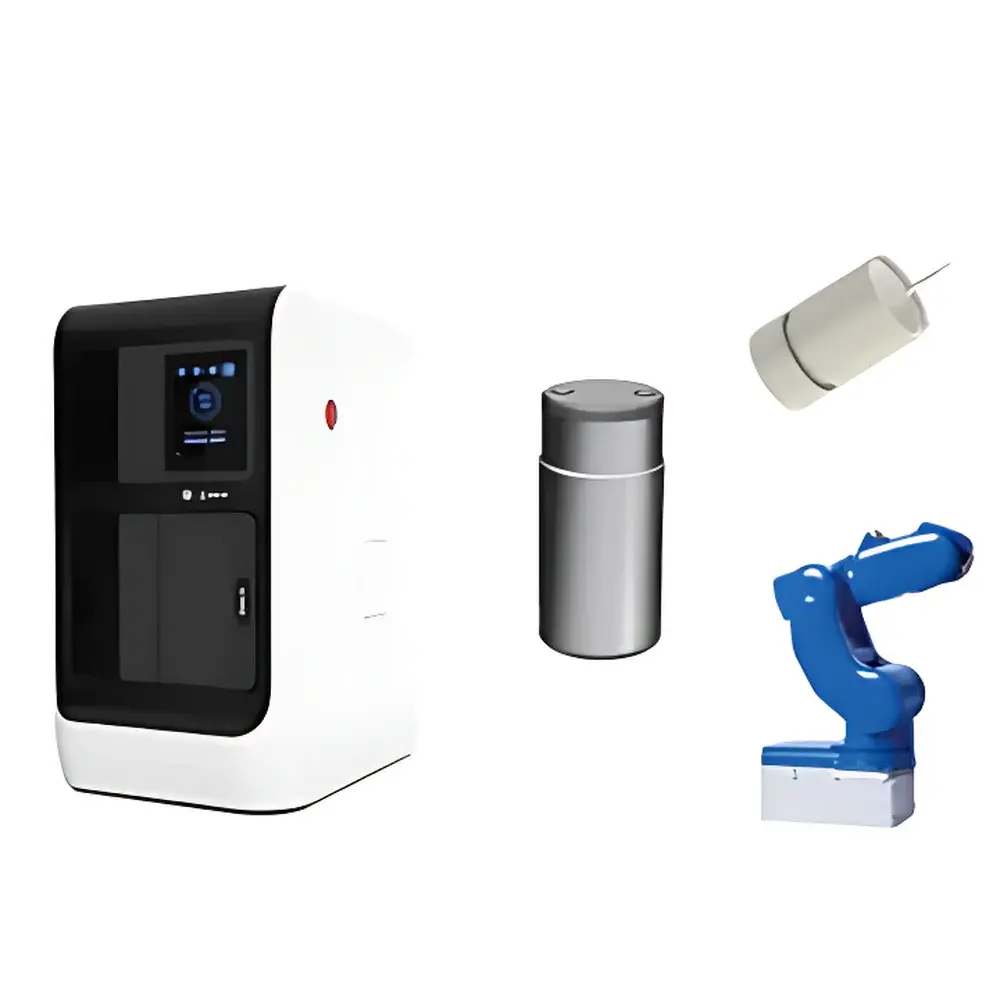
Fully Automated Radiopharmaceutical Dispensing Robot
| Brand | — |
|---|---|
| Origin | Beijing, China |
| Manufacturer Type | Authorized Distributor |
| Origin Category | Domestic |
| Model | Fully Automated Radiopharmaceutical Dispensing Robot |
| Pricing | Available Upon Request |
Overview
The Fully Automated Radiopharmaceutical Dispensing Robot is an engineered solution for the safe, precise, and reproducible preparation and dispensing of technetium-99m (⁹⁹ᵐTc)-labeled radiopharmaceuticals in clinical nuclear medicine laboratories. Designed around the principles of ALARA (As Low As Reasonably Achievable) radiation safety, the system integrates lead-shielded containment, pneumatic actuation, and closed-vial processing to eliminate manual handling of radioactive materials during labeling, quality control verification, and unit-dose dispensing. It operates on a validated workflow architecture compliant with IEC 61000-6-3 (EMC), IEC 62304 (medical device software lifecycle), and ISO 13485:2016 (quality management systems for medical devices). The robot supports standard kit-based labeling protocols—including ⁹⁹ᵐTc-MDP, ⁹⁹ᵐTc-HMPAO, ⁹⁹ᵐTc-DTPA, and ⁹⁹ᵐTc-tetrofosmin—while maintaining strict adherence to pharmacopeial requirements for radiochemical purity (RCP) and pH stability.
Key Features
- Integrated self-shielding enclosure with ≥50 mm Pb-equivalent shielding walls and lead-glass viewing window, certified per NCRP Report No. 147 for diagnostic radionuclide handling.
- Remote operation via Ethernet-connected HMI or secure web interface; supports role-based user authentication and audit trail logging in accordance with FDA 21 CFR Part 11 requirements.
- Automated labeling sequence: vial reconstitution, incubation with controlled heating (37–85 °C) and orbital shaking (0–1200 rpm), post-labeling QC measurement, and sterile dose dispensing into syringes or vials.
- Onboard semiconductor gamma detector (CdZnTe-based) for real-time activity quantification (range: 1–1500 MBq at 140 keV), with energy calibration traceable to NIST standards and automatic decay correction.
- Modular nuclear generator interface: optional integrated ⁹⁹Mo/⁹⁹ᵐTc generator mount with automated elution, column conditioning, and saline flush—eliminating manual generator manipulation.
- Tubing-free fluid path architecture utilizing disposable, pre-sterilized single-use cassettes; eliminates cross-contamination risk and residual activity carryover between preparations.
Sample Compatibility & Compliance
The system accommodates standard lyophilized radiopharmaceutical kits (1–10 mL reconstitution volume), glass or polymer reaction vials (10–30 mL), and ISO 8536-4-compliant syringes (1–10 mL). All wetted components are USP Class VI-certified and compatible with 0.9% NaCl, sodium pertechnetate solution, and common reducing agents (e.g., stannous chloride). The platform meets essential requirements of EURATOM Directive 2013/59/Euratom for occupational exposure control and aligns with national regulatory expectations for radiopharmaceutical manufacturing under China’s NMPA Guideline on GMP for Radiopharmaceuticals (2022). Full documentation package includes IQ/OQ/PQ protocols, radiation survey reports, and software validation summary.
Software & Data Management
The embedded control software (v3.x) provides step-by-step guided workflows, configurable SOP templates, and electronic batch records (EBR) with timestamped operator actions, sensor readings, and QC results. All data—including activity measurements, temperature profiles, shake duration, and elution parameters—are stored locally in encrypted SQLite databases and exportable in CSV or PDF formats. Audit trails record user login/logout events, parameter changes, and alarm acknowledgments with immutable timestamps. Optional integration with LIS/HIS via HL7 v2.5 or ASTM E1384 interfaces enables seamless patient-data linkage and dose administration tracking.
Applications
- Clinical nuclear medicine departments preparing ⁹⁹ᵐTc-labeled agents for SPECT imaging without reliance on centralized radiopharmacy services.
- Academic research facilities conducting tracer development studies requiring repeatable, low-variability radiolabeling under GLP conditions.
- Regional hospitals implementing decentralized radiopharmaceutical production to reduce logistics delays and improve dose availability for time-sensitive procedures (e.g., myocardial perfusion imaging).
- Training centers using the system for radiation safety education and automated workflow certification programs accredited by national nuclear regulatory bodies.
FAQ
Does the system support non-⁹⁹ᵐTc isotopes such as ¹²³I or ⁶⁷Ga?
No—this configuration is optimized exclusively for ⁹⁹ᵐTc chemistry due to its specific energy signature, half-life constraints, and kit compatibility. Alternate isotopes require hardware and software revalidation.
Can the robot be integrated into an existing hot lab ventilation system?
Yes—the enclosure includes dedicated HEPA-filtered exhaust ports compatible with standard negative-pressure ducting (DN100, 150 Pa static pressure requirement). Installation must comply with local radiation safety authority specifications.
Is remote software update capability available?
Firmware and application updates are delivered via secure USB media or authenticated HTTPS download; over-the-air updates are disabled by default to maintain regulatory compliance and system integrity.
What is the maximum number of doses prepared per batch?
Up to 12 unit doses (1–10 mL each) can be dispensed sequentially in a single unattended run, subject to initial activity input and decay-corrected yield targets.
How is calibration of the semiconductor detector performed?
Daily energy and efficiency calibration uses traceable ⁹⁹ᵐTc point sources; full linearity verification is conducted quarterly using multi-energy reference standards per ISO/IEC 17025-accredited procedures.




