
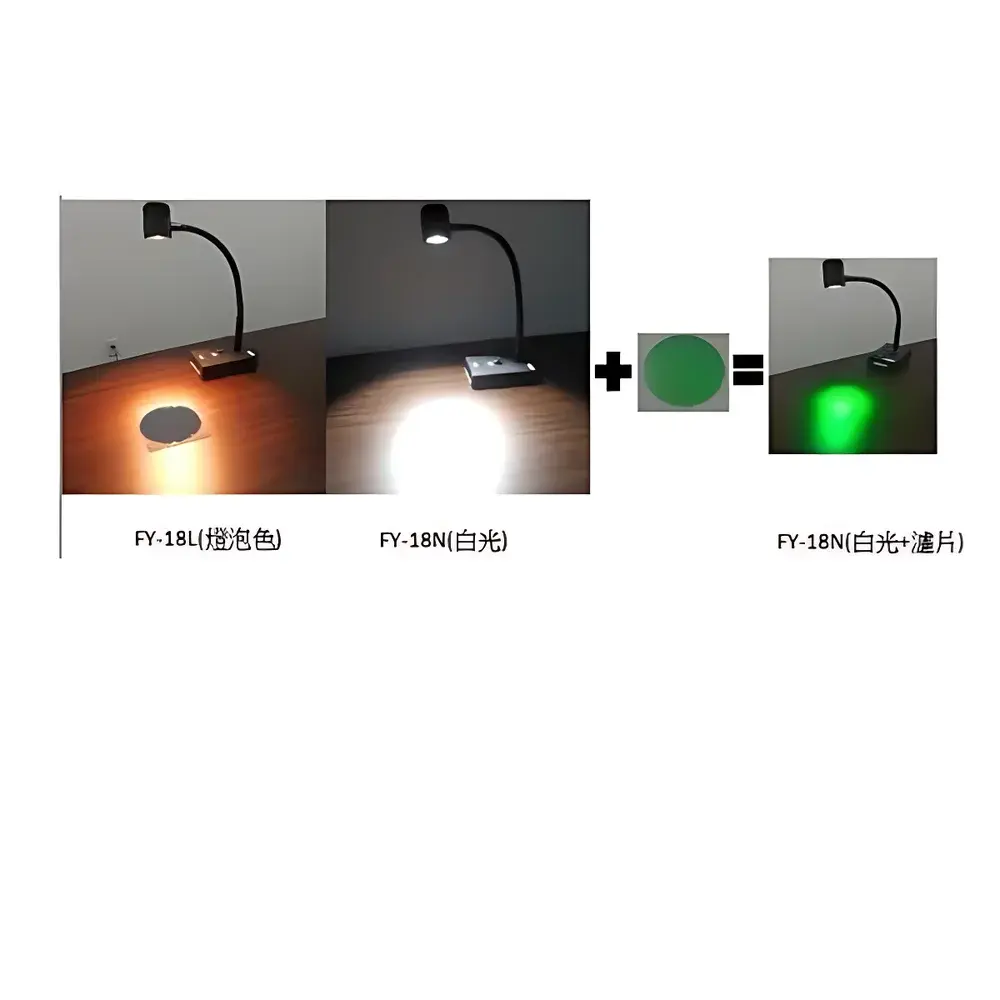
FUNATECH FY-18L LED Surface Inspection Lamp with Optional Green Bandpass Filter
| Brand | TAMASAKI |
|---|---|
| Origin | Japan |
| Model | FY-18L |
| Light Source | 18 W High-Power White LED |
| Illuminance | ~34,000 lux at 45 cm (with clear filter) |
| Adjustable Brightness | Continuous DC dimming (0–100%) |
| Optical Output | Dual-filter system (clear and diffuser), optional Daiglo green bandpass filter (transmission peak ~525 nm, cutoff <500 nm & >600 nm) |
| Cooling | Fanless active heat sink |
| Power Input | AC 100–240 V, 47–63 Hz |
| Output | DC 24 V / 1.67 A |
| Power Consumption | 2.8–22.6 W |
| LED Lifetime | ≈50,000 h (L70) |
| Dimensions (Base) | W180 × D120 × H50 mm |
| (Light Head) | Ø68 × D86 mm |
| (Max Extended Height) | 638 mm |
| Weight | 3.4 kg (lamp only, excluding adapter) |
| Photodetector Type | Silicon photodiode (integrated illuminance reference path) |
| Compliance | CE-marked per EN 61326-1 (EMC), EN 62471 (Photobiological Safety), RoHS 2015/863/EU |
Overview
The FUNATECH FY-18L is a precision-engineered LED surface inspection lamp designed for human-eye-based visual quality control in regulated manufacturing and laboratory environments. Unlike generic task lighting, it operates on photometric principles aligned with CIE standard observer functions and delivers stable, spectrally controlled illumination optimized for contrast-sensitive defect detection—such as micro-scratches, coating inconsistencies, particle contamination, or solder joint anomalies—on reflective, semi-gloss, or textured surfaces. Its core architecture integrates a high-luminance 18 W white LED array with thermally stabilized current regulation, ensuring minimal chromatic drift (<0.002 Δuv over 4 hours) and intensity variation (<±1.5% RMS over 8 h at constant dimming level). The lamp employs a calibrated silicon photodiode reference channel to support traceable illuminance verification, making it suitable for internal SOP-defined visual inspection protocols where repeatability and documentation are required under ISO 9001, IATF 16949, or IPC-A-610 frameworks.
Key Features
- Continuous DC dimming (0–100%) with linear luminance response—enabling precise adaptation to ambient light conditions and operator fatigue mitigation during extended shifts.
- Fully articulating gooseneck arm with dual-axis pivot joints and counterbalanced head—allowing repeatable positioning within ±0.5° angular tolerance and stable hold across 10,000+ adjustment cycles.
- Interchangeable optical filters: Clear filter (transmittance >92% @ 400–700 nm) for maximum brightness and edge definition; Diffuser filter (Lambertian output, ±15° beam spread) for uniform low-glare illumination of curved or irregular surfaces.
- Fanless active cooling via extruded aluminum heat sink with thermal interface material—maintaining junction temperature below 65°C at full output, thereby preserving LED spectral stability and lifetime reliability.
- Integrated photodiode monitoring circuit with analog voltage output (0–5 V = 0–100,000 lux)—compatible with external data loggers or PLC-based process validation systems for audit-ready illuminance logging.
- Universal AC input (100–240 V, 47–63 Hz) with medical-grade isolation transformer—ensuring compliance with IEC 60601-1 creepage/clearance requirements for use in cleanroom-adjacent or Class II electrical environments.
Sample Compatibility & Compliance
The FY-18L is validated for use with optically sensitive substrates including silicon wafers, anodized aluminum housings, printed circuit boards (PCBs), polymer films, and pharmaceutical blister packaging. Its optional Daiglo green bandpass filter (sold separately) provides narrowband emission centered at 525 nm (FWHM ≈ 45 nm), conforming to ASTM E308-22 spectral weighting conventions for green-light-enhanced contrast inspection of red-dyed residues or fluorescent markers. The lamp meets EN 62471 (Risk Group 1 — Exempt), EN 61000-6-3 (Emission), and EN 61000-6-2 (Immunity) standards. It supports GLP/GMP-aligned workflows through optional integration with electronic batch records (EBR) via analog output logging and satisfies FDA 21 CFR Part 11 requirements when paired with validated acquisition software.
Software & Data Management
While the FY-18L operates as a standalone hardware device, its analog photodiode output enables seamless integration into existing QC data infrastructure. When connected to a calibrated DAQ system (e.g., National Instruments USB-6009 or Keysight 34972A), real-time illuminance values can be timestamped, trended, and exported in CSV or TDMS format. Optional firmware update kits (available from TAMASAKI technical support) enable future compatibility with Modbus RTU or Ethernet/IP protocols for factory-wide lighting parameter synchronization. All calibration certificates—including photometric verification at 45 cm using NIST-traceable lux meter—are provided with each unit and archived for 10 years per ISO/IEC 17025 clause 7.8.3.
Applications
- Final visual inspection of automotive interior trim components under standardized lighting (per VDA 19.2 Annex B).
- Post-cleaning verification of medical device surfaces prior to sterilization (ISO 15883-5).
- Manual solder joint evaluation per IPC-A-610 Class 2/3 criteria using green-filter-enhanced contrast.
- In-process inspection of thin-film solar cell substrates for pinhole or delamination defects.
- Pharmaceutical packaging line checks for seal integrity, ink adhesion, or foreign particulate presence under controlled illuminance (USP <1118>).
- Academic materials science labs performing qualitative surface morphology assessment without microscopy.
FAQ
Is the FY-18L compatible with ISO/IEC 17025-accredited calibration laboratories?
Yes—the lamp includes a factory-issued calibration certificate referencing NIST-traceable lux measurements at 45 cm, with uncertainty budget documented per ILAC-G8:2022.
Can the green bandpass filter be used simultaneously with the diffuser?
No—only one filter may be mounted at a time due to mechanical interference; however, both filters share identical M36×0.75 threading for rapid exchange.
Does the FY-18L meet FDA requirements for use in pharmaceutical manufacturing?
It complies with photobiological safety (EN 62471) and EMC standards applicable to equipment in Grade C/D cleanrooms; formal qualification must be performed per site-specific risk assessment per Annex 1.
What is the recalibration interval recommendation?
TAMASAKI recommends photometric verification every 12 months or after 2,000 operating hours—whichever occurs first—to maintain traceability to initial certification.
Is the LED module replaceable in the field?
No—the LED assembly is potted and thermally bonded; replacement requires return-to-factory service to preserve thermal and optical alignment integrity.




