
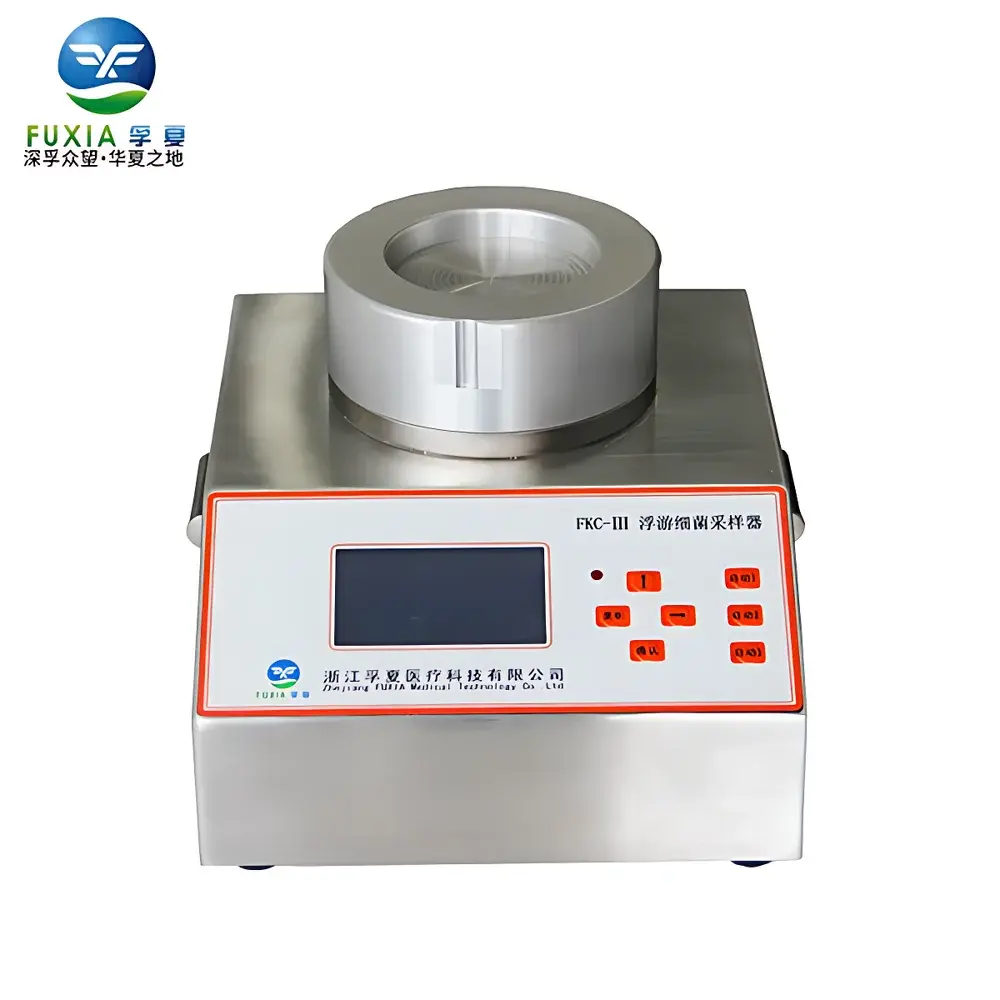
FUXIA FKC-III Desktop Active Air Microbial Sampler
| Brand | FUXIA |
|---|---|
| Origin | Zhejiang, China |
| Model | FKC-III |
| Sampling Principle | Isokinetic Impaction (Active Airborne Microorganism Collection) |
| Flow Rate | 100 L/min |
| Flow Accuracy | ±3% |
| Sampling Volume Range | 0.001–9.999 m³ (programmable) |
| Sampling Time Range | 1–6000 seconds (or volume-based termination) |
| Operating Temperature | 25–35 °C |
| Operating Relative Humidity | 30–85% RH |
| Power Supply | DC 12 V (center-positive), AC 220 V adapter included |
| Dimensions (Main Unit) | 200 × 240 × 150 mm (W×D×H) |
| Sampling Head Diameter | Φ120 mm, Height: 60 mm |
| Weight | 4.0 kg |
| Nozzle | 397-mesh stainless steel sieve (0.7 mm aperture), enabling uniform impaction and minimizing colony overlap |
| Compatibility | Standard Petri Dishes (Φ90 × 15 mm) |
| Data Interface | USB 2.0 port for configuration and data export |
| Remote Control | 10 m wireless RF remote (real-time start/stop/pause/resume) |
| Onboard Memory | Parameter logging per sampling session (volume, time, date, flow status) |
| Microcontroller | Proprietary FUXIA sampling control IC for flow stability and thermal drift compensation |
Overview
The FUXIA FKC-III Desktop Active Air Microbial Sampler is an ISO 14698-1–compliant, isokinetic impactor designed for quantitative monitoring of viable airborne microorganisms in controlled environments. Unlike passive sedimentation methods (e.g., settle plates), the FKC-III actively draws air through a precision-engineered 397-mesh stainless steel nozzle at a calibrated flow rate of 100 L/min. This ensures representative sampling by matching the nozzle inlet velocity (~0.38 m/s) to typical unidirectional airflow velocities in ISO Class 5–8 cleanrooms—thereby satisfying the fundamental requirement of isokinetic sampling as defined in EU GMP Annex 1 and ISO 14644-1. The device operates on the principle of inertial impaction: viable particles ≥0.6 µm are accelerated onto the surface of standard Φ90 × 15 mm agar-filled Petri dishes with minimal bounce or re-aerosolization, preserving colony-forming unit (CFU) integrity for subsequent incubation and enumeration.
Key Features
- 397-mesh stainless steel sampling head (0.7 mm aperture) optimized to minimize particle bounce and colony overlap, enhancing counting accuracy and reproducibility per USP & EP microbiological guidelines.
- Programmable sampling volume from 0.001 to 9.999 m³ (equivalent to 1–6000 L at 100 L/min), supporting both time-based and volume-based collection protocols required under FDA Aseptic Processing Guidance and EU Annex 1.
- Integrated real-time flow stabilization via proprietary FUXIA sampling control IC, compensating for filter loading and ambient temperature drift to maintain ±3% flow accuracy across operational conditions.
- Backlit LCD interface displaying instantaneous flow rate, elapsed time, cumulative volume, remaining battery life (when using optional DC power), and error codes (e.g., low flow, nozzle blockage).
- Non-volatile onboard memory stores up to 100 independent sampling sessions—including date/time stamp, set volume, actual volume delivered, and flow deviation—supporting audit-ready documentation per 21 CFR Part 11 (when used with validated software).
- USB 2.0 interface enables firmware updates, parameter configuration, and raw sampling log export (CSV format) for integration into LIMS or electronic batch record systems.
- 10-meter RF wireless remote control allows hands-free operation during critical zone sampling—eliminating operator-induced turbulence and contamination risk near laminar flow hoods or isolators.
- Tool-free Petri dish exchange: lifting the sampling head unlocks direct access to the agar surface; no alignment fixtures or torque tools required—reducing setup time and cross-contamination potential.
Sample Compatibility & Compliance
The FKC-III is validated for use with standard tryptic soy agar (TSA), sabouraud dextrose agar (SDA), and other pharmacopeial culture media in Φ90 × 15 mm Petri dishes. Its isokinetic design meets the performance criteria outlined in ISO 14698-1:2003 (Biocontamination control — General principles and methods) and aligns with the sampling methodology referenced in EU GMP Annex 1 (2022 revision), USP , and PDA Technical Report No. 13 (Fundamentals of Environmental Monitoring). The device’s mechanical construction conforms to IP20 ingress protection and operates within the environmental limits specified for Grade A/B cleanroom monitoring: 25–35 °C ambient temperature and 30–85% RH. All electrical components comply with IEC 61010-1 safety standards for laboratory equipment.
Software & Data Management
FUXIA provides a Windows-compatible desktop application (v2.1+) for full instrument configuration, historical log review, and CSV report generation. The software supports user-defined sampling templates, electronic signature capture (role-based login), and automatic timestamping synchronized with system clock. Audit trail functionality records all parameter changes, session starts/stops, and firmware updates—enabling compliance with ALCOA+ data integrity principles and facilitating GLP/GMP inspections. When deployed in regulated environments, the FKC-III + software package may be qualified per IQ/OQ protocols; validation documentation templates (URS, DQ, FAT/SAT reports) are available upon request from FUXIA’s technical support team.
Applications
- Routine environmental monitoring (EM) in pharmaceutical aseptic processing suites (Grade A/B zones), isolators, and RABS.
- Microbial load assessment in biotechnology cleanrooms during process simulation (media fill) and facility qualification (IQ/OQ/PQ).
- Validation and routine surveillance of HVAC filtration efficiency in hospital operating theaters and sterile compounding pharmacies (USP /).
- Quality control of compressed gases (air, nitrogen) used in manufacturing, per ISO 8573-7 requirements for viable particle testing.
- Research applications requiring reproducible bioaerosol collection for strain isolation, antimicrobial efficacy testing, or HVAC system characterization.
FAQ
What is the difference between passive sedimentation and active impaction sampling?
Passive methods rely on gravitational settling over extended periods (e.g., 4 hours), yielding qualitative data only and suffering from poor recovery efficiency (<10% for particles 95% collection efficiency for 1–5 µm bioaerosols per ISO 14698-2 test protocols.
Can the FKC-III be used in ISO Class 5 environments?
Yes—the 0.38 m/s nozzle velocity matches laminar airflow specifications for Grade A (ISO 5) zones, and its compact footprint (200 × 240 mm) permits placement inside gloveboxes and restricted access areas without disrupting unidirectional flow patterns.
Is calibration traceable to national standards?
Flow calibration is performed using a NIST-traceable primary standard rotameter or thermal mass flow meter; calibration certificates (with uncertainty budget) are provided with each unit and annually recommended per ISO/IEC 17025 practices.
Does the device support continuous monitoring mode?
No—it is designed for discrete, programmable sampling events. For continuous viable particle monitoring, FUXIA offers complementary real-time systems (e.g., FKC-Online series) based on laser-induced fluorescence (LIF) technology.







