
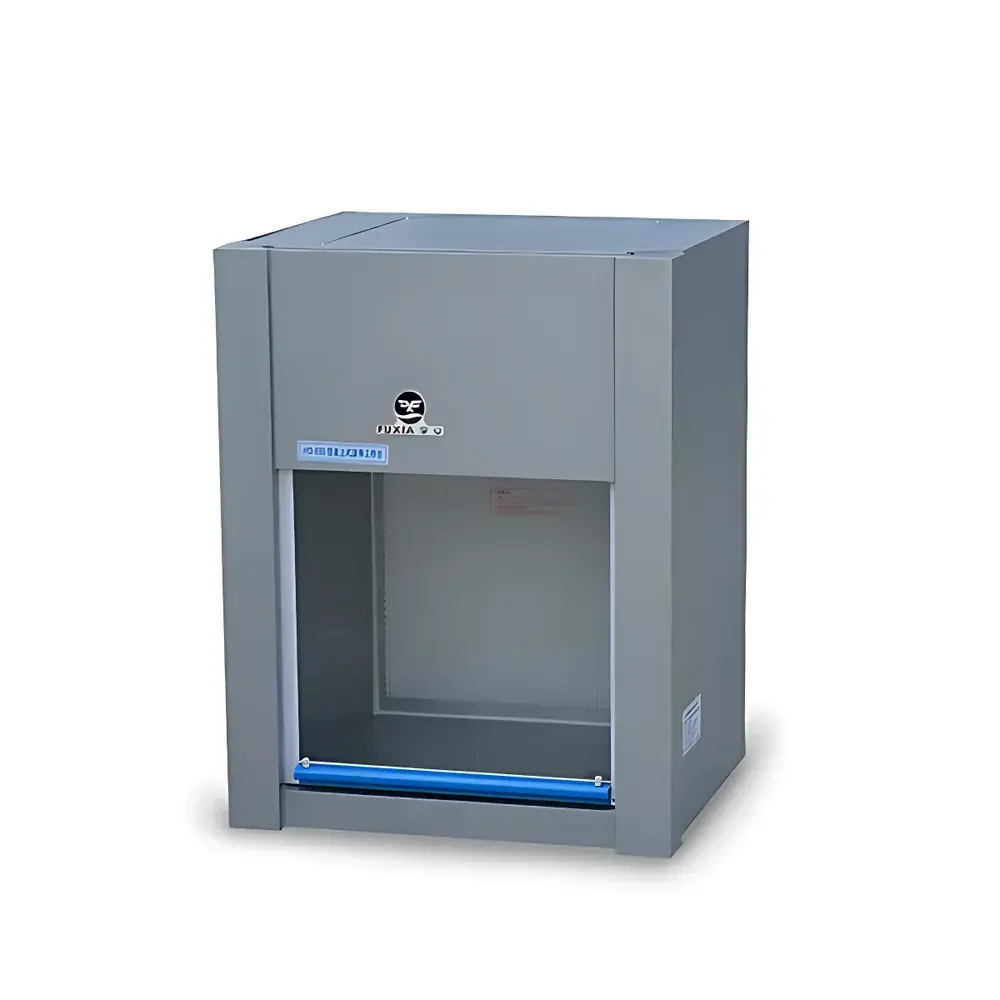
FUXIA HD-650 Horizontal Laminar Flow Clean Bench
| Brand | FUXIA |
|---|---|
| Origin | Zhejiang, China |
| Model | HD-650 |
| Instrument Type | Horizontal Laminar Flow Clean Bench |
| Cleanliness Class | ISO Class 5 (100 @ ≥0.5 µm, per US Federal Standard 209E) |
| Noise Level | ≤62 dB(A) |
| User Capacity | Single-user, front-access |
| Airflow Pattern | Horizontal laminar flow |
| Average Air Velocity | 0.25–0.45 m/s |
| Vibration (Half-Peak) | ≤0.5 µm (X/Y/Z axes) |
| Illuminance | ≥300 lx |
| Power Supply | AC 220 V, 50 Hz |
| Power Consumption | 180 W |
| Net Weight | 50 kg |
| Working Area Dimensions | 485 × 385 × 455 mm (W×D×H) |
| Overall Dimensions | 640 × 530 × 845 mm (W×D×H) |
| HEPA Filter Specification | 480 × 480 × 38 mm (1 unit) |
| Lighting | 10 W fluorescent lamp (1), 10 W UV germicidal lamp (1) |
| Pre-filter | Integrated coarse particulate pre-filter |
| Safety Interlock | UV lamp and fluorescent lamp interlocked |
| Control Interface | Remote control enabled |
| Structural Material | Steel-wood frame with fully coated color steel panels |
| Compliance | Meets requirements for ISO 14644-1 Class 5 environments |
Overview
The FUXIA HD-650 Horizontal Laminar Flow Clean Bench is an ISO Class 5-certified local air purification system engineered for reliable, low-turbulence containment in non-hazardous applications. It operates on the principle of horizontal laminar airflow—drawing ambient laboratory air through a pre-filter and then a certified HEPA filter (≥99.99% efficiency at 0.3 µm), delivering unidirectional, particle-free air across the work surface at a controlled velocity of 0.25–0.45 m/s. Unlike vertical flow hoods or biosafety cabinets, the HD-650 does not recirculate air nor provide personnel or environmental protection against biohazards; instead, it is purpose-built to safeguard sensitive samples—such as cell cultures, sterile pharmaceutical preparations, microelectronic components, and precision optical assemblies—from airborne particulate contamination. Its compact desktop footprint and front-access configuration make it suitable for integration into limited-space laboratories, QC labs, R&D cleanrooms, and pilot-scale manufacturing environments where consistent ISO 5 conditions are required for non-critical, open-process operations.
Key Features
- Horizontal laminar airflow architecture optimized for uniform velocity distribution and minimal turbulence across the full working area (485 × 385 mm)
- Integrated dual-stage filtration: washable coarse pre-filter + certified HEPA filter (480 × 480 × 38 mm, H14 grade per EN 1822) to extend service life and maintain long-term filtration integrity
- Top-mounted, energy-efficient blower system with continuously adjustable airflow control—enabling precise velocity tuning within the validated operational range
- Dual-lamp interlock system: UV germicidal lamp (10 W, 254 nm) and fluorescent task lighting (10 W) operate independently with hardware-enforced mutual exclusion to prevent accidental UV exposure during active work
- Remote-control interface for power, lighting, UV activation, and fan speed—reducing physical contact and supporting ergonomic workflow design
- Robust steel-wood structural frame with seamless color-coated steel panel enclosure—resistant to corrosion, static buildup, and routine disinfectant exposure
- Comprehensive electrical safety suite including over-current protection, thermal cutoff, and grounded chassis compliance per IEC 61010-1
Sample Compatibility & Compliance
The HD-650 is validated for use with non-volatile, non-toxic, non-aerosol-generating materials requiring particulate-free handling. It supports aseptic techniques compliant with USP , ISO 14644-1, and EU GMP Annex 1 (for Grade A background support in segregated zones). While not certified for biological safety (i.e., no NSF/ANSI 49 classification), its ISO Class 5 performance has been verified using discrete particle counters (e.g., TSI 3330) and microbial settle plate assays (<0.5 CFU/plate·hour, 90 mm Petri dish), meeting the acceptance criteria defined in ISO 14698-1 for viable particle monitoring. The unit is designed for installation in ISO Class 7 or cleaner ambient environments to ensure stable upstream air quality.
Software & Data Management
The HD-650 operates as a standalone hardware platform without embedded firmware-based data logging or network connectivity. However, its operational parameters—including fan speed setting, UV runtime, and lamp status—are mechanically or electrically indicated via front-panel LEDs and remote control feedback. For regulated environments, users may integrate external validation tools: digital anemometers (traceable to NIST standards) for periodic airflow verification, calibrated lux meters for illuminance auditing, and portable particle counters for routine ISO 14644-1 classification requalification. All maintenance records—including HEPA filter replacement dates, pre-filter cleaning logs, and UV lamp usage hours—can be documented manually or imported into LIMS or QMS platforms supporting 21 CFR Part 11-compliant electronic signatures when paired with approved documentation workflows.
Applications
- Aseptic preparation of culture media, reagents, and sterile pharmaceutical intermediates in QC/QA laboratories
- Assembly and inspection of high-precision optical components, semiconductor wafers, and MEMS devices
- Handling of sensitive analytical standards and reference materials prone to particulate adsorption
- Non-hazardous microbiological work involving non-pathogenic strains (e.g., ATCC 6538 for filter challenge testing)
- Electronics prototyping and soldering of fine-pitch PCBs under particle-controlled conditions
- Support function in ISO Class 5 cleanrooms—used for staging, labeling, and secondary packaging of terminally sterilized products
FAQ
Is the HD-650 suitable for handling pathogenic microorganisms or toxic chemicals?
No. It provides only product protection—not personnel or environmental protection—and lacks negative-pressure containment, exhaust ducting, or certified air filtration for hazardous aerosols.
What is the recommended HEPA filter replacement interval?
Under typical laboratory use (8 hrs/day, ISO Class 7 ambient), replace the HEPA filter every 18–24 months—or sooner if measured airflow drops below 0.25 m/s or differential pressure exceeds 250 Pa across the filter.
Can the unit be installed in a non-cleanroom environment?
Yes, but ambient air quality must meet ISO Class 7 (10,000) or better; otherwise, pre-filter loading increases significantly, shortening HEPA service life and risking localized turbulence.
Does the HD-650 comply with FDA 21 CFR Part 11 requirements?
As a non-networked, non-data-logging device, it does not inherently satisfy Part 11—but its operation, maintenance, and qualification activities can be fully documented in compliant QMS systems to support audit readiness.
Is UV irradiation time programmable?
No. UV exposure duration is manually controlled via remote switch; users must adhere to institutional SOPs defining minimum decontamination cycles (typically 15–30 minutes post-use).



