
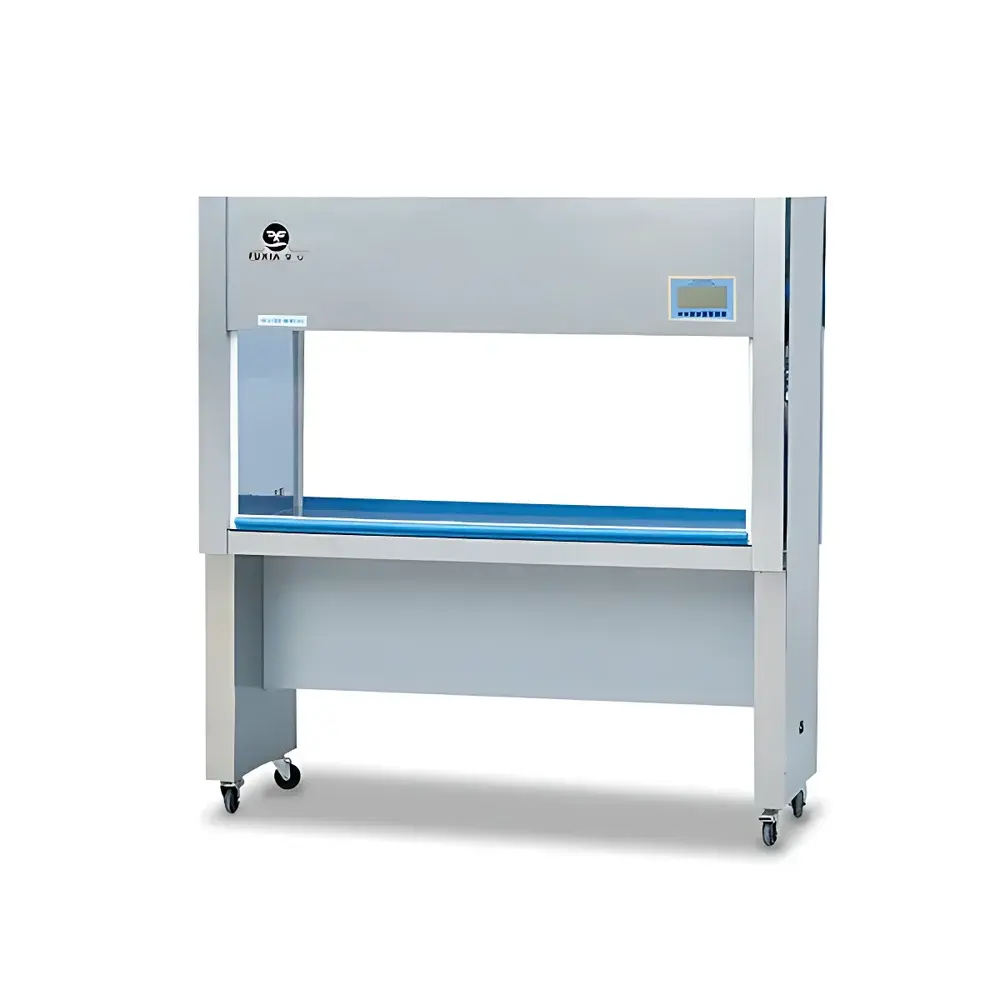
FUXIA SW-CJ-2F Dual-Operator Vertical Laminar Flow Clean Bench
| Brand | FUXIA |
|---|---|
| Origin | Zhejiang, China |
| Model | SW-CJ-2F |
| Instrument Type | Vertical Laminar Flow Clean Bench |
| Cleanliness Class | ISO Class 5 (100 @ ≥0.5 µm, Fed. Std. 209E) |
| Noise Level | ≤62 dB(A) |
| Operator Capacity | Dual-operator, dual-sided |
| Airflow Pattern | Vertical downward laminar flow |
| Average Air Velocity | 0.25–0.45 m/s |
| Illumination | ≥300 lx |
| UV Lamp | 15 W × 2 |
| Fluorescent Lamp | 16 W × 2 |
| Power Supply | AC 220 V / 50 Hz |
| Power Consumption | 800 W |
| Net Weight | 200 kg |
| Working Area Dimensions | 1360 × 600 × 520 mm |
| Overall Dimensions | 1540 × 680 × 1600 mm |
| Microbial Contamination | <0.5 CFU/plate·hour (90 mm Petri dish) |
| Vibration | ≤0.5 µm (peak-to-peak, XYZ axes) |
| Control Interface | Digital LCD with three-speed fan control |
| Safety Interlock | UV lamp and lighting circuits mutually interlocked |
Overview
The FUXIA SW-CJ-2F Dual-Operator Vertical Laminar Flow Clean Bench is an ISO Class 5-certified (Fed. Std. 209E Class 100) containment device engineered for aseptic manipulation of non-hazardous biological, pharmaceutical, and chemical materials. It operates on the principle of vertical laminar airflow: ambient air is drawn through a pre-filter to remove coarse particulates, then forced through a certified HEPA filter (≥99.99% efficiency at 0.3 µm), delivering unidirectional, particle-free air vertically downward across the work surface at a controlled velocity of 0.25–0.45 m/s. This downward curtain forms a dynamic barrier that isolates the work area from ambient room air, minimizing cross-contamination and protecting both samples and operators from airborne microbial and particulate intrusion. Designed for routine sterility assurance in QC labs, cell culture facilities, and formulation suites, the SW-CJ-2F complies with core environmental control requirements outlined in ISO 14644-1, USP <797>, and EU GMP Annex 1—particularly where low-risk, open manipulations are performed under Grade A conditions supported by Grade B background environments.
Key Features
- Vertical laminar airflow architecture with adjustable sash window: counterbalanced, frictionless glass sliding door enables precise, hands-free positioning at any height—enhancing ergonomics and workflow continuity during extended procedures.
- Robust enclosure construction: electrogalvanized steel frame with color-coated steel outer panels; work surface fabricated from brushed 304 stainless steel (standard), offering superior corrosion resistance, non-porous integrity, and compatibility with common disinfectants (e.g., 70% ethanol, hydrogen peroxide vapor).
- Dual-safety interlocked lighting system: fluorescent lamps (16 W × 2) and germicidal UV lamps (15 W × 2) operate independently with hardware-level interlock—UV emission is automatically disabled when the sash is raised above safe threshold, preventing operator exposure.
- Digital LCD controller with three discrete fan speed settings (low/medium/high), real-time airflow status indication, and programmable UV timer—enabling protocol-specific airflow optimization without mechanical recalibration.
- Vertically oriented, quasi-enclosed work chamber: optimized geometry ensures stable downflow velocity distribution across the full 1360 × 600 mm working area, minimizing turbulence and maintaining laminarity even at peripheral zones.
- Integrated dual-stage filtration: washable aluminum pre-filter extends HEPA service life; HEPA filter (1355 × 555 × 38 mm) meets EN 1822-1 H14 classification and is certified per IEST-RP-CC001.3.
Sample Compatibility & Compliance
The SW-CJ-2F supports open handling of sterile media, agar plates, pipette tips, vials, and small-scale bioreactors—ideal for microbiological testing, media preparation, vaccine component assembly, and analytical sample weighing. It is not designed for volatile organic compounds, cytotoxic agents, or pathogenic microorganisms requiring biosafety level containment (i.e., BSCs or fume hoods). Regulatory alignment includes conformity with ISO 14644-1:2015 (cleanroom performance testing), ISO 14644-3:2019 (test methods), and ASTM E2500-13 (verification of clean equipment). Routine validation per IQ/OQ protocols—including airflow uniformity mapping, particle count verification (using ISO 21501-4 compliant counters), and microbial challenge testing—is fully supported. Documentation packages include filter certification reports, factory airflow calibration records, and electrical safety test certificates (IEC 61010-1).
Software & Data Management
While the SW-CJ-2F operates via embedded firmware without external software dependency, its digital control module logs operational history—including total UV exposure time, cumulative fan runtime, and manual mode selections—for internal audit trails. The interface supports GLP-compliant recordkeeping: all parameter changes require user confirmation, and no configuration data is retained after power loss unless backed up externally. For laboratories implementing electronic lab notebooks (ELN) or LIMS integration, optional RS-485 or Modbus RTU output modules (available upon request) enable remote monitoring of fan status, UV cycle completion, and door position—facilitating automated SOP enforcement and FDA 21 CFR Part 11–aligned audit logging when paired with validated middleware.
Applications
- Pharmaceutical quality control: aseptic preparation of reference standards, dissolution media, and microbial assay plates under USP <1117> environmental controls.
- Biotechnology labs: handling of primary cell lines, transfection reagents, and CRISPR components where nucleic acid integrity must be preserved from RNase/DNase aerosols.
- Clinical microbiology: streaking of clinical specimens onto selective agars, subculturing of isolates, and preparation of antibiotic susceptibility test plates.
- Academic research: sterile dissection of plant tissues, inoculation of fungal cultures, and handling of non-pathogenic recombinant strains in teaching laboratories.
- Medical device manufacturing: final assembly of sterile packaging components and visual inspection of Class II devices prior to sealing.
FAQ
What ISO cleanliness class does the SW-CJ-2F achieve, and how is it verified?
It achieves ISO Class 5 (equivalent to Fed. Std. 209E Class 100) at ≥0.5 µm particles, verified via on-site particle counting per ISO 14644-1 Annex B using calibrated light-scattering particle counters.
Can the HEPA filter be replaced in-house, and what documentation accompanies replacement units?
Yes—filter replacement requires only basic tools and follows standardized procedures in the user manual; each new HEPA carries an EN 1822 test report, serial-numbered traceability, and upstream/downstream penetration scan data.
Is the unit suitable for use in a GMP-regulated environment?
Yes, provided it is installed, qualified (IQ/OQ/PQ), and maintained per Annex 1 and ISO 14644-2 requirements; full validation support documentation is available upon request.
Does the SW-CJ-2F meet electrical safety standards for international deployment?
It conforms to IEC 61010-1:2010 for laboratory equipment; CE marking is applicable for EU markets; UL/cUL listing requires regional adaptation and is available as an optional certification package.
How frequently should the pre-filter be cleaned, and what is the typical HEPA service life under standard lab conditions?
Pre-filter cleaning is recommended every 2–4 weeks depending on ambient dust load; HEPA service life averages 3–5 years when pre-filter maintenance is performed regularly and airflow velocity remains within specification.



