
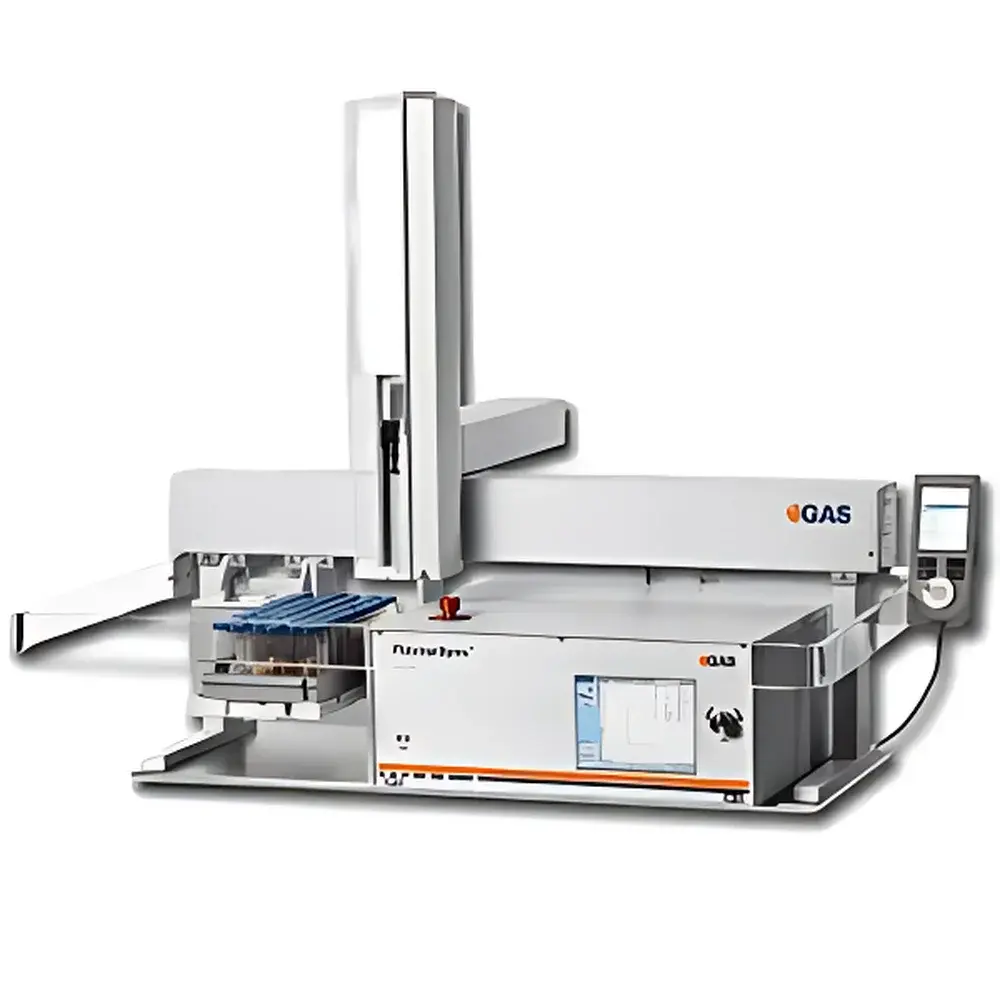
G.A.S. FlavourSpec® 25 Gas Chromatography–Ion Mobility Spectrometry (GC–IMS) Analyzer
| Brand | G.A.S. |
|---|---|
| Origin | Germany |
| Model | FlavourSpec® 25 |
| Sample Introduction | Headspace Auto-sampling |
| Sensitivity | Sub-ppb (without preconcentration) |
| Spectral Output Formats | 2D ion mobility chromatograms, 3D retention time–drift time–intensity plots, and compound-specific fingerprint spectra |
Overview
The G.A.S. FlavourSpec® 25 is a fully integrated gas chromatography–ion mobility spectrometry (GC–IMS) platform engineered for high-resolution, real-time detection and characterization of volatile organic compounds (VOCs) in complex headspace matrices. Unlike conventional GC–MS systems, the FlavourSpec® 25 leverages orthogonal separation—first by GC retention time, then by ion drift time under a controlled electric field—enabling unambiguous resolution of co-eluting isomers and structurally similar volatiles (e.g., aldehydes, ketones, esters, sulfur compounds) without derivatization or extensive sample preparation. Its core architecture combines a thermally stable capillary GC column (MXT-5, 15 m × 0.53 mm × 1 µm), a radioactive tritium (³H) β-emitter ionization source (activity 75–370 MBq, compliant with EU Directive 96/26/Euratom), and a precisely temperature-regulated IMS drift tube (98 mm length, 35–80 °C, ±1 °C stability). The system operates in either positive- or negative-ion mode, delivering >75 peak capacity in drift time dimension and sub-500 ppt detection limit (measured against 2-hexanone). Designed for routine laboratory deployment, it supports analysis durations from 3 to 35 minutes depending on sample complexity, with full instrumental self-cleaning capability when contamination is detected.
Key Features
- Fully automated headspace sampling with 60-position vial tray, programmable incubation (40–200 °C), orbital shaking (60–750 rpm), and precise syringe-based injection (100 µL minimum volume, 40–150 °C needle heating)
- Integrated GC–IMS hyphenation with dual-dimension separation: GC retention time (1–150 mL/min carrier gas flow, RSD ≤0.01% pressure stability) + IMS drift time (0–500 mL/min drift gas, <1.00% migration time RSD)
- Tritium-based ionization source with ≥12-year operational lifetime (half-life 12.5 years), certified for safe handling under international radiological safety frameworks
- High-fidelity spectral acquisition: simultaneous generation of 2D heatmaps (retention time vs. drift time), 3D surface plots, and normalized fingerprint spectra for inter-sample comparison
- Robust thermal management: independent temperature control for inlet (35–80 °C), column oven, and drift tube (all ±1 °C accuracy), ensuring method reproducibility across ambient fluctuations
Sample Compatibility & Compliance
The FlavourSpec® 25 accepts standard 20 mL crimp-top headspace vials with magnetic seals and accommodates liquid, semi-solid, and solid samples—including food matrices (cheese, coffee, meat), pharmaceutical excipients, polymer off-gassing emissions, and environmental air samples. All hardware and software comply with ISO/IEC 17025:2017 requirements for analytical testing laboratories. The tritium source meets EU Council Directive 96/26/Euratom Annex A exemption thresholds (<1 GBq), and instrument operation adheres to IEC 61010-1 safety standards for laboratory equipment. Data integrity is maintained per FDA 21 CFR Part 11 through VOCal’s audit-trail-enabled user authentication, electronic signatures, and immutable raw data storage (.mea format). Method validation protocols support GLP/GMP environments, particularly for shelf-life studies, origin authentication, and batch release testing.
Software & Data Management
VOCal software—developed exclusively for G.A.S. GC–IMS platforms—provides end-to-end data processing in English, German, and Chinese interfaces. It natively imports .mea files and exports processed results to CSV, enabling interoperability with third-party statistical tools (e.g., MATLAB, R, SIMCA). Core modules include:
- Reporter Plugin: Enables pairwise comparison of reference and unknown samples via aligned 2D peak maps; highlights statistically significant intensity differences (p < 0.05) in real time
- Gallery Plot Plugin: Generates side-by-side visual overlays of multiple samples’ fingerprint spectra, supporting rapid authenticity screening and compositional similarity scoring
- Dynamic PCA Plugin: Performs unsupervised principal component analysis on user-defined peak lists; outputs clustering dendrograms and score plots for origin, age, grade, or adulteration classification
- NIST 2014 Retention Index Library + G.A.S. Drift Time Database: Dual-database matching improves compound identification confidence; users may curate proprietary spectral libraries with retention/drift coordinates and CAS numbers
- Quantitative workflow: Supports external standard calibration curves and internal standard normalization; validated for linear dynamic ranges spanning three orders of magnitude
Applications
The FlavourSpec® 25 serves as a dedicated tool for sensory-driven quality assurance and forensic chemical profiling. Typical use cases include:
- Differentiation of geographical origins (e.g., single-origin coffee beans, regional olive oils, protected designation of origin cheeses)
- Non-destructive shelf-life monitoring via time-series VOC evolution tracking (e.g., lipid oxidation markers in snacks, ethanol accumulation in fermented beverages)
- Authentication of premium products against counterfeits (e.g., essential oils, wine varietals, herbal extracts) using multivariate fingerprint patterns
- In-process control of fermentation, drying, roasting, or packaging steps by detecting process-specific marker volatiles (e.g., diacetyl in dairy, furaneol in caramelized foods)
- Residual solvent screening in pharmaceuticals and medical devices per ICH Q3C guidelines
- Odor impact assessment in packaging materials, automotive interiors, and building products
FAQ
Is the tritium source subject to regulatory licensing in the US or EU?
Yes—though exempt from licensing under EU Directive 96/26/Euratom due to its activity range (75–370 MBq < 1 GBq), installation requires notification to national radiation protection authorities. In the US, NRC general license provisions (10 CFR 31.12) apply; G.A.S. provides full documentation for compliance filing.
Can VOCal software be validated for regulated QC environments?
Yes—VOCal includes IQ/OQ documentation templates, electronic signature support, audit trail export, and version-controlled method storage—all aligned with FDA 21 CFR Part 11 and EU Annex 11 expectations.
What is the typical maintenance interval for the IMS drift tube and GC column?
Under normal operation with clean headspace samples, the MXT-5 column maintains performance for >2 years; the drift tube requires no consumable replacement and is cleaned automatically during system regeneration cycles.
Does the system support method transfer between laboratories?
Yes—VOCal methods (.voc files) encapsulate all instrument parameters, calibration data, and processing settings, enabling direct import into other FlavourSpec® 25 units without re-optimization.
How is sensitivity verified post-installation?
A standardized 2-hexanone challenge test (500 ppt in headspace) is performed during commissioning; signal-to-noise ratio and peak width at half-height are documented in the final SAT report.
Related Products






