
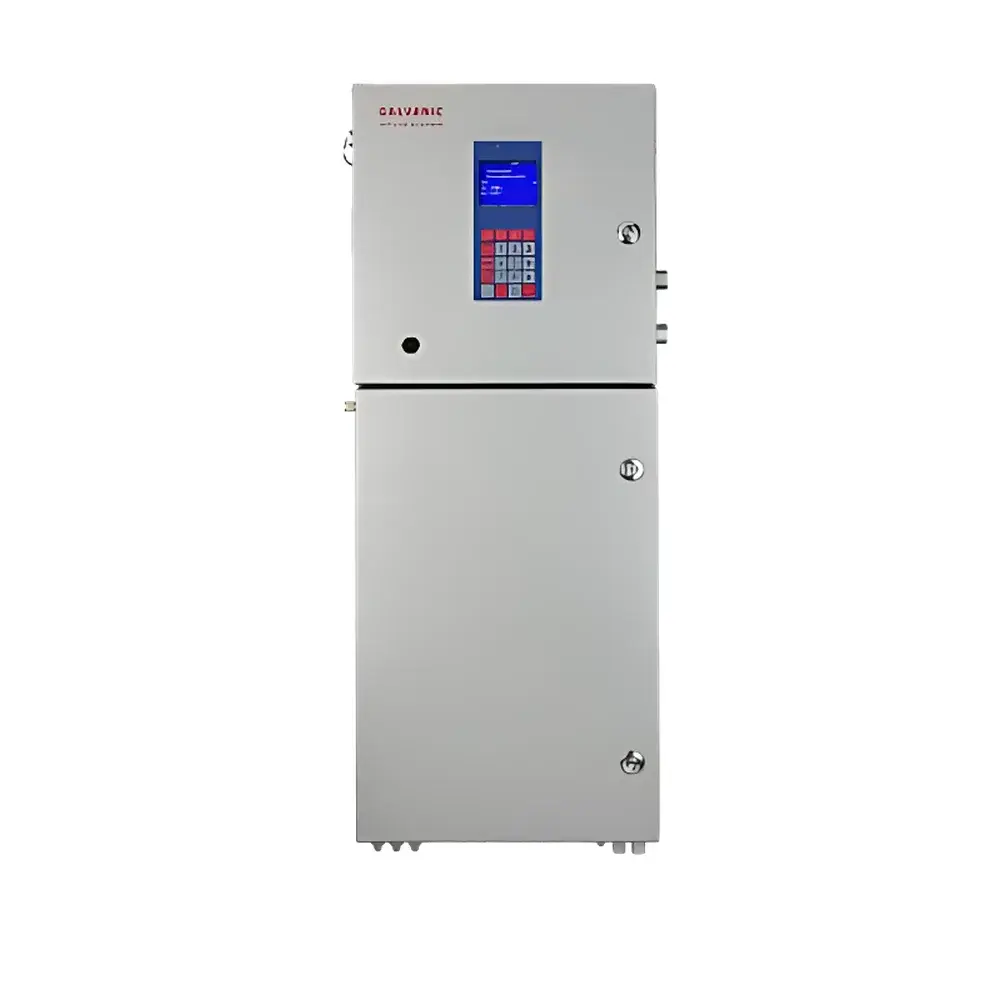
Galvanic Accuseries-LPA Online Cyanide Analyzer
| Brand | Galvanic |
|---|---|
| Origin | USA |
| Model | Accuseries-LPA Online Analyzer |
| Type | Online Analyzer |
| Measurement Principle | Pyrazolone-based Colorimetric Method |
| Detection Range | 0–1 ppm CN⁻ |
| Communication Interfaces | 4–20 mA, Modbus TCP/IP, RS232, RS485, USB, GUI PC Direct Connection, Relay Outputs |
| Sample Handling | Up to 6 Independent Flow Paths |
| Enclosure Rating | Corrosion-Resistant Design (H₂S/Cl₂ Resistant, Humidity-Protected) |
| Compliance | Designed for Continuous Emission Monitoring Systems (CEMS) and Industrial Wastewater Compliance Applications |
Overview
The Galvanic Accuseries-LPA Online Cyanide Analyzer is an industrial-grade, fully automated photometric analyzer engineered for continuous, real-time quantification of free and total cyanide (CN⁻) in challenging wastewater streams. It employs the standardized pyrazolone colorimetric reaction—recognized in ASTM D7511-18 and ISO 11292—where cyanide reacts with 4-aminobenzoic acid and chloramine-T under controlled pH to form a stable pink-colored complex, measured at dual wavelengths (500 nm and 600 nm) to correct for turbidity-induced absorbance interference. Unlike batch-mode laboratory analyzers, the Accuseries-LPA operates unattended 24/7, delivering high reproducibility (<±3% RSD) in dynamic effluent environments typical of electroplating, metallurgical leaching, gold mining, and agrochemical manufacturing facilities. Its architecture separates sample fluidics from electronics—ensuring operational continuity even during flow-path maintenance—and supports integration into plant-wide DCS or PLC networks via native Modbus TCP/IP and 4–20 mA analog outputs.
Key Features
- Dual-wavelength photometry with automatic turbidity compensation—eliminates false positives from suspended solids without filtration or dilution
- Fiber-optic probe design minimizes fouling and extends calibration intervals; no moving parts in wetted path
- Modular reagent cartridge system enables on-site method configuration without firmware updates or hardware replacement
- Integrated self-diagnostic suite monitors reagent levels, sample presence, valve actuation status, and optical path integrity—with configurable relay alarms and event logging
- Full automation cycle: auto-zero, auto-calibration (with standard addition capability), reagent dispensing, reaction timing, waste evacuation, and system rinse—all synchronized to user-defined analysis frequency (1–60 min intervals)
- Corrosion-resistant fluidic manifold constructed from PFA, PVDF, and Hastelloy C-276—validated for long-term exposure to H₂S-saturated, chlorine-containing, and low-pH industrial effluents
- Decoupled electronics architecture: main control board remains functional during individual flow-path faults, enabling fault-isolated operation and DCS-level error reporting
Sample Compatibility & Compliance
The Accuseries-LPA is validated for direct analysis of raw, unfiltered industrial wastewater with TSS ≤ 150 mg/L and chloride ≤ 5,000 mg/L. It meets the performance criteria outlined in U.S. EPA Method 335.4 for online cyanide monitoring and aligns with EU Directive 2000/60/EC (Water Framework Directive) requirements for priority hazardous substance tracking. The analyzer’s data integrity framework supports audit-ready operation under GLP and GMP environments: all critical events—including calibration timestamps, reagent lot numbers, operator logins, and measurement deviations—are time-stamped, digitally signed, and exportable in CSV/Excel format. Optional 21 CFR Part 11-compliant software modules provide electronic signatures, role-based access control, and immutable audit trails for regulated pharmaceutical or semiconductor wastewater applications.
Software & Data Management
The embedded web-based GUI provides real-time visualization of concentration trends, diagnostic status, and maintenance schedules via any modern browser—no proprietary client required. Historical data is stored locally (≥30 days at 1-min resolution) and synchronizable to cloud-based SCADA platforms using secure HTTPS or MQTT protocols. All communication interfaces support bi-directional command/response protocols: external PLCs can trigger immediate analysis cycles, pause/restart sequences, or initiate remote zero/calibration. Configuration files are version-controlled and exportable for backup or multi-unit deployment consistency. Firmware updates are delivered as signed binary packages with SHA-256 verification to ensure system integrity.
Applications
- Real-time monitoring of cyanide breakthrough in activated carbon or ion-exchange columns used in gold ore processing
- Compliance assurance for electroplating rinse waters subject to local discharge limits (e.g., <0.2 mg/L CN⁻ per California Title 22)
- Process control feedback loop for sodium nitroprusside dosing in chemical oxidation of cyanide in metallurgical tailings
- Emergency response detection in pesticide formulation plants where accidental cyanide release poses acute toxicity risk
- Long-term trend analysis for environmental impact assessments in proximity to mining or smelting operations
FAQ
What cyanide species does the Accuseries-LPA detect?
It measures total cyanide after acid distillation pretreatment (per ASTM D7511), and optionally free cyanide when coupled with a membrane-diffusion pre-concentrator module.
Can the instrument operate in explosive atmospheres?
No—the standard enclosure is rated IP66 for outdoor use but not ATEX/IECEx certified; explosion-proof variants require custom engineering consultation.
How often must reagents be replaced?
Standard reagent cartridges last 30 days at one analysis per hour; shelf life is 12 months when stored at 4–25°C in original sealed packaging.
Is remote firmware update supported over Modbus TCP/IP?
Firmware updates require authenticated HTTPS session via the onboard web server; Modbus is read-only for operational parameters.
Does the analyzer comply with ISO/IEC 17025 calibration traceability requirements?
Yes—factory calibration uses NIST-traceable potassium ferricyanide standards; calibration certificates include uncertainty budgets per ISO/IEC 17025:2017 Annex A.3.
Related Products







