
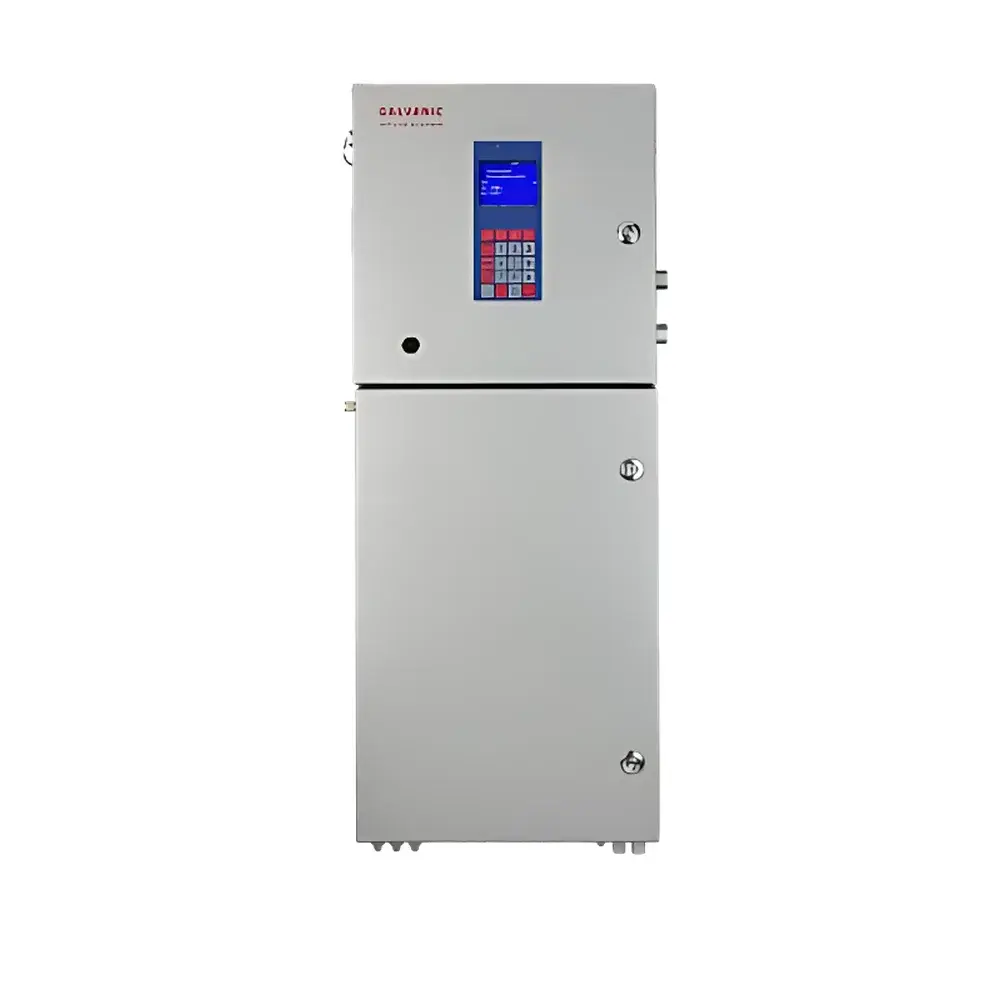
Galvanic Accuseries-LPA Online Silica Analyzer
| Brand | Galvanic |
|---|---|
| Origin | USA |
| Model | Accuseries-LPA |
| Instrument Type | Online Analyzer |
| Measurement Principle | Molybdenum Blue Colorimetric Method |
| Range | 0–5000 ppb SiO₂ (as soluble silica) |
| Communication Interfaces | 4–20 mA, Modbus TCP/IP, RS232, RS485, USB, GUI PC Direct Connection, Relay Outputs |
| Sample Flow Paths | Up to 6 modular channels |
| Environmental Rating | Corrosion-resistant housing |
| Compliance | Designed for continuous operation in industrial water monitoring per ASTM D859, ISO 10530, and EPA Method 365.3 contexts |
Overview
The Galvanic Accuseries-LPA Online Silica Analyzer is an industrial-grade, fully automated photometric analyzer engineered for continuous, real-time quantification of dissolved silica (SiO₂) in critical water streams. It operates on the standardized molybdenum blue colorimetric principle—where soluble silicate reacts with ammonium molybdate under acidic conditions to form a heteropoly blue complex, whose absorbance at two discrete wavelengths (typically 650 nm and 750 nm) is measured via fiber-optic detection. The dual-wavelength optical architecture actively compensates for turbidity-induced spectral interference, ensuring measurement integrity in non-filtered or mildly suspended samples common in boiler feedwater, condensate, and power plant cycle streams. Designed for unattended 24/7 operation, the system integrates reagent delivery, sample conditioning, reaction timing, photometric detection, and waste handling within a single robust enclosure—eliminating manual intervention while maintaining trace-level accuracy in the 0–5000 ppb range.
Key Features
- Fiber-optic probe-based optical detection system minimizes fouling and enables long-term stability without routine optical cleaning
- Modular flow-path architecture supports up to six independent sample streams—each configurable with dedicated reagent dosing, timing, and calibration protocols
- Physically isolated electronics and wet chemistry modules: failure in fluidic control does not compromise data acquisition, alarm reporting, or communication integrity
- Self-diagnostic firmware continuously monitors reagent levels, sample presence, valve actuation status, photometer baseline drift, and temperature stability—triggering configurable relay alarms and event logs
- Full automation cycle includes auto-zero, auto-calibration (with user-defined standard points), reagent replenishment, line flushing, and reaction chamber purge—all scheduled or event-driven
- Corrosion-resistant enclosure rated for Class I, Division 2 hazardous locations; chemically inert wetted materials (e.g., PFA, FKM, sapphire optics) ensure compatibility with chlorinated, sulfide-laden, or low-conductivity waters
Sample Compatibility & Compliance
The Accuseries-LPA is validated for use across low-TDS, high-purity water matrices—including turbine condensate, deaerator outlet, boiler drum water, and ultrapure make-up water—where silica scaling poses operational risk to heat exchangers and steam turbines. It meets functional requirements aligned with ASTM D859 (Standard Test Method for Silica in Water), ISO 10530 (Water quality — Determination of silica — Spectrophotometric method), and EPA Method 365.3 (for regulatory-grade silica monitoring in discharge compliance). While not intrinsically certified for SIL2/SIL3, its fault-tolerant design and deterministic alarm response support integration into safety-rated DCS/PLC architectures per IEC 61511. All firmware logging adheres to ALCOA+ principles, with optional audit trail configuration supporting GLP/GMP-aligned validation packages.
Software & Data Management
The embedded Linux-based controller provides local HMI via a high-resolution LCD touchscreen and optional external keyboard. Configuration, calibration, and diagnostic utilities are accessible via web GUI (HTTPS), Modbus TCP/IP, or direct USB connection. All measurements, alarms, maintenance events, and calibration records are timestamped and stored locally for ≥90 days. Data export supports CSV and XML formats; historical trends can be visualized in-browser or forwarded to SCADA systems using OPC UA or MQTT brokers. Remote firmware updates and parameter push are supported over secure TLS connections. For regulated environments, optional 21 CFR Part 11-compliant user role management (admin/operator/auditor), electronic signatures, and immutable audit trails are available via licensed software module.
Applications
- Power generation: Real-time silica monitoring in boiler feedwater and steam cycle condensate to prevent silica deposition on turbine blades
- Petrochemical refining: Silica tracking in hydrogen production purge water and high-pressure steam networks
- Pharmaceutical water systems: USP compliant monitoring of purified water and water-for-injection (WFI) distribution loops
- Municipal drinking water treatment: Early detection of silica leaching from corrosion-resistant piping or ion exchange resins
- Industrial cooling towers: Trend analysis of silica accumulation to optimize blowdown scheduling and antiscalant dosing
FAQ
What sample pretreatment is required prior to analysis?
No filtration or dilution is required for typical applications. The system handles turbidities up to 50 NTU via dual-wavelength compensation. For samples exceeding 100 NTU or containing particulate iron/manganese oxides, inline cartridge filtration (5 µm) is recommended.
How frequently must reagents be replaced?
Reagent consumption is flow- and cycle-dependent. Under standard 15-minute analysis intervals, the onboard reagent reservoirs (ammonium molybdate, reducing agent, acid buffer) typically last 30–45 days. Low-level alerts trigger 72-hour advance notification.
Can the analyzer interface with existing DCS systems?
Yes. Native 4–20 mA analog outputs (isolated, HART-enabled) and Modbus TCP/IP are standard. Optional Profibus DP or Foundation Fieldbus interfaces are available upon request.
Is validation documentation provided for pharmaceutical or regulated use?
IQ/OQ templates, test protocols, and raw data logs are included. Full 21 CFR Part 11 compliance requires optional software licensing and site-specific URS execution.
What is the expected mean time between failures (MTBF) for the fluidic module?
Based on field data from 2020–2023 deployments, the average MTBF for the peristaltic pump and solenoid valve assembly exceeds 18,000 operating hours under continuous duty at ambient temperatures ≤45°C.
Related Products







