
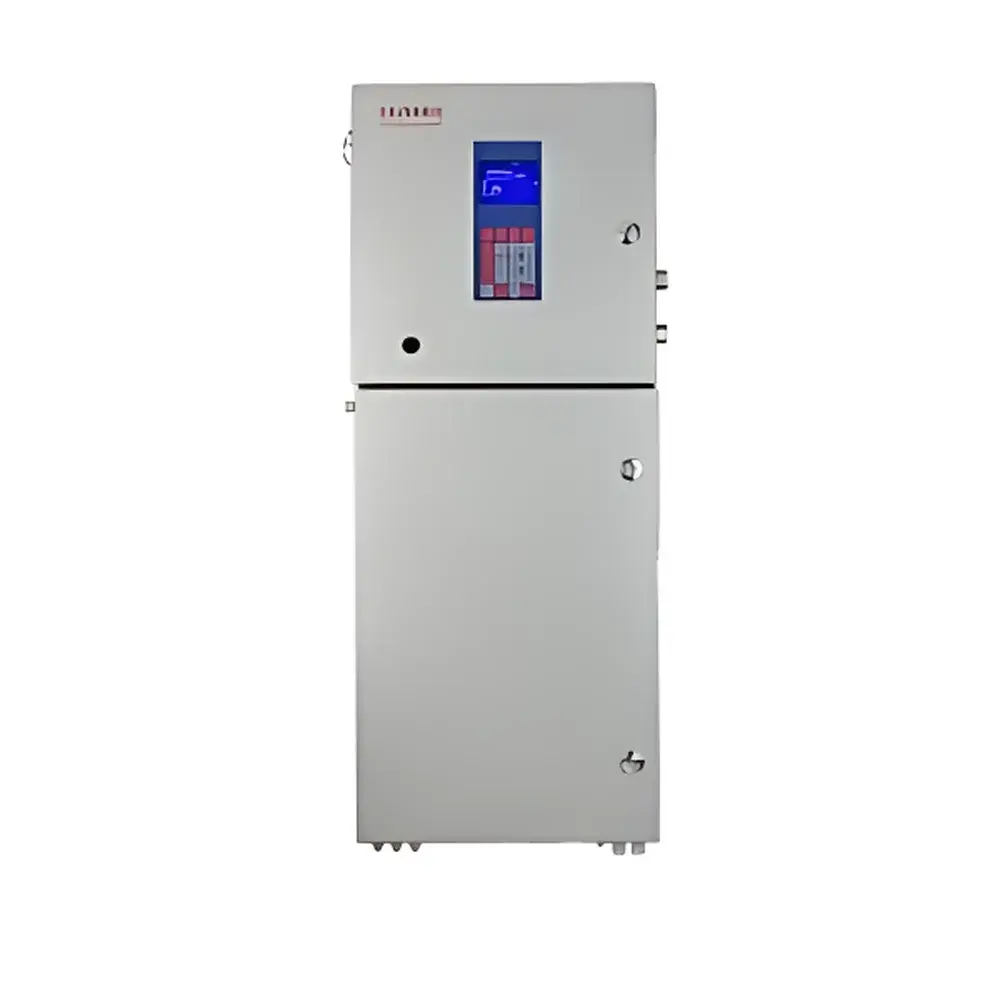
Galvanic AccuSeries Online CHP (Cumene Hydroperoxide) Concentration Analyzer
| Brand | Galvanic |
|---|---|
| Origin | USA |
| Manufacturer Type | Authorized Distributor |
| Origin Category | Imported |
| Model | AccuSeries |
| Price | Upon Request |
| Measurement Principle | Redox Colorimetric Titration |
| Wavelengths | 650 nm (test), 810 nm (reference) |
| Range | 0–1,000 ppm (customizable) |
| Accuracy | ±1% of full scale |
| Linearity | ±1% FS |
| Repeatability | ±1% FS |
| Analysis Cycle Time | 10 min |
| Sensitivity | 1% FS |
| Ambient Temperature | 20–60 °C (−4–140 °F) |
| Dimensions | 1016 mm H × 406 mm W × 241 mm D |
| Weight | 45.3 kg |
| Sample Interface | 1/4″ compression fitting |
| Sample Flow Rate | 200 mL/min |
| Max Sample Pressure | <5 psi |
| Max Suspended Solids | <1,000 µm |
| Power Supply | 24 VDC or 90–240 VAC |
| Analog Outputs | up to eight isolated 4–20 mA (self-powered) |
| Digital Inputs | 8 dry/wet contacts (24 VDC) |
| Ethernet | Embedded GUI via Modbus TCP/IP |
| Serial Protocols | Modbus RTU over RS-232/RS-485 |
| Alarm Outputs | User-configurable relay outputs |
| Enclosure Rating | NEMA 4X (IP65) |
| Mounting | Wall-mounted with included hardware |
| Corrosion Resistance | H₂S- and Cl₂-resistant housing |
| Flow Path Architecture | Modular, scalable to 6 independent sample streams |
| Control Architecture | Physically segregated electronics and wet chemistry modules |
Overview
The Galvanic AccuSeries Online CHP (Cumene Hydroperoxide) Concentration Analyzer is an industrial-grade, fully automated process analyzer engineered for continuous, real-time quantification of cumene hydroperoxide in liquid-phase epoxidation processes—particularly in propylene oxide (PO) production facilities. It operates on a validated redox colorimetric titration principle, wherein CHP reacts stoichiometrically with a standardized reducing reagent under controlled pH and temperature conditions, generating a measurable chromophore whose absorbance is monitored at dual wavelengths (650 nm test, 810 nm reference). This ratiometric photometric approach inherently compensates for optical path disturbances—including turbidity, fouling, and variable sample clarity—ensuring robust performance in challenging refinery and chemical plant environments. Designed for 24/7 unattended operation, the system integrates auto-calibration, auto-cleaning, reagent replenishment, and fault-tolerant diagnostics into a single platform, earning its designation as a “robotic chemist” in modern process analytical technology (PAT) frameworks.
Key Features
- Patented dual-wavelength photometric detection architecture minimizes drift from sample turbidity, bubble formation, or window fouling.
- Fiber-optic probe interface eliminates moving parts in the wet stream, reducing maintenance frequency and extending service intervals.
- High-resolution LCD display with backlit graphical user interface and dedicated function keypad enables local configuration, diagnostics, and real-time trend viewing without external tools.
- Modular flow-path design supports up to six independent sample streams, each configurable with unique method parameters, reagent sets, and calibration schedules.
- Electronically isolated architecture separates the control unit (CPU, I/O, power supply) from the wet chemistry module—ensuring continued system monitoring and alarm reporting even during fluidic subsystem faults.
- Comprehensive embedded diagnostics include reagent level monitoring, sample presence verification, peristaltic pump status, valve actuation feedback, and optical path integrity checks—all accessible via local display or remote GUI.
- NEMA 4X (IP65)-rated enclosure with corrosion-resistant materials ensures reliable operation in humid, H₂S-laden, or chlorine-exposed areas typical of hydrocarbon processing units.
- Scalable analog and digital I/O: eight isolated 4–20 mA outputs, eight programmable digital inputs (dry or wet contact), and multiple relay alarms—fully integrable with DCS, PLC, and SIS systems.
Sample Compatibility & Compliance
The AccuSeries analyzer is validated for use with process liquids containing low-to-moderate suspended solids (<1,000 µm), non-volatile organics, and moderate ionic strength—common in cumene oxidation effluents, CHP extraction streams, and epoxidation reactor feeds/effluents. It complies with ISA-84.00.01 (IEC 61511) functional safety guidelines for analyzers deployed in safety instrumented functions (SIFs), and meets electromagnetic compatibility (EMC) requirements per IEC 61326-1. Its modular architecture and audit-trail-capable software support compliance with FDA 21 CFR Part 11 when deployed in GMP-regulated pharmaceutical intermediate manufacturing. All wetted materials—including flow cells, tubing, and reagent reservoirs—are selected for chemical resistance to acidic, oxidizing, and aromatic media encountered in CHP handling.
Software & Data Management
The embedded firmware supports full-cycle automation: scheduled or event-triggered calibration (using certified CHP standards), timed reagent refill, multi-stage line purge, and automatic waste evacuation. Remote access is enabled via embedded web server and native Modbus TCP/IP protocol, allowing integration into enterprise-level MES or historian platforms (e.g., OSIsoft PI, AspenTech IP.21). The GUI provides real-time chromatogram-like reaction progress visualization, method parameter versioning, and timestamped audit logs—including operator actions, calibration events, alarm triggers, and hardware fault codes. Data export supports CSV and XML formats for offline statistical process control (SPC) analysis. Firmware updates are performed securely via USB or network, with checksum validation and rollback capability.
Applications
- Continuous monitoring of CHP concentration pre- and post-epoxidation reactors in propylene oxide plants.
- Quality assurance in cumene oxidation units where CHP yield directly impacts downstream PO selectivity and catalyst lifetime.
- Real-time optimization of hydrogenation and decomposition steps in integrated PO/SM (styrene monomer) complexes.
- Process safety interlocks—triggering shutdown or diversion logic upon deviation beyond defined CHP concentration thresholds.
- Supporting PAT initiatives under ICH Q8/Q9/Q10 by providing high-fidelity, time-synchronized concentration data for multivariate model development.
FAQ
What measurement principle does the AccuSeries CHP analyzer use?
It employs redox colorimetric titration with dual-wavelength photometry (650 nm and 810 nm) to quantify CHP concentration based on stoichiometric reaction with a certified reducing agent.
Can the analyzer handle samples with suspended solids?
Yes—it is rated for samples containing particulates up to 1,000 µm in diameter, provided the total suspended solids content remains within operational limits specified in the installation manual.
Is remote configuration and diagnostics supported?
Yes—via embedded web interface and Modbus TCP/IP, enabling full method editing, alarm setup, calibration initiation, and real-time diagnostic readouts from any network-connected workstation.
How many sample streams can be analyzed simultaneously?
The base system supports one stream; modular expansion allows up to six independent, concurrently analyzed process lines with individual reagent management and timing control.
What safety certifications apply to this analyzer?
It meets NEMA 4X (IP65) ingress protection, complies with IEC 61326-1 for EMC, and supports functional safety integration per IEC 61511 when configured with appropriate voting logic in the host DCS.




