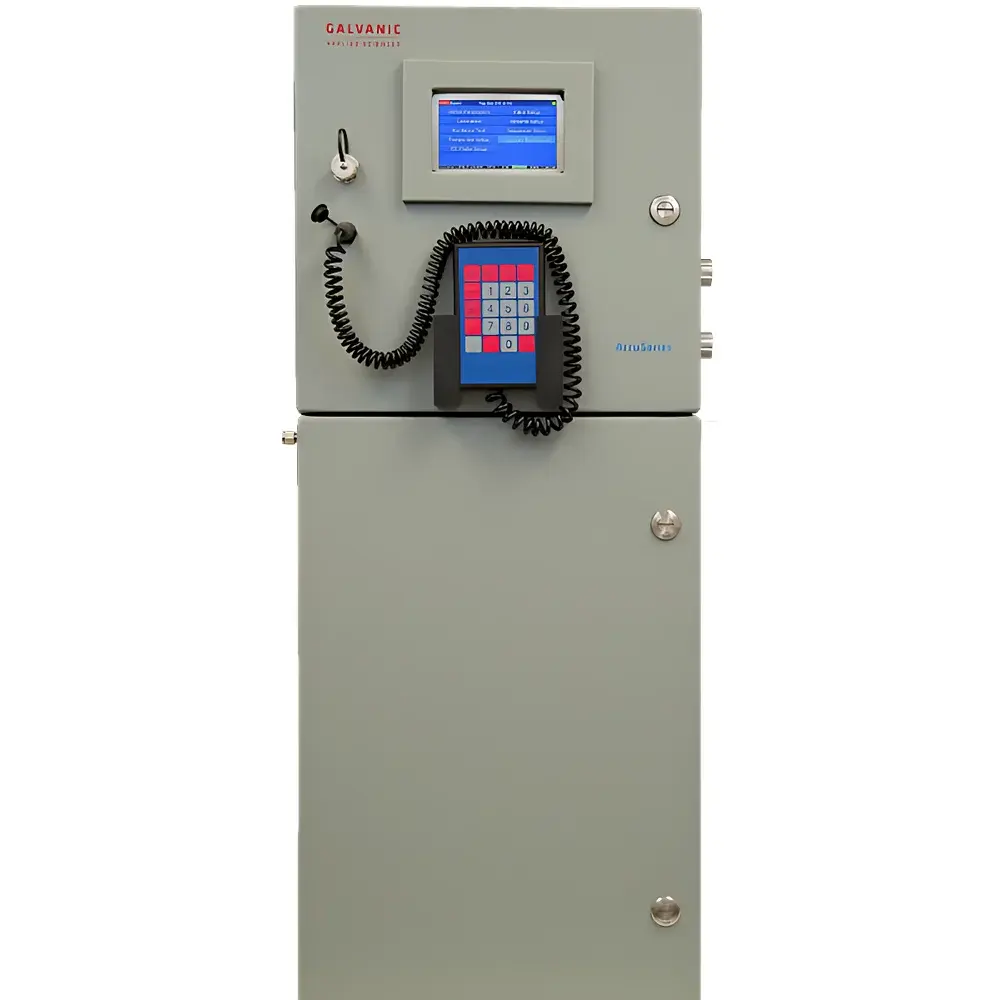
Galvanic AccuSeries Online Sodium Carbonate Analyzer
| Brand | Galvanic |
|---|---|
| Origin | USA |
| Model | AccuSeries |
| Measurement Principle | Potentiometric Titration (pH electrode endpoint detection) |
| Range Options | 0–1 g/L or 0–0.5 g/L (customizable per application) |
| Accuracy | ±1% of full scale |
| Linearity | ±1% of full scale |
| Repeatability | ±1% of full scale |
| Response Time | 8–12 minutes |
| Operating Temperature | –20 °C to +60 °C |
| Dimensions | 1016 mm × 406 mm × 241 mm |
| Weight | 45.3 kg |
| Power Supply | 10–32 VDC or 90–240 VAC |
| Power Consumption | 300 W |
| Analog Outputs | up to eight 4–20 mA isolated channels |
| Communication Protocols | Modbus RTU (RS232/RS485), Modbus TCP/IP, USB, GUI PC direct connection |
| Relay Outputs | configurable alarm and control relays |
| Sample Streams | up to six independent flow paths (modular architecture) |
| Enclosure Rating | NEMA 4X / IP66 equivalent (corrosion-resistant, H₂S/Cl₂ tolerant, humidity resistant) |
Overview
The Galvanic AccuSeries Online Sodium Carbonate Analyzer is a fully automated, industrial-grade process analyzer engineered for continuous, real-time monitoring of sodium carbonate (Na₂CO₃) concentration in brine streams within chlor-alkali production facilities. It employs potentiometric titration with a high-stability pH electrode to precisely detect the stoichiometric endpoint of acid–carbonate reaction—ensuring trace-level quantification without interference from chloride or other common brine matrix components. Designed for unattended 24/7 operation in harsh chemical environments, the AccuSeries integrates fluidic automation, embedded diagnostics, and modular hardware architecture to deliver metrologically reliable data directly into DCS, PLC, or MES systems. Its separation of electronic control and wet chemistry modules ensures operational continuity—even during maintenance or failure of individual analysis channels—making it suitable for critical control loops where process safety and regulatory compliance are non-negotiable.
Key Features
- Modular multi-stream capability: Supports up to six independent sample flow paths, each programmable with unique reagent sequences, timing, and calibration schedules.
- True “robotic chemist” functionality: Fully automated reagent dispensing, endpoint detection, post-measurement cleaning, zero-point verification, and system flushing—requiring no manual intervention between scheduled maintenance cycles.
- Dual-zone architecture: Physical and electrical isolation between the main processing unit and sample analysis module prevents cross-contamination and enables hot-swappable maintenance without system shutdown.
- Advanced fault-resilient design: Board-level modularity allows localized fault identification; if a flow path controller fails, the master CPU remains operational and transmits diagnostic codes and status alerts via Modbus or analog outputs to upstream control systems.
- Corrosion-hardened construction: Housing and wetted components resist degradation from hydrogen sulfide (H₂S), chlorine gas (Cl₂), high-salinity brine, and ambient humidity—validated for long-term deployment in NEMA 4X-rated enclosures.
- Multi-protocol connectivity: Native support for Modbus RTU (RS232/RS485), Modbus TCP/IP, USB host interface, and direct GUI-based configuration via Windows/Linux PC—enabling seamless integration with legacy and modern automation infrastructures.
Sample Compatibility & Compliance
The AccuSeries is specifically validated for use in saturated sodium chloride brine solutions containing residual sodium carbonate at concentrations ranging from 0 to 1 g/L—optimized for membrane cell chlor-alkali processes where precise Na₂CO₃ control (<50 mg/L) prevents caustic soda contamination and membrane fouling. All fluidic components comply with ASTM D1193 Type II water purity standards for reagent delivery, and the titration method aligns with ISO 9963-1 (water quality — determination of alkalinity) principles adapted for high-ionic-strength matrices. The analyzer supports audit-ready operation under GLP and GMP frameworks, with optional timestamped event logging, user-access-controlled parameter changes, and configurable alarm history—all exportable via USB or network interface. While not FDA 21 CFR Part 11 certified out-of-the-box, its deterministic logic architecture and immutable event logs facilitate validation for regulated manufacturing environments.
Software & Data Management
Embedded firmware provides intuitive web-based GUI access via Ethernet or direct USB connection, enabling real-time visualization of titration curves, reagent consumption trends, calibration drift metrics, and system health diagnostics. All analytical events—including start/stop timestamps, endpoint voltage thresholds, slope stability checks, and cleaning cycle completion—are stored in non-volatile memory with configurable retention (up to 30 days). Data export supports CSV and XML formats compatible with PI System, Ignition SCADA, and custom historian platforms. Remote firmware updates and configuration backups are supported over secure HTTP/S connections. Optional OPC UA server integration enables native interoperability with Industry 4.0 data lakes and predictive maintenance analytics engines.
Applications
- Chlor-alkali plant brine purification: Continuous monitoring of carbonate carryover after caustic soda scrubbing to ensure ≤50 mg/L Na₂CO₃ prior to electrolysis.
- Brine recirculation loop optimization: Feedback control of acid dosing pumps based on real-time carbonate load, minimizing excess HCl addition and reducing corrosion risk.
- Electrolyzer feed qualification: Automated pass/fail reporting against pre-set specification limits, triggering alarms or interlocks when thresholds are exceeded.
- Batch-to-batch consistency tracking: Correlation of carbonate levels with current efficiency, chlorine purity, and membrane voltage drop across production shifts.
- Regulatory reporting: Generation of daily summary reports compliant with EPA 40 CFR Part 63 Subpart SS (chlorine production MACT) recordkeeping requirements.
FAQ
What titration method does the AccuSeries use, and how is endpoint detection achieved?
It uses potentiometric titration with a solid-state pH electrode optimized for high-chloride environments; endpoint is determined by first-derivative analysis of the pH vs. titrant volume curve.
Can the instrument be calibrated automatically, and what reference standards are required?
Yes—automated single-point or two-point calibration is supported using certified Na₂CO₃ standard solutions traceable to NIST SRM 921b; no manual electrode recalibration is needed between runs.
Is hazardous area certification available for installation in Zone 1 or Class I Div 1 locations?
The base unit is rated for general-purpose use; explosion-proof enclosures (e.g., ATEX II 2G Ex d IIB T4) and intrinsic safety barriers are available as factory-installed options upon request.
How often does the system require maintenance, and what consumables must be replaced?
Reagent cartridges and pH electrodes typically require replacement every 3–6 months depending on sample frequency and matrix aggressiveness; tubing and valves are rated for ≥12 months of continuous service.
Does the AccuSeries support remote diagnostics and predictive maintenance alerts?
Yes—embedded self-test routines monitor electrode impedance, pump actuation torque, valve seal integrity, and reagent level sensors; anomalies trigger Modbus register flags and relay alarms for proactive intervention.