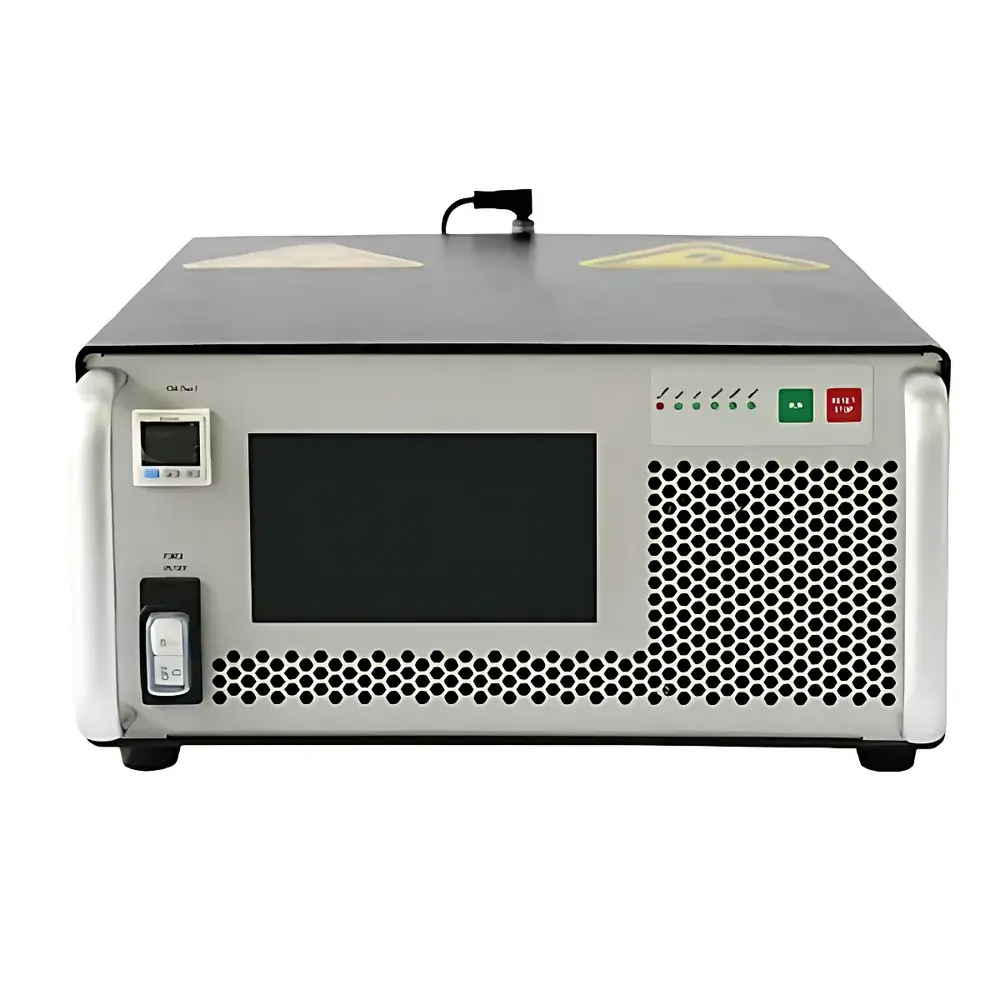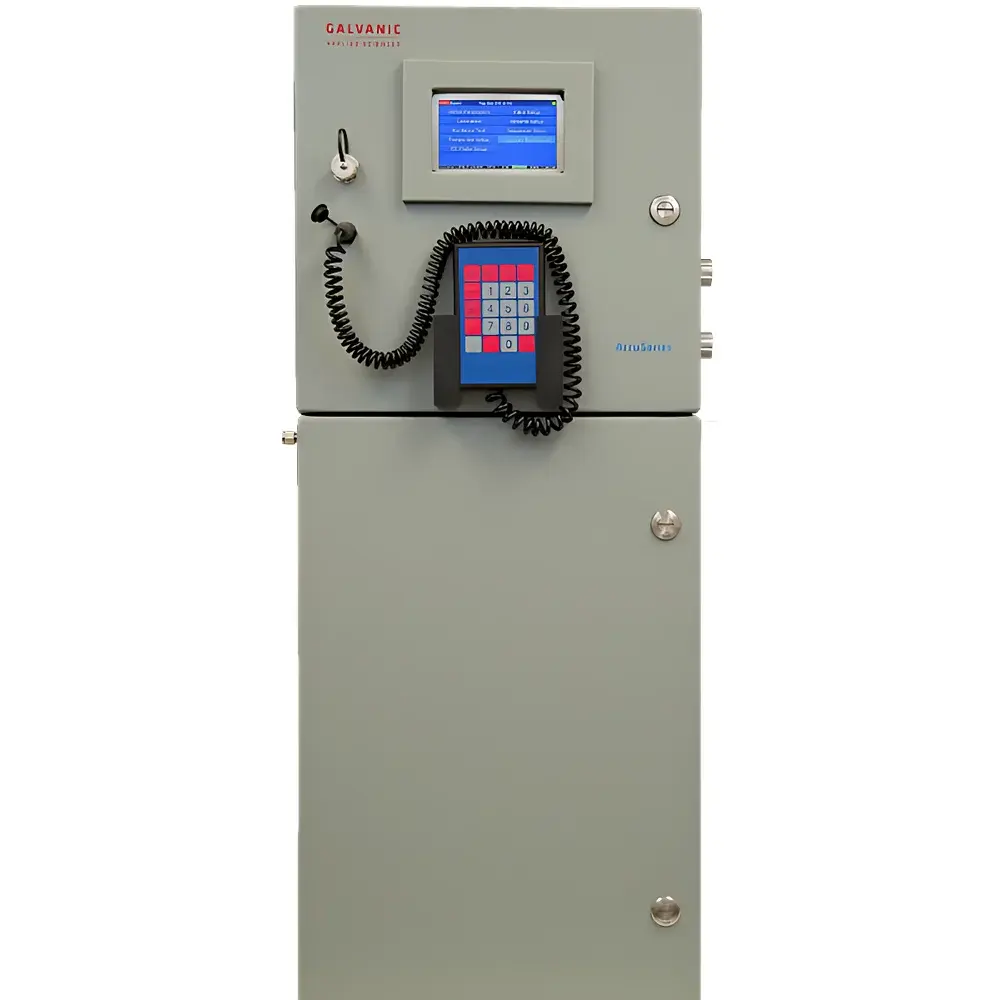
Galvanic AccuSeries Online Sodium Ion Analyzer
| Brand | Galvanic |
|---|---|
| Origin | USA |
| Manufacturer Type | Authorized Distributor |
| Product Origin | Imported |
| Model | AccuSeries |
| Price | Upon Request |
| Measurement Principle | Ion-Selective Electrode (ISE) |
| Range | 0–10,000 ppb Na⁺ |
| Accuracy | ±1% of Full Scale |
| Linearity | ±1% of Full Scale |
| Repeatability | ±1% of Full Scale |
| Response Time | 3–12 minutes |
| Operating Temperature | −20 °C to +60 °C |
| Dimensions | 1016 mm × 406 mm × 241 mm |
| Weight | 45.3 kg |
| Power Supply | 10–32 VDC or 90–240 VAC |
| Power Consumption | 100 W |
| Analog Outputs | Up to eight 4–20 mA isolated outputs |
| Communication Protocols | Modbus RTU (RS232/RS485), Modbus TCP/IP, USB, GUI direct PC connection |
| Relay Outputs | Configurable alarm and control relays |
| Sample Pathways | Up to six independent flow paths |
| Enclosure Rating | IP65-rated corrosion-resistant cabinet (H₂S/Cl₂ resistant, moisture-proof) |
| System Architecture | Physically segregated electronics and fluidic modules |
Overview
The Galvanic AccuSeries Online Sodium Ion Analyzer is an industrial-grade, continuous-monitoring instrument engineered for high-reliability sodium ion (Na⁺) quantification in critical water streams across power generation, petrochemical refining, and municipal water treatment facilities. It employs a potentiometric ion-selective electrode (ISE) measurement principle—based on the Nernst equation—to deliver real-time, trace-level sodium concentration data from 0 to 10,000 ppb. Unlike optical or colorimetric methods, ISE-based detection provides direct thermodynamic activity measurement with minimal interferences in low-conductivity matrices such as boiler feedwater, condensate, and ultra-pure process water. The system’s fully automated operation—including auto-calibration, reagent replenishment, electrode cleaning, and sample conditioning—enables unattended 24/7 analysis, reducing manual intervention while maintaining compliance with ASTM D4582, ISO 10523, and USP guidelines for conductivity and ionic purity verification.
Key Features
- Modular, field-configurable architecture supporting up to six independent sample streams—ideal for multi-point monitoring in distributed plant networks.
- Physically isolated electronic control unit and fluidic analysis module—ensures continued DCS/PLC communication and fault reporting even during localized fluidic subsystem failure.
- Corrosion-resistant, IP65-rated enclosure engineered for harsh industrial environments; validated resistance to hydrogen sulfide (H₂S), chlorine (Cl₂), and high-humidity conditions.
- Integrated remote diagnostics with real-time status monitoring of sample presence, reagent levels, electrode health, and calibration drift—accessible via embedded web interface or SCADA integration.
- Multi-protocol connectivity: eight isolated 4–20 mA analog outputs, Modbus RTU (RS232/RS485), Modbus TCP/IP, USB, and native GUI-based PC configuration tool.
- High-visibility LCD display with tactile auxiliary keypad—designed for glove-compatible operation in control room or field-mount applications.
Sample Compatibility & Compliance
The AccuSeries analyzer is optimized for aqueous samples with conductivity below 1 µS/cm and pH between 4.5 and 11. It demonstrates robust performance in ultra-pure water (UPW), steam-cycle condensate, desalinated feedwater, and treated wastewater effluents. All wetted materials—including tubing, valves, and electrode housings—are constructed from chemically inert polymers (e.g., PTFE, PVDF) and 316 stainless steel to prevent leaching or surface adsorption artifacts. The system supports audit-ready operation under GLP and GMP frameworks: full event logging (including calibration history, alarm triggers, and maintenance timestamps), user-access-level controls, and optional 21 CFR Part 11-compliant software extensions for regulated pharmaceutical or nuclear applications.
Software & Data Management
Configuration, diagnostics, and data visualization are managed through Galvanic’s proprietary AccuView™ software suite—deployable on Windows-based engineering workstations or embedded within the analyzer’s onboard Linux OS. The software provides time-stamped trend graphs, configurable alarm thresholds (with hysteresis), batch export to CSV/Excel, and seamless OPC UA or Modbus gateway mapping to DCS historian systems (e.g., Emerson DeltaV, Honeywell Experion, ABB Ability). All calibration events, sensor diagnostics, and system faults are logged with ISO 8601 timestamps and stored locally for ≥90 days—supporting root-cause analysis during regulatory audits or process deviation investigations.
Applications
- Power plant boiler feedwater and steam condensate monitoring to detect early-stage cation exchange resin breakthrough.
- Petrochemical refinery pure water stations where sodium ingress indicates demineralizer exhaustion or seal leakage.
- Nuclear facility secondary coolant loop surveillance per ANSI/ANS-18.2 requirements for sodium impurity limits.
- Municipal drinking water distribution systems requiring compliance with EPA Method 300.0 for dissolved sodium.
- Pharmaceutical water-for-injection (WFI) systems validating sodium residuals prior to sterilization cycles.
FAQ
What is the minimum detectable sodium concentration with the AccuSeries analyzer?
The lower detection limit is application-dependent but typically achieves stable quantification down to 0.1 ppb in low-conductivity, low-TDS samples when operated with optimized electrode conditioning and zero-sodium calibration standards.
Can the AccuSeries be integrated into existing DCS or PLC systems?
Yes—it supports native Modbus RTU (RS485/RS232) and Modbus TCP/IP protocols, enabling direct register mapping to Allen-Bradley, Siemens S7, or Rockwell ControlLogix platforms without third-party gateways.
How often does the system require maintenance or recalibration?
Under normal operating conditions, scheduled maintenance is recommended every 6 months; automatic daily calibration eliminates routine manual intervention, though electrode replacement is advised every 12–18 months depending on sample matrix aggressiveness.
Is the analyzer certified for hazardous area installation?
The standard AccuSeries is rated for Class 1, Division 2 (C1D2) environments; ATEX/IECEx-certified variants are available upon request for Zone 1/Zone 2 deployment.
Does the system support remote firmware updates?
Yes—secure over-the-air (OTA) updates are supported via authenticated HTTPS or local USB import, with rollback capability and SHA-256 integrity verification.