
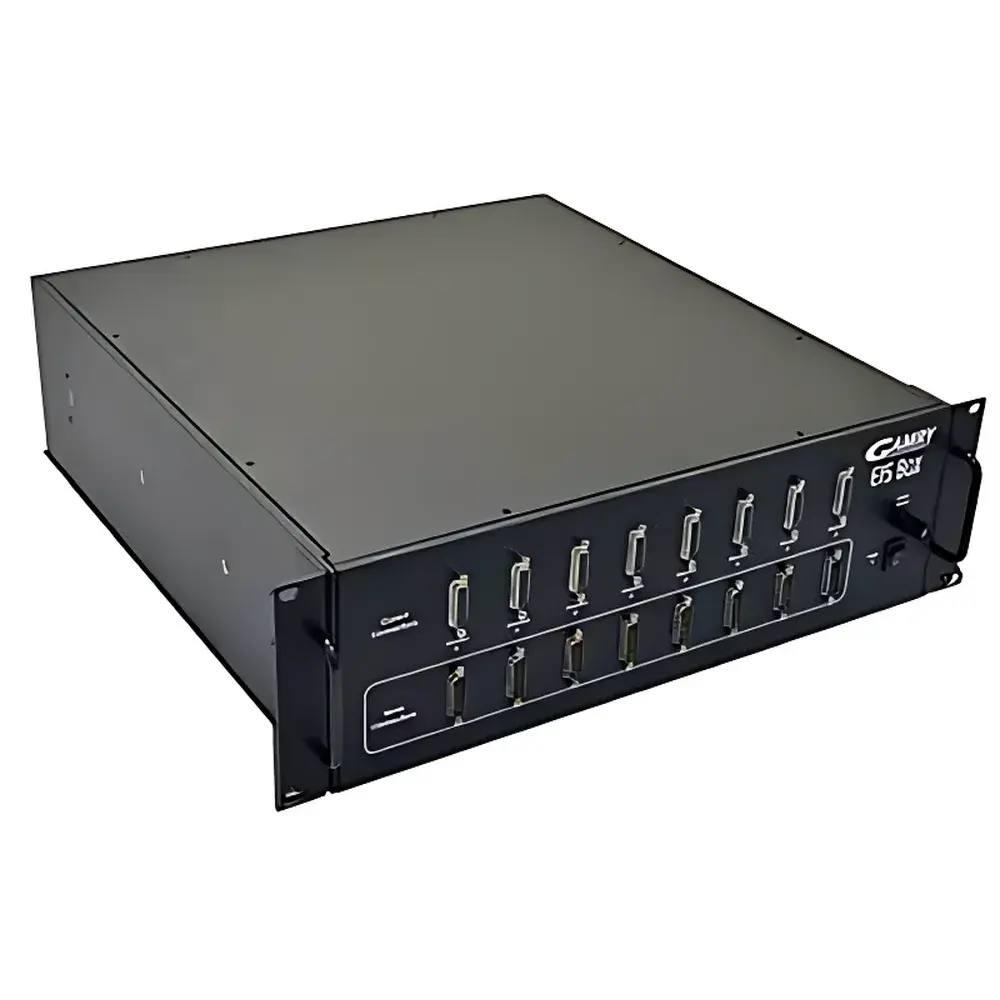
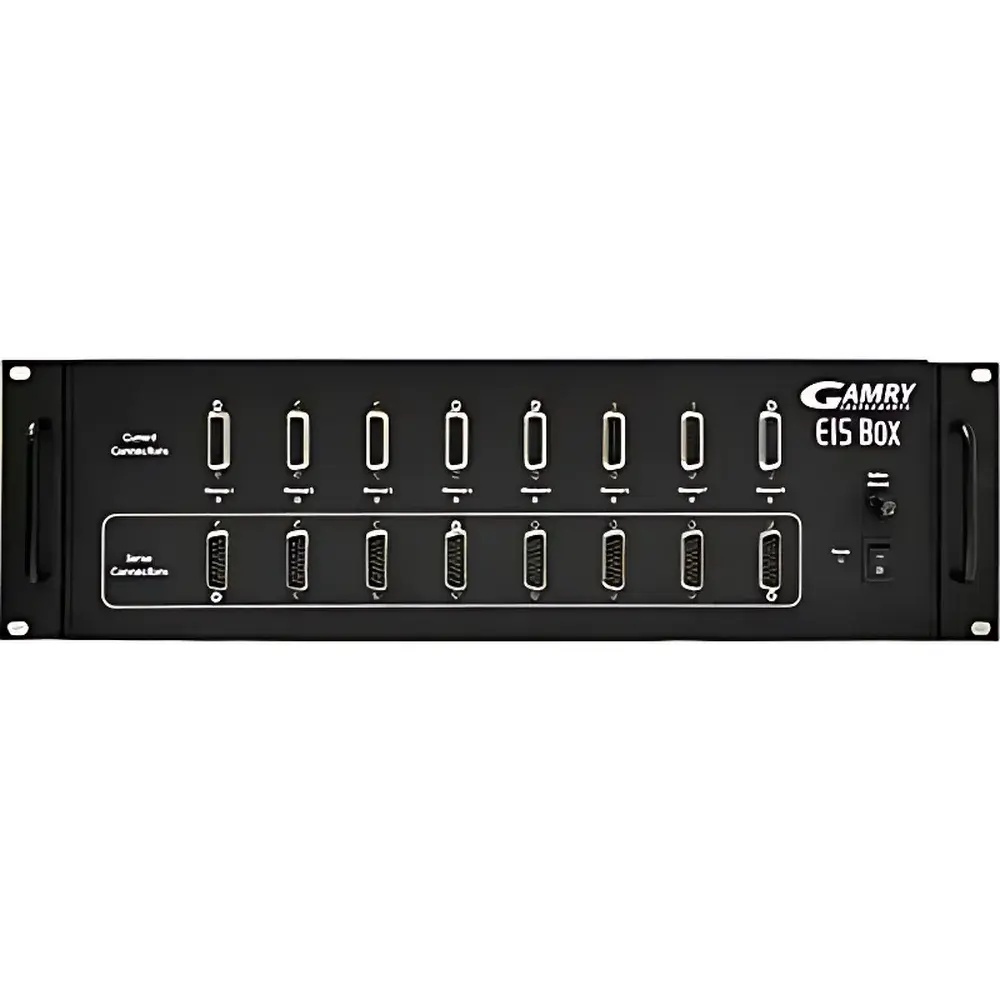
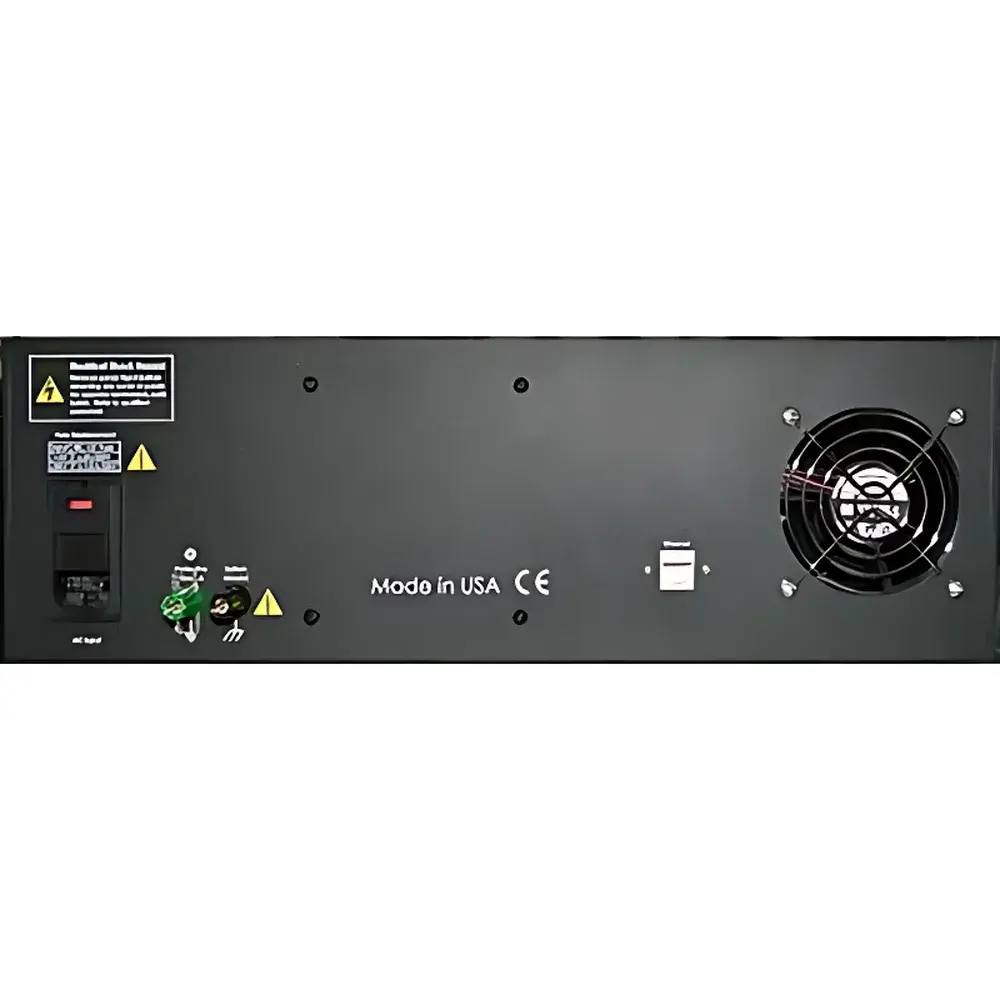
Gamry EIS Box Multi-Channel Electrochemical Impedance Spectroscopy Multiplexer
| Brand | Gamry |
|---|---|
| Origin | USA |
| Model | EIS Box |
| Instrument Type | Electrochemical Workstation |
| Channel Count | 8-channel multiplexer |
| Current Range | ±50 µA to ±5 A |
| Current Accuracy | ±25 pA ±0.2% of reading |
| Potential Accuracy | ±1 mV ±0.2% of reading |
| Potentiostatic Range | ±6 V |
| AC Impedance Frequency Range | 10 µHz – 100 kHz |
| Maximum AC Amplitude | 3 V (peak-to-peak) or 5 A (peak-to-peak) |
| Electrode Cable Length | 8 × 3 m four-terminal leads |
| Rack Mount | 19″ (48.3 cm), 3 U height |
| Interface | Ethernet or USB 2.0 |
| Operating System | Windows 10 only |
| Input Isolation | Fully floating, ground-referenced voltage limit ≤28 V |
| Weight | ~10 kg |
| Dimensions | 13.3 cm H × 41.5 cm W × 45.7 cm D |
| Power Supply | 100–240 VAC, 50–60 Hz, max. 120 W |
Overview
The Gamry EIS Box is an engineered 8-channel electrochemical impedance spectroscopy (EIS) multiplexer designed for automated, sequential impedance characterization of multiple electrochemical cells—primarily lithium-ion batteries, but also applicable to supercapacitors, fuel cells, and corrosion coupons. Unlike conventional single-channel potentiostats, the EIS Box operates as a high-fidelity signal routing and conditioning unit that interfaces with a host Gamry electrochemical workstation (e.g., Interface 5000P, Reference 600+, or Vertex series) to extend its EIS capability across up to eight independent, galvanically isolated channels. It implements true four-electrode (Kelvin) measurement per channel, preserving measurement integrity by eliminating lead resistance and contact impedance artifacts. The device does not generate excitation signals itself; rather, it routes the workstation’s AC perturbation and DC bias signals to individual cells while simultaneously returning differential potential and current responses—enabling precise, time-synchronized EIS acquisition without manual reconfiguration. Its architecture supports low-frequency stability down to 10 µHz, critical for modeling solid-electrolyte interphase (SEI) growth, diffusion-limited processes, and aging mechanisms in energy storage systems.
Key Features
- Fully isolated 8-channel multiplexing with individual ±6 V, ±5 A capability per channel—each supporting independent DC bias and AC perturbation.
- True four-terminal (working, counter, reference, sense) connections per channel using factory-terminated 3 m shielded cables—minimizing noise and ensuring reproducible contact resistance.
- Galvanic isolation rated to ±28 V relative to earth ground—enabling safe measurement of individual cells within stacked configurations (e.g., battery modules), subject to per-channel voltage limits.
- Dual communication interface: Gigabit Ethernet (preferred for networked lab environments) and USB 2.0 (for direct workstation tethering); both support deterministic timing for synchronized multi-cell EIS sequences.
- Rack-mountable 3U 19″ chassis compliant with IEC 60297-3-100 standards—designed for integration into automated test racks alongside battery cyclers (e.g., Arbin, BioLogic, or Maccor systems).
- Hardware-level overvoltage and overcurrent protection per channel, including self-resetting fuses (IEC 127) and active clamping circuits to safeguard connected cells and instrumentation.
Sample Compatibility & Compliance
The EIS Box is optimized for non-destructive, in-situ, and operando impedance monitoring of electrochemical devices under load. It supports standard coin cells (CR2032, CR2025), pouch cells, cylindrical cells (18650, 21700), and custom test fixtures equipped with four-terminal contacts. Each channel accommodates cells with open-circuit voltages up to ±6 V and total stack potentials ≤28 V referenced to earth—making it suitable for early-stage module-level diagnostics (e.g., identifying weak cells in 6S or 8S configurations). The system complies with IEC 61010-1 (safety requirements for electrical equipment) and meets EMC Class B emission limits per CISPR 32. While not intrinsically certified for hazardous locations, its grounded-shield design and optical isolation pathways minimize common-mode interference in shared lab power environments. Data acquisition workflows adhere to GLP principles when paired with Gamry Framework software’s audit-trail-enabled experiment logging and user-access controls.
Software & Data Management
Control and sequencing are executed exclusively through Gamry Framework v7.60+ running on Windows 10 (64-bit). The EIS Box integrates natively as a hardware extension—not as a standalone instrument—allowing users to define multi-step protocols (e.g., “hold at 3.7 V for 1 h → acquire EIS from 100 kHz to 10 mHz → repeat every 5 cycles”) across all eight channels with programmable dwell times, trigger conditions, and failure-handling logic. All raw time-domain and frequency-domain data are stored in Gamry’s binary .DTA format, which preserves metadata including timestamp, channel ID, cell ID, environmental temperature (when external sensor is configured), and full instrument configuration history. Export to ASCII, CSV, or MATLAB (.mat) is supported with optional column headers conforming to ASTM E2977-21 conventions for impedance data reporting. Audit trails—including operator login, parameter changes, and file modifications—are retained per FDA 21 CFR Part 11 requirements when Framework is configured in validated mode.
Applications
- High-throughput battery screening: Simultaneous EIS acquisition across 8 cells during formation cycling or calendar-life testing—reducing total characterization time by >80% compared to serial measurement.
- Cell-to-cell variation analysis in pack development: Quantifying impedance dispersion across parallel/series strings to inform balancing algorithms and thermal management strategies.
- Operando degradation tracking: Correlating real-time EIS spectra (e.g., charge-transfer resistance, Warburg diffusion coefficients) with voltage-capacity hysteresis during long-term cycling.
- Fuel cell membrane hydration studies: Monitoring proton exchange membrane (PEM) impedance shifts under controlled humidity and load steps across multiple MEAs.
- Corrosion inhibitor evaluation: Parallel EIS of coated steel coupons exposed to varying electrolyte compositions and pH levels.
FAQ
Can the EIS Box operate independently without a Gamry electrochemical workstation?
No. The EIS Box is a signal multiplexer and conditioning unit—it requires a host Gamry potentiostat/galvanostat to generate excitation signals and digitize responses.
What is the maximum allowable voltage between any two channels?
Each channel is isolated, but the absolute potential of any channel terminal must remain within ±28 V relative to earth ground. Inter-channel differential voltages are not constrained beyond this limit.
Is USB connection suitable for long-duration unattended experiments?
Ethernet is strongly recommended for experiments exceeding 24 hours due to superior bus arbitration, reduced host CPU dependency, and resilience against USB suspend/resume events.
Does the EIS Box support DC polarization techniques like cyclic voltammetry or galvanostatic charge/discharge?
No. It is purpose-built for AC impedance measurements only. DC techniques require direct connection to the host workstation’s main terminals.
How is channel crosstalk mitigated during simultaneous multi-channel EIS?
Through hardware-level channel gating, differential input stages with >98 dB CMRR (DC–10 kHz), and synchronous digital demodulation synchronized to the workstation’s master clock—ensuring <−80 dB typical inter-channel leakage at 1 kHz.



