
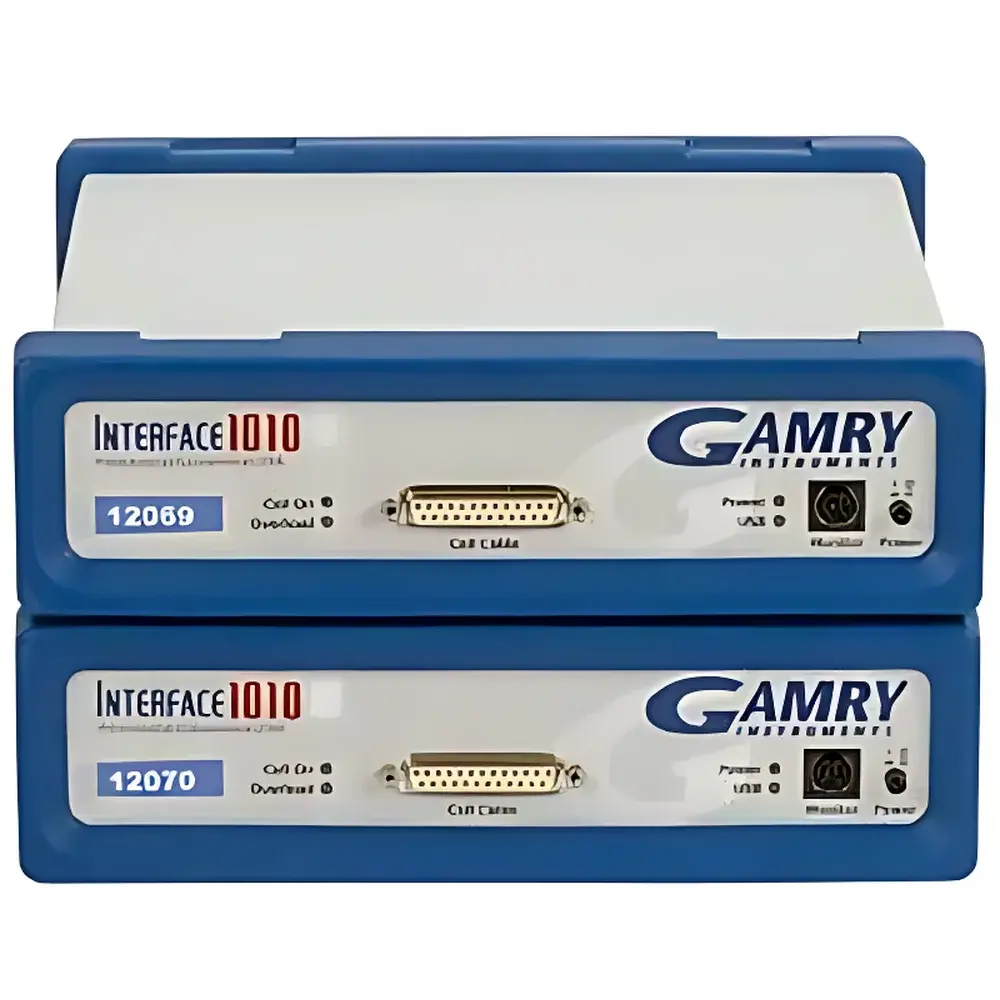
Gamry Interface 1010E Dual-Channel Potentiostat/Galvanostat
| Brand | Gamry |
|---|---|
| Origin | USA |
| Manufacturer Type | Authorized Distributor |
| Origin Category | Imported |
| Model | Interface 1010E |
| Instrument Type | Electrochemical Workstation |
| Channel Configuration | Dual Independent Potentiostatic Channels |
| Current Range | ±10 nA to ±1 A (9 decades) |
| Current Accuracy | ±5 pA ±0.3% of reading |
| Potential Accuracy | ±1 mV ±0.2% of reading |
| Potentiostatic Range | ±12 V |
| Electrochemical Impedance Spectroscopy (EIS) Frequency Range | 10 µHz – 2 MHz |
Overview
The Gamry Interface 1010E Dual-Channel Potentiostat/Galvanostat is a high-fidelity, research-grade electrochemical workstation engineered for advanced multi-electrode experiments requiring strict channel isolation, temporal synchronization, and independent control. Based on Gamry’s proven potentiostat architecture—featuring low-noise analog front-ends, precision digital-to-analog conversion, and real-time feedback loop execution—the Interface 1010E implements two fully isolated, hardware-synchronized potentiostatic channels. Each channel operates with its own dedicated reference electrode input, counter electrode drive, working electrode current measurement circuitry, and analog signal conditioning path. This physical separation eliminates crosstalk and enables true simultaneous dual-potential control—critical for techniques such as rotating ring-disk electrode (RRDE) voltammetry, electrochemical scanning tunneling microscopy (EC-STM), and segmented electrode studies where independent biasing and current monitoring are mandatory. The system supports both galvanostatic and potentiostatic modes across all standard electrochemical methods—including cyclic voltammetry (CV), chronoamperometry (CA), chronopotentiometry (CP), pulse techniques (DPV, SWV), and full-frequency EIS—without compromise in resolution or stability.
Key Features
- Two physically isolated potentiostatic channels with independent reference, counter, and working electrode connections
- Hardware-level synchronization enabling sub-millisecond inter-channel timing alignment for time-resolved dual-electrode experiments
- Current measurement range spanning nine decades: ±10 nA to ±1 A, with base resolution down to 0.1 fA (via internal gain switching)
- Potential control accuracy of ±1 mV ±0.2% of reading over the full ±12 V range
- EIS capability covering 10 µHz to 2 MHz with single-sine and multi-sine options, supporting complex impedance modeling and equivalent circuit fitting
- Support for custom experiment scripting via Gamry’s Framework™ software SDK (C#, Python, MATLAB interfaces available)
- Integrated Faraday cage compatibility and shielded cable routing to minimize electromagnetic interference in sensitive low-current measurements
Sample Compatibility & Compliance
The Interface 1010E accommodates a broad range of electrochemical cell configurations—including standard three-electrode cells, RRDE assemblies, microelectrode arrays, thin-film electrodes, and in situ/operando cells for battery and fuel cell testing. Its modular design allows seamless integration with external hardware such as rotation controllers (e.g., Pine Instruments AFMSRCE), temperature-controlled stages, and vacuum-compatible SEM/TEM sample holders. From a regulatory standpoint, the instrument meets IEC 61010-1:2010 safety requirements for laboratory electrical equipment. Data acquisition and reporting workflows comply with GLP and GMP principles when configured with audit-trail-enabled software settings; optional 21 CFR Part 11 compliance packages support electronic signature validation and secure data archiving for regulated environments.
Software & Data Management
Operation is managed through Gamry’s Framework™ electrochemical analysis platform—a Windows-based application offering intuitive method setup, real-time visualization, and post-experiment analysis tools including Tafel fitting, EIS modeling (ZView®-compatible), derivative analysis, and baseline correction algorithms. All raw data are stored in open-format .DTA files (ASCII-readable), enabling third-party processing in Python (via gamrytools), MATLAB, or Origin. The software includes built-in templates for RRDE collection efficiency calculation, TOF (time-of-flight) transient deconvolution, and dual-channel chronoamperometric triggering—where one channel initiates an event (e.g., potential step) while the other records response kinetics without software-induced latency. Experimental sequences can be exported as reusable XML protocols for lab-wide standardization.
Applications
- Oxygen reduction reaction (ORR) mechanism studies using rotating ring-disk electrodes with simultaneous oxidation/reduction current quantification
- Electrochemical time-of-flight (EC-TOF) measurements for catalytic intermediate lifetime determination
- In situ corrosion monitoring of coated alloys under variable pH or chloride exposure
- Multi-electrode sensor array characterization for environmental or biomedical detection platforms
- Electrocatalyst stability assessment via accelerated stress tests with synchronized potential hold and impedance tracking
- Hybrid operando experiments coupling electrochemistry with spectroscopic techniques (e.g., Raman, UV-Vis) via external trigger synchronization
FAQ
Can the two channels operate independently without synchronization?
Yes—each channel functions as a standalone potentiostat with its own power supply, grounding, and control loop. They may be used simultaneously in different labs or configured separately for distinct experiments.
Is hardware-based triggering supported between channels?
Yes—the Interface 1010E provides TTL-compatible trigger I/O ports enabling precise external event initiation (e.g., laser pulse, mechanical actuation) with <1 µs jitter.
Does the system support bipotentiostatic mode for RRDE experiments out-of-the-box?
Yes—dedicated RRDE experiment templates are preloaded in Framework™, automatically configuring disk/ring potentials, current scaling, and collection efficiency calculations.
What is the maximum sampling rate for transient techniques like chronoamperometry?
Up to 1 MHz per channel (with appropriate filter settings), supporting nanosecond-scale rise time resolution in optimized configurations.
Are firmware updates provided free of charge during the warranty period?
Yes—Gamry delivers periodic firmware and software updates at no cost to registered users, including new method implementations and performance enhancements.






