
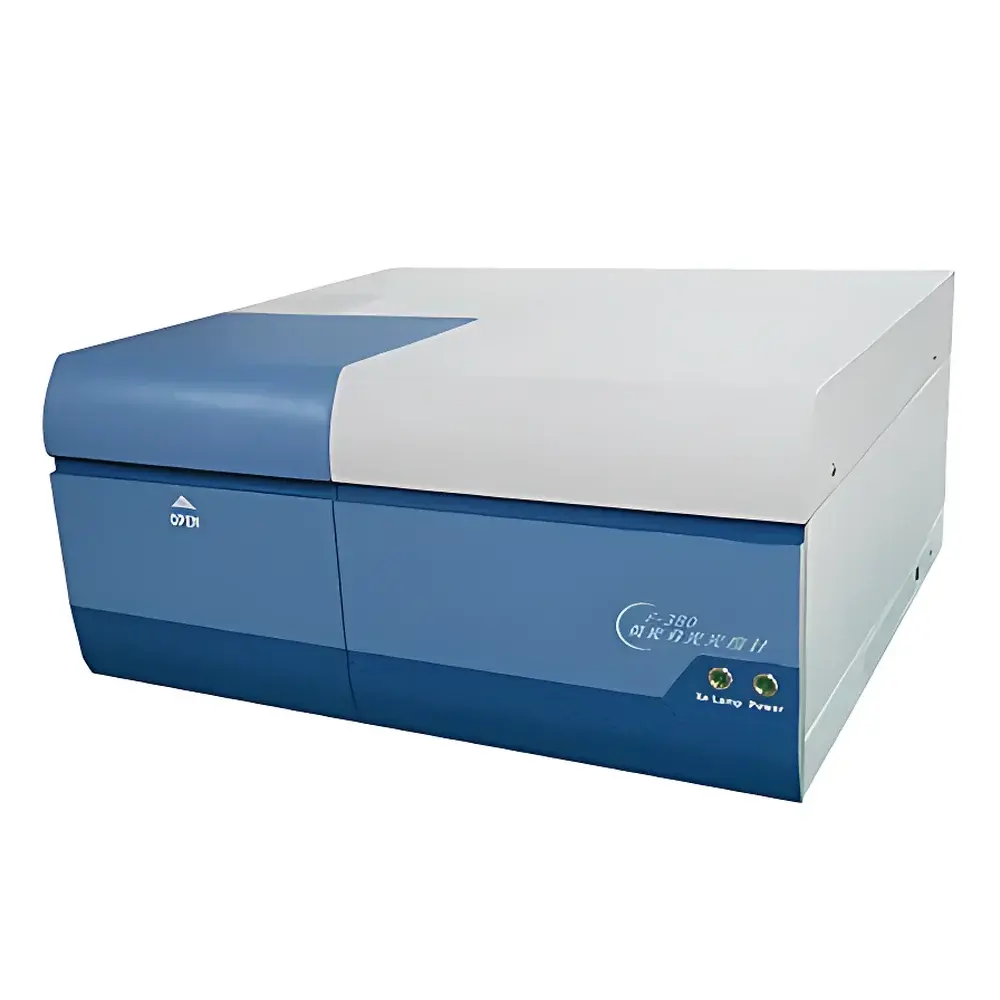
Gangdong F-380 Molecular Fluorescence Spectrometer
| Brand | Gangdong |
|---|---|
| Origin | Tianjin, China |
| Manufacturer Type | Direct Manufacturer |
| Product Category | Domestic |
| Model | F-380 |
| Price Range | USD 14,000–28,000 (est.) |
| Dispersive Element | Holographic Concave Grating |
| Slit Width (Spectral Bandwidth) | 1.0–20.0 nm (adjustable in 5 steps) |
| Resolution | ≤1.0 nm |
| Sensitivity (P-P) | >250:1 |
| Wavelength Accuracy | ±1.0 nm |
| Excitation/Emission Wavelength Range | 200–760 nm (expandable to 900 nm with optional PMT) |
| Scan Speed | Up to 30,000 nm/min |
| Minimum Sample Volume | 0.5 mL (in 10-mm cuvette) |
| Stray Light | <0.05% at 340 nm |
| Raman Peak S/N (H₂O) | >250:1 |
| Wavelength Repeatability | ≤0.5 nm |
| Response Time | 4 ms–8 s (8-step adjustable) |
| Lamp | 150 W Xenon Arc Lamp (Ozone-Filtered, Imported) |
Overview
The Gangdong F-380 Molecular Fluorescence Spectrometer is a research-grade benchtop fluorimeter engineered for high-fidelity photoluminescence characterization across academic, pharmaceutical, environmental, and materials science laboratories. It operates on the principle of molecular fluorescence excitation and emission detection using dual monochromators based on holographic concave gratings (1200 L/mm), enabling precise wavelength selection for both excitation (EX) and emission (EM) pathways. The instrument supports steady-state fluorescence, time-resolved phosphorescence (down to 1 ms decay lifetimes), synchronous scanning, and full three-dimensional (3D) excitation-emission matrix (EEM) mapping—making it suitable for complex mixture analysis, quenching studies, quantum yield estimation, and photostability assessment. Its optical architecture minimizes stray light (250:1 P-P), meeting benchmark requirements for trace-level quantification and structural probing of fluorophores.
Key Features
- Dual Holographic Concave Grating Monochromators: Custom-manufactured in the U.S., these 1200 L/mm gratings deliver superior dispersion efficiency, reduced aberration, and enhanced throughput—critical for maintaining sensitivity during high-resolution scans.
- Phosphorescence Measurement Capability: Integrated chopper-based time-gated detection eliminates interference from Rayleigh scattering, Raman bands, and short-lived fluorescence, enabling accurate measurement of phosphorescent decays as short as 1 ms.
- High-Speed 3D EEM Scanning: With scan speeds up to 30,000 nm/min and programmable step intervals (0.2–1.0 nm), the F-380 acquires comprehensive excitation-emission landscapes rapidly—ideal for fingerprinting unknown samples or tracking photochemical evolution.
- Synchronous Fluorescence Spectroscopy: Supports constant-wavelength difference (Δλ) and constant-energy (Δν) modes to resolve overlapping peaks in multi-analyte systems and suppress elastic scattering artifacts.
- Optimized Optical Path Design: Horizontal slit geometry applied to both EX and EM beams maximizes photon collection efficiency while minimizing sample volume requirement (as low as 0.5 mL in standard 10-mm quartz cuvettes).
- Protective Optomechanical Controls: Motorized excitation shutter limits photobleaching of light-sensitive specimens; gated emission aperture safeguards the photomultiplier tube (PMT) from saturation and prolongs detector lifetime.
Sample Compatibility & Compliance
The F-380 accommodates liquid, solid, and powder samples via interchangeable accessories—including solid-sample holders, thermostatted magnetic-stirring cuvette stands, automated 8-position sample changers, polarization kits, and immersion probes. All hardware and firmware comply with fundamental electromagnetic compatibility (EMC) and electrical safety standards (IEC 61010-1). The embedded software implements audit trail functionality per FDA 21 CFR Part 11 requirements, including user authentication (three-tier access control), electronic signature support, and immutable log recording of method parameters, calibration events, and raw data modifications. Optional IQ/OQ/PQ documentation packages are available to facilitate GMP/GLP-compliant installation and operational qualification.
Software & Data Management
Bundled with Gangdong’s proprietary FluoroStation™ v4.x acquisition and analysis suite, the F-380 provides intuitive workflow-driven operation—from method setup and real-time preview to post-acquisition processing (baseline correction, peak deconvolution, contour plot rendering, and multivariate analysis). Data export conforms to ASTM E131 and ISO/IEC 17025–aligned formats (CSV, ASCII, JCAMP-DX), ensuring interoperability with third-party chemometric tools such as MATLAB, OriginLab, and Unscrambler. Built-in validation modules support routine performance verification using certified reference materials (e.g., quinine sulfate in 0.1 M H₂SO₄), and automated calibration routines maintain long-term wavelength fidelity (±1.0 nm) and photometric linearity across the dynamic range (–9999 to +9999 arbitrary units).
Applications
- Quantitative analysis of polycyclic aromatic hydrocarbons (PAHs) and heavy metal ions (e.g., Hg²⁺, Pb²⁺) in environmental water matrices
- Characterization of quantum dots, carbon nanodots, and conjugated polymers in optoelectronic material development
- Stability and degradation profiling of photosensitive APIs under ICH Q1B photostress conditions
- Detection of mycotoxins (aflatoxin B1), vitamins (B2, K), and polyphenols in food and beverage QC workflows
- Protein conformational studies via intrinsic tryptophan fluorescence and Förster resonance energy transfer (FRET)
- Time-resolved luminescence assays for oxygen sensing and singlet oxygen quantum yield determination
FAQ
What is the minimum detectable concentration for quinine sulfate under standard conditions?
The F-380 achieves sub-nanomolar detection limits (LOD ≈ 0.2 nM) for quinine sulfate in 0.1 M H₂SO₄ when configured with 1.0 nm slits and optimized integration time.
Can the instrument be upgraded for near-infrared fluorescence detection beyond 760 nm?
Yes—by replacing the standard red-sensitive PMT with an extended-range GaAsP or InGaAs photodetector module, the emission range can be extended to 900 nm.
Is GLP-compliant data archiving supported?
Yes—the FluoroStation™ software includes full audit trail logging, electronic signatures, and secure database encryption compatible with laboratory information management systems (LIMS).
Does the system support kinetic measurements over extended timeframes?
Yes—time-scan mode supports acquisition durations up to 10,000 seconds with user-defined interval resolution (10 ms to 10 s), enabling monitoring of slow photochemical reactions or thermal relaxation processes.
Are calibration certificates traceable to NIST standards available?
Factory-calibrated wavelength and photometric accuracy are verified against NIST-traceable reference standards; optional on-site calibration services include uncertainty reporting per ISO/IEC 17025 guidelines.
Related Products





