
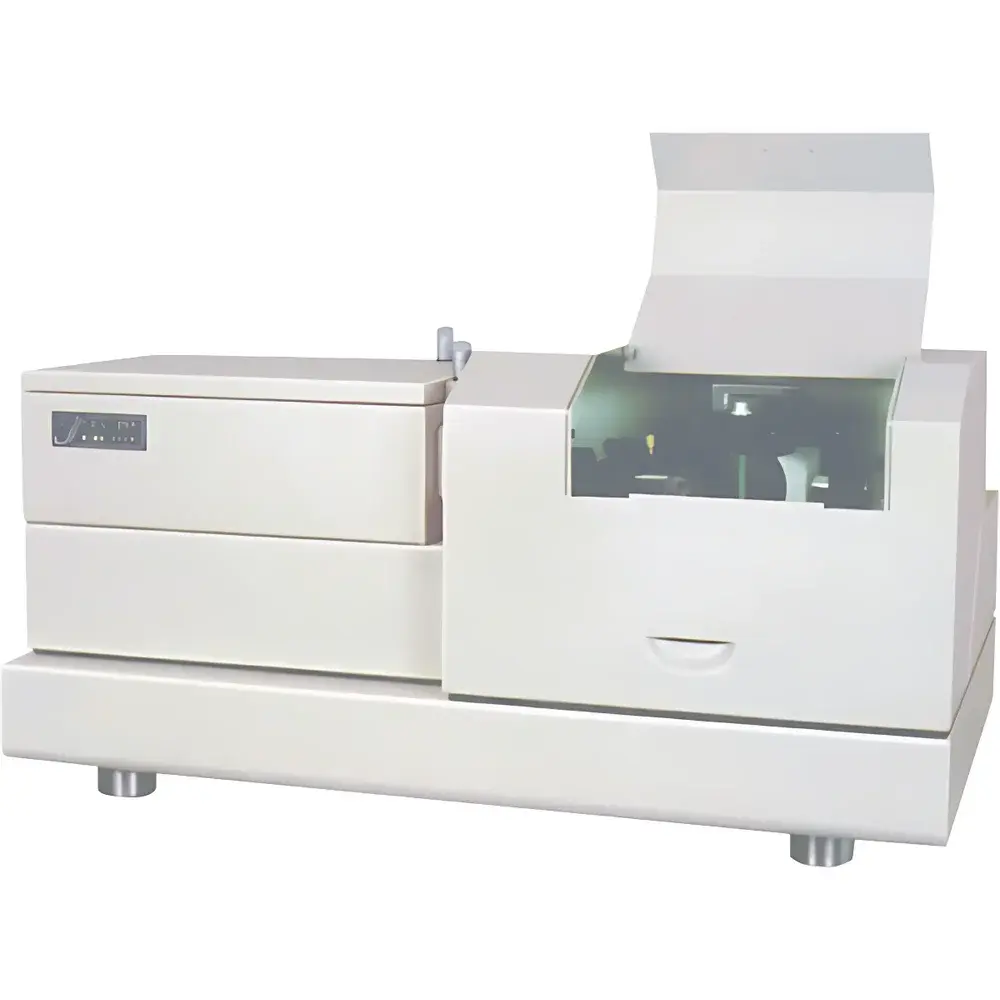
Gangdong LRS-2/3 Laser Raman Spectrometer
| Brand | Gangdong |
|---|---|
| Origin | Tianjin, China |
| Manufacturer Type | Manufacturer |
| Instrument Type | Grating-Based Raman Spectrometer |
| Spectral Range | 200–800 nm |
| Spectral Resolution | ≤0.2 nm (at 500 nm) |
| Spatial Resolution | 0.2 nm (horizontal) |
| Minimum Wavenumber Coverage | ≥200 cm⁻¹ (calculated from 532 nm excitation) |
| Spectral Repeatability | ≤0.2 nm |
| Focal Length | 302.5 mm |
| f-number | f/5.5 |
| Grating Density | 1200 lines/mm |
| Slit Width | 0–2 mm (adjustable, 0.01 mm resolution) |
| Laser Source | 532 nm diode-pumped solid-state laser, ≥100 mW output |
| Detector | Photon-counting photomultiplier tube (PMT) with discrimination circuitry |
| Stray Light Level | ≤10⁻³ |
| Dimensions | 700 × 500 × 450 mm |
| Weight | 70 kg |
Overview
The Gangdong LRS-2/3 Laser Raman Spectrometer is a grating-based, benchtop Raman spectrometer engineered for teaching laboratories and entry-level research environments in physics, chemistry, and materials science. It operates on the principle of inelastic light scattering—where monochromatic laser radiation (532 nm) interacts with molecular vibrational modes, producing Stokes and anti-Stokes Raman shifts that serve as fingerprint signatures of chemical structure and bonding. Designed around a Czerny–Turner monochromator with a 302.5 mm focal length and 1200 lines/mm holographic grating, the system delivers high optical throughput and spectral fidelity across a calibrated range of 200–800 nm (corresponding to ~200–3500 cm⁻¹ wavenumber shift under 532 nm excitation). Its modular external optical path supports polarization-resolved measurements, angular-dependent scattering configurations, and integration of auxiliary components including notch filters, waveplates, polarizers, and analyzers—enabling both conventional backscattering and oblique-incidence geometries.
Key Features
- Fully computer-controlled acquisition and real-time spectral display via USB interface and dedicated acquisition software
- Automated recording of both Raman and fluorescence emission spectra with synchronized wavelength calibration
- High-resolution monochromator featuring f/5.5 optics, adjustable slit (0–2 mm, 0.01 mm resolution), and low-stray-light design (≤10⁻³)
- Photon-counting detection architecture based on a high-gain, low-noise photomultiplier tube with digital pulse discrimination circuitry
- Stable 532 nm diode-pumped solid-state laser source (≥100 mW output, near TEM₀₀ mode) with integrated thermal management
- Five-axis sample stage accommodating diverse geometries: vertical solid mounting, horizontal liquid cells, transparent slab holders, oblique-incidence fixtures, and backscattering alignment
- Integrated 532 nm notch filter for efficient Rayleigh line rejection, improving signal-to-background ratio in low-frequency Raman regions
Sample Compatibility & Compliance
The LRS-2/3 supports qualitative and semi-quantitative analysis of solids (crystalline powders, thin films, polymers), liquids (aqueous and organic solutions), and gels without destructive sample preparation. Its flexible optical layout permits transmission, reflection, and surface-enhanced configurations when coupled with optional accessories. While primarily intended for educational use and method development, the instrument meets foundational requirements for GLP-aligned spectral documentation: wavelength accuracy (≤±0.1 nm) and repeatability (≤0.2 nm) are traceably verified using mercury-argon lamp standards. Data files include embedded metadata (acquisition time, laser power, slit width, integration time), supporting basic auditability in academic and pre-regulatory research settings. The system does not claim compliance with FDA 21 CFR Part 11 or ISO/IEC 17025 for regulated QC environments but provides raw spectral data compatible with third-party chemometric platforms (e.g., MATLAB, Python SciPy, GRAMS/AI) for further validation.
Software & Data Management
The included Windows-based acquisition software enables real-time spectrum preview, multi-scan averaging, baseline correction (polynomial and asymmetric least squares), peak search with centroid fitting, and export in ASCII, CSV, and JCAMP-DX formats. All spectral acquisitions are timestamped and tagged with instrument parameters; no proprietary binary lock-in prevents long-term archival or cross-platform reprocessing. Calibration curves can be saved and recalled per sample type. The software architecture supports batch processing of sequential measurements—useful for kinetic studies or temperature-dependent Raman mapping—and allows overlay of reference libraries (e.g., RRUFF, ICDD PDF-4+ subsets) for preliminary phase identification. Raw PMT count data is preserved at full detector resolution, enabling post-hoc noise modeling and uncertainty propagation analysis.
Applications
- Undergraduate and graduate laboratory instruction in vibrational spectroscopy, symmetry analysis, and molecular orbital theory
- Identification of functional groups in organic molecules (e.g., C=O stretch at ~1700 cm⁻¹, aromatic ring breathing modes at ~1600 cm⁻¹)
- Phase characterization of carbon allotropes (graphite, graphene, diamond), metal oxides (TiO₂ anatase/rutile), and layered semiconductors (MoS₂, WS₂)
- Monitoring polymer crystallinity, cross-linking density, and stress-induced band shifts
- Distinguishing polymorphs and hydrate forms in pharmaceutical compounds
- Fluorescence background subtraction and dual-mode Raman–fluorescence correlation in dye-doped matrices
FAQ
What laser wavelength is used, and is it replaceable?
The LRS-2/3 uses a fixed 532 nm diode-pumped solid-state laser. The module is factory-aligned and not user-replaceable; alternative excitation wavelengths require external laser coupling via the external optical path port.
Can the system perform confocal measurements?
No—the LRS-2/3 lacks spatial filtering optics and motorized Z-stage required for true confocal Raman microscopy. However, its five-axis sample stage enables precise positioning for macro-Raman spot analysis (~50–100 µm lateral resolution depending on focusing optics).
Is spectral calibration traceable to NIST standards?
Yes—wavelength calibration is performed using Hg–Ar lamp emission lines (e.g., 546.07 nm, 576.96 nm), which are NIST-traceable reference transitions. Users may perform routine verification using the same lamp.
What file formats are supported for data export?
ASCII (.txt), comma-separated values (.csv), and JCAMP-DX (.jdx) formats are natively supported. No proprietary format is used for raw spectral storage.
Does the system support time-resolved or gated detection?
No—it operates in continuous-wave (CW) acquisition mode only. Time-resolved capabilities (e.g., picosecond lifetime resolution) require external TCSPC hardware and are outside the scope of this platform.






