
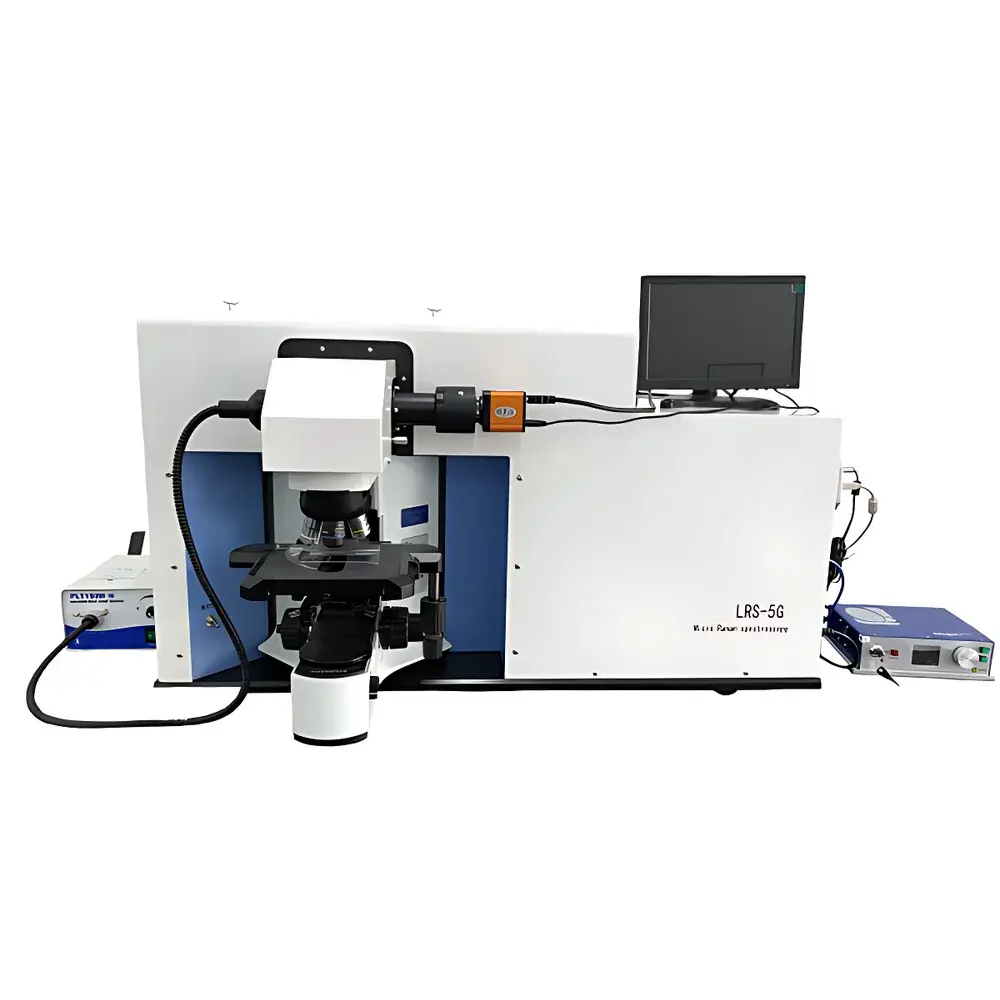
Gangdong LRS-5 Confocal Micro-Raman Spectrometer
| Brand | Gangdong |
|---|---|
| Origin | Tianjin, China |
| Manufacturer Type | Direct Manufacturer |
| Instrument Type | Confocal Micro-Raman Spectrometer |
| Model | LRS-5 |
| Spectral Range | 50–7000 cm⁻¹ |
| Spectral Resolution | <1.5 cm⁻¹ |
| Spatial Resolution | X/Y = 0.01 µm |
| Minimum Wavenumber | 50 cm⁻¹ |
| Spectral Reproducibility | ≤1 cm⁻¹ |
| Focal Length | 800 mm |
| Laser Options | 532 nm (633 nm & 785 nm optional) |
| CCD Detector | 1650 × 200 pixels, 16 × 16 µm pixel size, active area 26.6 × 3.2 mm |
| Pinhole Apertures | 50, 150, 200, 400 µm |
| Wavelength Accuracy | ≤±1 cm⁻¹ |
| Sensitivity | Capable of resolving up to 4th-order Raman modes of crystalline silicon |
Overview
The Gangdong LRS-5 Confocal Micro-Raman Spectrometer is a research-grade analytical instrument engineered for high-fidelity vibrational spectroscopy at the micro- and sub-micron scale. It operates on the principle of inelastic light scattering (Raman effect), where monochromatic laser excitation induces molecular vibrational transitions, yielding characteristic spectral fingerprints. The system employs a true confocal optical architecture—integrated with an 800 mm focal length spectrograph—to achieve diffraction-limited spatial resolution while maintaining high optical throughput. This dual optimization enables precise depth-resolved chemical mapping of heterogeneous samples without compromising signal-to-noise ratio or acquisition speed. Designed for laboratory environments requiring rigorous spectral fidelity and reproducible micro-localization, the LRS-5 meets foundational requirements for materials science, pharmaceutical polymorph screening, semiconductor defect analysis, and geological phase identification.
Key Features
- True confocal optical design with motorized, software-selectable pinholes (50–400 µm) for adjustable depth discrimination and axial resolution control
- High-throughput Czerny–Turner spectrograph with 800 mm focal length, delivering spectral resolution <1.5 cm⁻¹ across 50–7000 cm⁻¹ range
- Automated XYZ piezo-driven stage with sub-micron repeatability, enabling rapid Raman mapping (line scans and area grids) with <0.01 µm lateral and 0.002 µm axial resolution
- Modular laser platform supporting primary 532 nm excitation, with field-upgradable 633 nm and 785 nm diode lasers for resonance enhancement and fluorescence suppression
- Back-illuminated CCD detector (1650 × 200 pixels, 16 × 16 µm pixel size, 26.6 × 3.2 mm active area) optimized for quantum efficiency in visible–NIR range
- Open-access sample chamber accommodating irregular, bulky, or temperature-controlled stages—compatible with in situ environmental cells and electrical probe stations
Sample Compatibility & Compliance
The LRS-5 supports solid, powder, thin-film, and liquid-phase specimens without mandatory coating or vacuum preparation. Its low-wave-number capability (down to 50 cm⁻¹) permits detection of lattice modes in layered materials (e.g., MoS₂, graphene interlayer vibrations) and heavy-atom vibrations in metal–organic frameworks. The system adheres to ISO/IEC 17025 general requirements for competence of testing and calibration laboratories. While not pre-certified for regulated environments, its hardware architecture—including stable thermal management, mechanical drift compensation, and traceable wavelength calibration via internal neon/argon reference lines—supports validation under GLP and GMP frameworks. Data integrity is reinforced through timestamped metadata logging and user-accessible audit trails within the native software environment.
Software & Data Management
The proprietary Gangdong RamanSuite v4.x software provides full instrument control, real-time spectral preview, and batch-processing workflows compliant with ASTM E1840-20 (Standard Guide for Raman Spectroscopy Data Acquisition and Analysis). It supports spectral subtraction, cosmic ray removal, baseline correction (asymmetric least squares), peak fitting (Voigt/Gaussian models), and multivariate analysis (PCA, cluster mapping). All raw spectra are saved in vendor-neutral .spc and .csv formats. Optional integration with commercial spectral libraries (e.g., KnowItAll®, BioRad KnowItAll® Raman DB) enables automated compound identification against >30,000 reference entries. Software architecture allows export of processed data to MATLAB, Python (via NumPy-compatible arrays), and LabVIEW for custom algorithm development or LIMS interfacing.
Applications
- Polymorph identification and phase distribution mapping in active pharmaceutical ingredients (APIs)
- Strain and doping profiling in 2D materials and epitaxial semiconductor heterostructures
- Inclusion analysis and mineral phase quantification in geological thin sections
- Corrosion product characterization on metallic surfaces and coated substrates
- Microplastic identification and polymer degradation assessment in environmental samples
- TERS (Tip-Enhanced Raman Spectroscopy) readiness via optional AFM coupling interface and nano-positioning synchronization module
FAQ
What laser wavelengths are standard or optional on the LRS-5?
The system ships with a 532 nm solid-state laser as standard. 633 nm and 785 nm diode lasers are available as factory-installed options or field-upgrade kits.
Is the LRS-5 compatible with regulatory-compliant data handling (e.g., 21 CFR Part 11)?
While the base software does not include electronic signature or role-based access controls, its structured metadata schema, immutable raw file format, and audit log export functionality enable third-party validation for FDA-regulated workflows.
Can the LRS-5 perform depth profiling below surface layers?
Yes—the true confocal design with variable pinhole selection and Z-axis motorized focusing enables optical sectioning with ~2 nm axial step resolution, supporting non-destructive subsurface interrogation up to several micrometers in transparent or semi-transparent media.
What maintenance is required for long-term spectral stability?
Annual wavelength calibration verification using built-in gas discharge lamps and biannual cleaning of optical paths per ISO 10110 standards are recommended. No consumables are involved in routine operation.
Does the system support external triggering or synchronization with other instruments?
Yes—TTL-compatible trigger I/O ports allow synchronization with pulsed lasers, AFM controllers, or environmental chambers for time-resolved or multi-modal experiments.




