
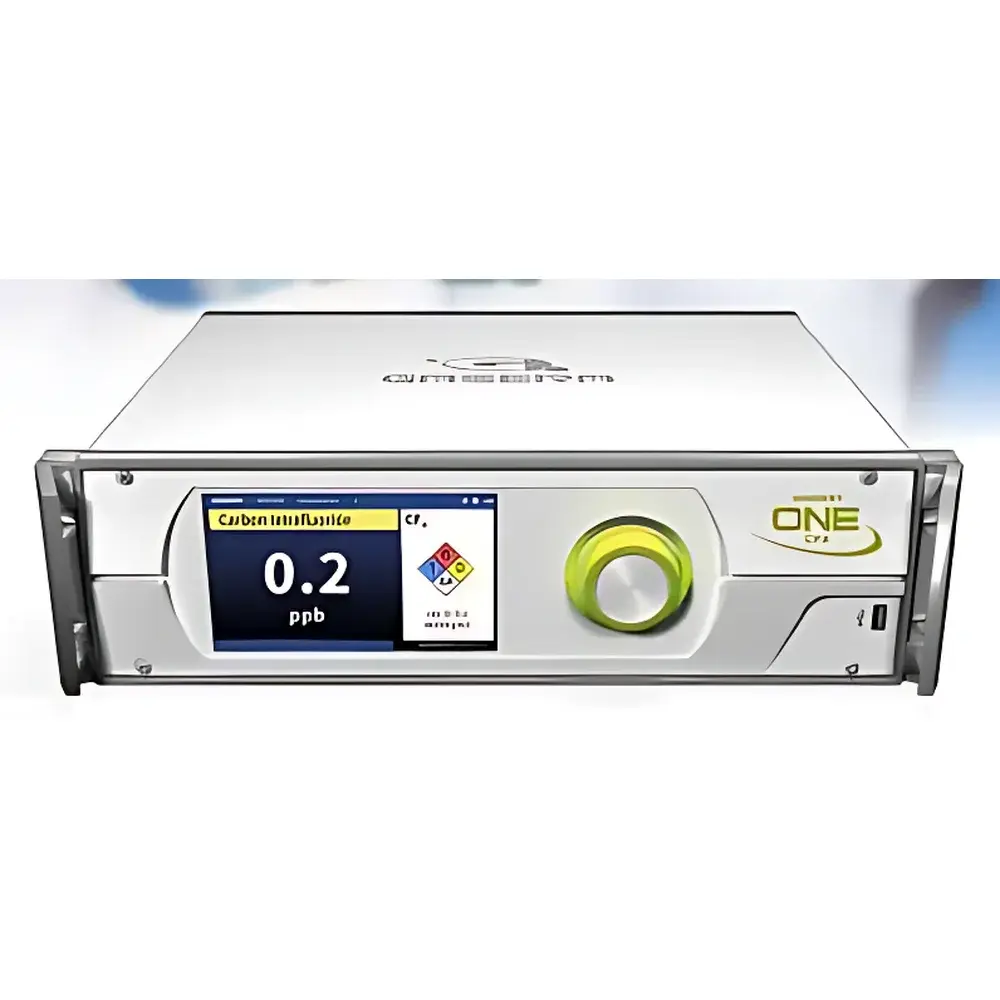
Gasera CF4 Photoacoustic Multicomponent Gas Analyzer
| Brand | Gasera |
|---|---|
| Origin | Finland |
| Model | CF4 |
| Principle | Photoacoustic Infrared Spectroscopy (PA-IR) |
| Type | Online Analyzer |
| Response Time | ≤10 s (typical, configurable via Channel Integration Time) |
| Repeatability | <1% of reading at calibration concentration |
| Detection Limit | <0.1 ppb for CF₄ |
| Dynamic Range | >5 decades |
| Accuracy | ±5% of reading (limited by calibration gas uncertainty) |
| Operating Temperature | 0–49 °C |
| Pressure Range | 750–1050 mbar |
| IP Rating | IP20 |
| Dimensions | 484 × 139 × 440 mm (W×H×D) |
| Weight | ~13 kg |
| Power | 90–264 VAC, 47–63 Hz, max 75 W |
| Data Storage | ≥1 year continuous logging (1-min intervals) |
| Sample Flow | ~1 L/min |
| Particulate Tolerance | <1 µm |
| Compliance | EU Low Voltage Directive 2014/35/EU, EMC Directive 2004/108/EC, RoHS II 2011/65/EU |
| Interface Options | Ethernet, USB, optional RS485/RS232, 4–20 mA, 0–10 V, Modbus, AK protocol |
Overview
The Gasera CF4 Photoacoustic Multicomponent Gas Analyzer is an ultra-sensitive, online trace gas monitoring system engineered for continuous, real-time quantification of carbon tetrafluoride (CF₄) in industrial and environmental applications. It employs patented photoacoustic infrared spectroscopy (PA-IR), combining a wavelength-stabilized distributed-feedback quantum cascade laser (DFB-QCL) operating in the mid-infrared fingerprint region (specifically tuned to CF₄’s fundamental vibrational absorption band near 10.5 µm) with a MEMS-based cantilever-enhanced optical microphone. Unlike conventional NDIR or GC-based systems, this architecture eliminates optical path-length dependency and baseline drift—enabling direct, absolute absorption measurement without reference cells or moving parts. The laser beam is focused into a compact, thermally stabilized photoacoustic cell (~30 mL internal volume), where absorbed IR energy induces localized heating and pressure oscillations. These nanoscale acoustic waves are detected with sub-picometer resolution by a resonant silicon cantilever sensor, whose deflection is measured interferometrically. This physics-based detection mechanism delivers exceptional signal-to-noise ratio, enabling sub-part-per-quadrillion (ppq)-level sensitivity in optimized configurations and routine sub-0.1 ppb detection limits for CF₄ under standard sampling conditions.
Key Features
- Sub-0.1 ppb detection limit for CF₄ with 10 ppm), validated per ISO 13843 and ASTM D6348 protocols
- Configurable response time: 10 seconds (minimum, using short channel integration time) to several minutes—optimized for transient leak detection or long-term trend analysis
- Drift-free operation: Thermal and pressure compensation algorithms ensure <0.5% signal drift over 24 h across full operating temperature (0–49 °C) and pressure (750–1050 mbar) ranges
- Zero-consumables architecture: No carrier gases, chemical scrubbers, or wet reagents required; maintenance limited to periodic inlet filter replacement
- Single-point calibration capability with certified CF₄ standards; recalibration intervals extend to 12–36 months under stable operating conditions, reducing total cost of ownership
- Integrated embedded computer with 7″ WSVGA touchscreen, local data visualization, and onboard storage supporting ≥1 year of 1-minute interval logging
- Rack-mountable 19″ 3U chassis (484 × 139 × 440 mm) with universal AC input (90–264 VAC) and low thermal footprint (<75 W)
Sample Compatibility & Compliance
The CF4 analyzer accepts sample streams with flow rates of approximately 1 L/min and particulate loading <1 µm. It is compatible with dry, non-corrosive process gases and ambient air matrices. Condensation must be avoided; integrated heated sample lines (optional) and Nafion™ dryers are recommended for high-humidity environments. The instrument complies with EU regulatory frameworks including the Low Voltage Directive 2014/35/EU, Electromagnetic Compatibility Directive 2004/108/EC, and RoHS II Directive 2011/65/EU. Its design supports GLP/GMP-aligned operation: audit-trail-enabled firmware logs all calibration events, parameter changes, and system diagnostics with timestamped records. While not intrinsically safe, it meets IP20 ingress protection requirements and is intended for indoor, controlled-environment deployment (e.g., cleanroom support utilities, semiconductor fab monitoring points, SF₆/CF₄ abatement verification).
Software & Data Management
Gasera ONE software provides full remote configuration, real-time visualization, and automated reporting via secure Ethernet (TCP/IP) or USB interface. Web-based access enables monitoring from smartphones, tablets, or PCs without client installation. Data export supports CSV, XML, and industry-standard MODBUS TCP and AK protocol formats for seamless integration into SCADA, DCS, or LIMS platforms. All measurements include metadata (temperature, pressure, flow status, laser power, cantilever resonance frequency) to support metrological traceability. Firmware updates are delivered over-the-air and validated via cryptographic signature. The system satisfies FDA 21 CFR Part 11 requirements for electronic records when deployed with appropriate network authentication and role-based access controls.
Applications
- Semiconductor manufacturing: Real-time CF₄ monitoring in etch tool exhaust streams and abatement system verification
- Power transmission: Detection of CF₄ tracer gas in GIS (gas-insulated switchgear) leak diagnostics
- Environmental research: Atmospheric background monitoring and emission flux studies (e.g., in conjunction with eddy covariance systems)
- Calibration laboratory support: Primary standard transfer and reference gas certification validation
- Industrial hygiene: Workplace exposure assessment where CF₄ is used as a plasma etchant or refrigerant substitute
FAQ
What makes photoacoustic detection superior to conventional NDIR for CF₄?
Photoacoustic detection measures absorbed energy directly as acoustic pressure—not transmitted intensity—eliminating errors from window fouling, source drift, or scattering losses. Its zero-background design ensures long-term stability without dual-beam referencing.
Can the CF4 analyzer measure other gases simultaneously?
Yes—the platform supports multi-laser configurations; additional QCLs can be integrated to monitor co-emitted species such as NF₃, CHF₃, or COF₂, subject to spectral separation and firmware licensing.
Is field calibration possible without certified gas standards?
No. Traceability requires certified reference materials traceable to NIST or BIPM standards. However, the single-point calibration procedure is fully automated and takes <5 minutes.
How does pressure variation affect measurement accuracy?
The system incorporates real-time pressure transduction and algorithmic compensation; performance remains within ±5% of reading across 750–1050 mbar without manual adjustment.
What is the expected lifetime of the QCL source?
The DFB-QCL is rated for >20,000 hours of continuous operation at 50 °C case temperature, with gradual output degradation <0.1%/1000 h.







