
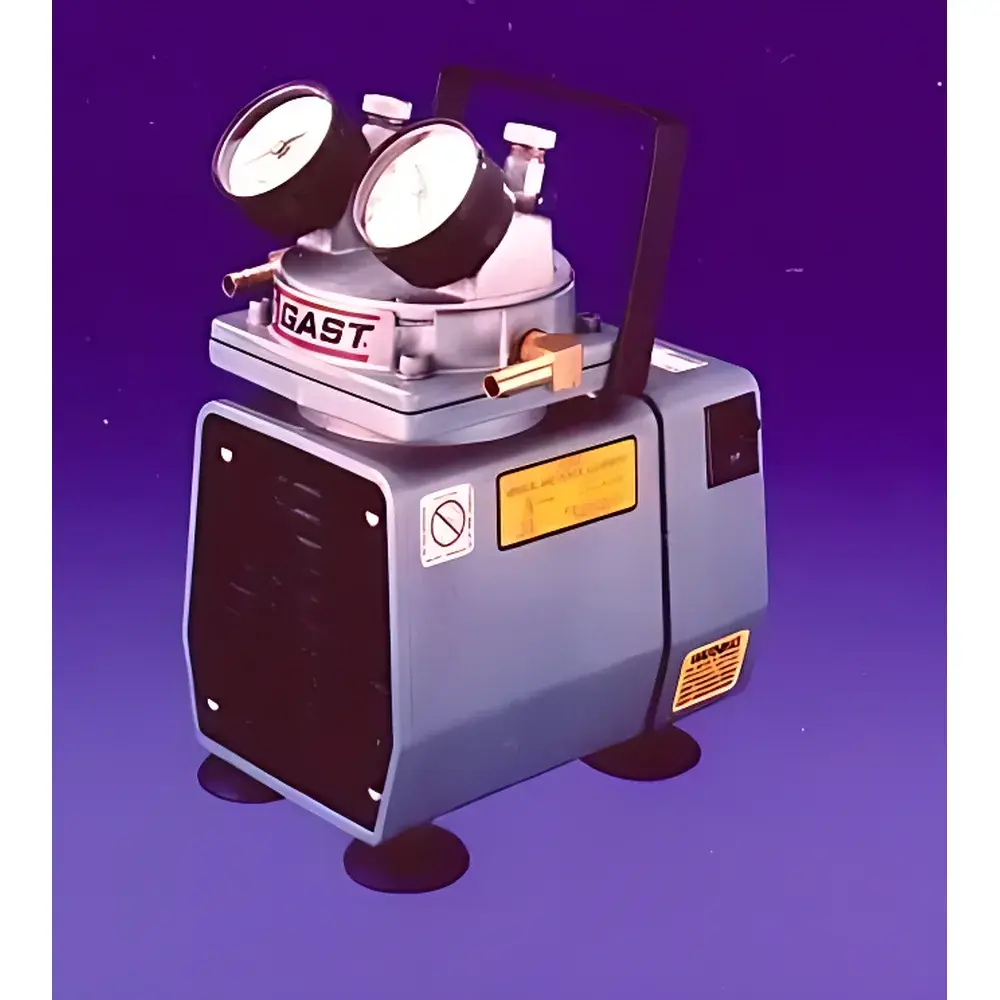
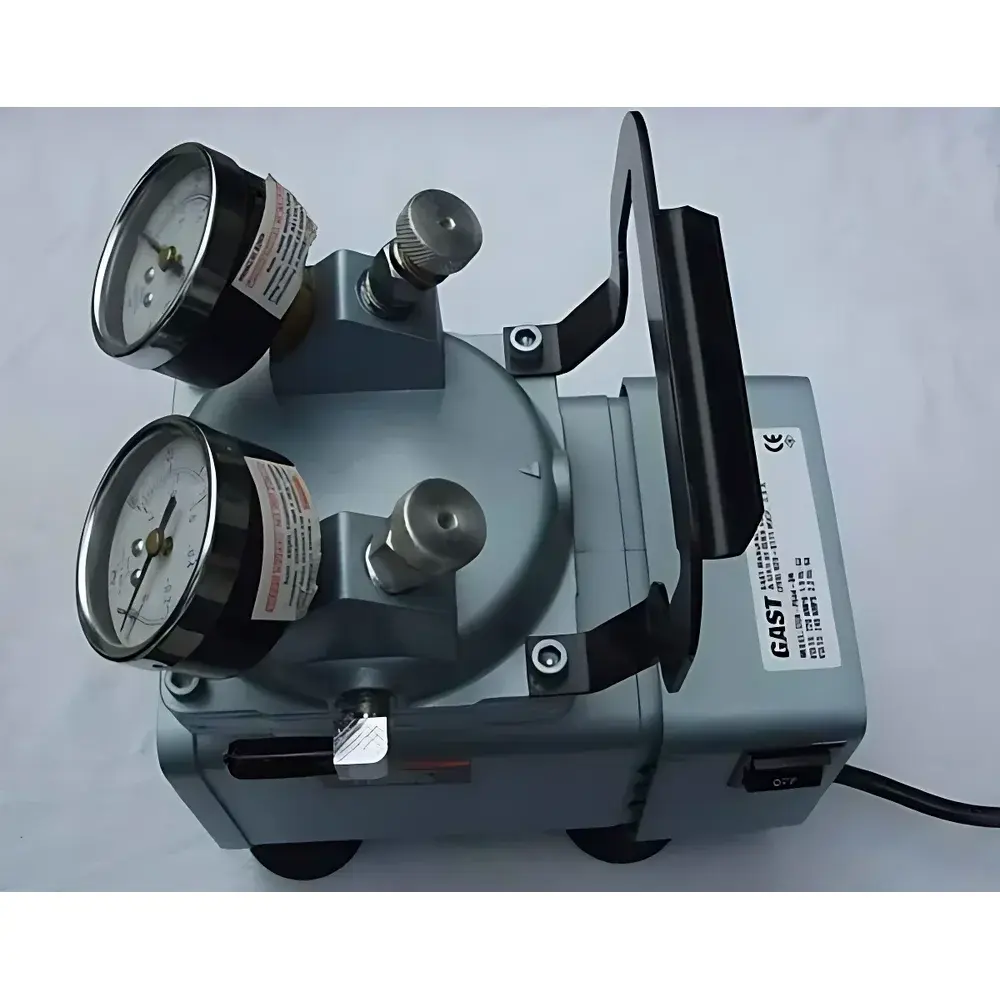
GAST DOA-P504-BN Oil-Free Diaphragm Vacuum Pump
| Brand | GAST |
|---|---|
| Origin | USA |
| Model | DOA-P504-BN |
| Pump Type | Oil-Free Diaphragm Vacuum Pump |
| Ultimate Vacuum | –81 kPa (24 inHg) |
| Free Air Displacement | 28 L/min |
| Motor Power | 90 W |
| Dimensions (L×W×H) | 194 × 130 × 260 mm |
| Weight | 8 kg |
| Noise Level | <50 dB(A) |
| Input Voltage | 220 V, 50 Hz, 2.2 A |
| Inlet/Outlet Port ID | 9.6 mm |
| Operating Ambient Temperature | 0–40 °C |
| Maximum Pressure Output | 420 kPa (60 psi) |
Overview
The GAST DOA-P504-BN is a compact, oil-free diaphragm vacuum pump engineered for reliable, maintenance-free operation in laboratory and light industrial environments. Utilizing a precision-machined PTFE-reinforced diaphragm and dual-head valve assembly, it generates vacuum via positive displacement without lubricating oil—eliminating risk of sample contamination, oil backstreaming, or hydrocarbon outgassing. Its design conforms to the fundamental principles of dry, non-contact vacuum generation: a reciprocating elastomeric diaphragm driven by an eccentric cam actuates inlet and exhaust valves in precise phase opposition, enabling continuous suction and discharge cycles. With an ultimate vacuum of –81 kPa (24 inHg) and a free air displacement rate of 28 L/min at atmospheric conditions, the DOA-P504-BN delivers consistent performance across variable load conditions typical of filtration, vacuum drying, degassing, and sample preparation workflows. Its thermally stable motor winding and integrated thermal protection ensure sustained duty-cycle operation within ambient temperatures from 0 to 40 °C.
Key Features
- Oil-free operation ensures zero hydrocarbon contamination—critical for analytical sample integrity in GC, HPLC, and mass spectrometry support applications.
- Low-noise architecture (<50 dB[A]) enables integration into shared lab spaces, laminar flow hoods, and benchtop instrumentation without acoustic interference.
- Compact footprint (194 × 130 × 260 mm) and lightweight construction (8 kg) facilitate mobility between workstations and integration into OEM systems or portable analytical platforms.
- Robust PTFE-coated diaphragm and stainless-steel valve components provide extended service life and resistance to mild chemical vapors encountered in solvent-based evaporation or acid gas handling (when paired with optional corrosion-resistant variants).
- Internally regulated pressure output up to 420 kPa (60 psi) supports dual-mode operation—vacuum drawdown and controlled positive-pressure purging—without external regulators.
- IEC-compliant motor (90 W, 220 V / 50 Hz / 2.2 A) includes Class B insulation and thermal cut-off protection for safe, unattended operation.
Sample Compatibility & Compliance
The DOA-P504-BN is compatible with aqueous, organic, and mildly aggressive vapor streams when used within its specified operating envelope. It is not rated for explosive, highly corrosive (e.g., HF, Cl₂), or particulate-laden gases without upstream filtration or chemical scrubbing. While not intrinsically safe, its oil-free design inherently reduces ignition risk compared to rotary vane alternatives. The pump complies with IEC 61000-6-3 (EMC emission standards) and IEC 61000-6-2 (immunity). Its construction materials meet RoHS Directive 2011/65/EU requirements. For regulated environments—including GLP, GMP, and ISO/IEC 17025-accredited laboratories—the pump’s deterministic performance, absence of consumable oils, and traceable serial-numbered build support audit-ready documentation of vacuum system qualification.
Software & Data Management
As a standalone pneumatic component, the DOA-P504-BN does not incorporate embedded firmware, digital interfaces, or onboard data logging. However, it is fully compatible with third-party vacuum control systems featuring analog 0–10 V or 4–20 mA feedback loops, programmable logic controllers (PLCs), and LabVIEW-compatible DAQ modules. When integrated into automated workflows—such as vacuum-controlled lyophilizers or multi-step extraction platforms—it supports time-stamped operational logs via external sensors (e.g., vacuum transducers, current monitors). Its mechanical consistency enables reproducible process parameter mapping, facilitating IQ/OQ validation per FDA 21 CFR Part 11 guidelines when paired with compliant data acquisition infrastructure.
Applications
- Rotary evaporation and cold trap evacuation in organic synthesis labs.
- Vacuum-assisted filtration (e.g., Buchner funnel, membrane filtration) for microbiological or environmental water analysis.
- Desiccator evacuation and low-temperature drying of hygroscopic compounds.
- Gas sampling and pre-concentration systems for ambient air monitoring and VOC analysis.
- OEM integration into automated analyzers requiring quiet, clean vacuum sources—e.g., blood gas analyzers, microfluidic assay platforms, and portable FTIR accessories.
- Positive-pressure purging of optical enclosures, sensor housings, and calibration chambers.
FAQ
Is the DOA-P504-BN suitable for continuous 24/7 operation?
Yes—when operated within its rated ambient temperature range (0–40 °C) and with adequate ventilation, the pump is designed for uninterrupted duty cycles. Thermal protection prevents coil damage under overload or restricted airflow conditions.
Can it handle corrosive gases such as HCl or SO₂?
Standard DOA-P504-BN units are not recommended for direct exposure to strong acids or oxidizers. GAST offers chemically resistant variants (e.g., models with EPDM or Viton® seals and electropolished stainless steel components) for such applications—consult technical specifications prior to deployment.
What is the expected service life under normal laboratory use?
With proper installation (vibration isolation, unrestricted inlet/exhaust paths) and periodic inspection of diaphragm integrity, typical service life exceeds 10,000 hours. No scheduled oil changes or lubrication are required.
Does it meet UL or CSA safety certification?
The DOA-P504-BN carries UL Recognized Component Mark (E150247) and complies with UL 508 and CSA C22.2 No. 14 standards for industrial control equipment.
How is vacuum stability maintained across varying process loads?
The dual-head diaphragm architecture provides inherent volumetric consistency; however, for critical pressure regulation, an external vacuum regulator or closed-loop PID controller is recommended to compensate for system leakage or variable conductance.



