
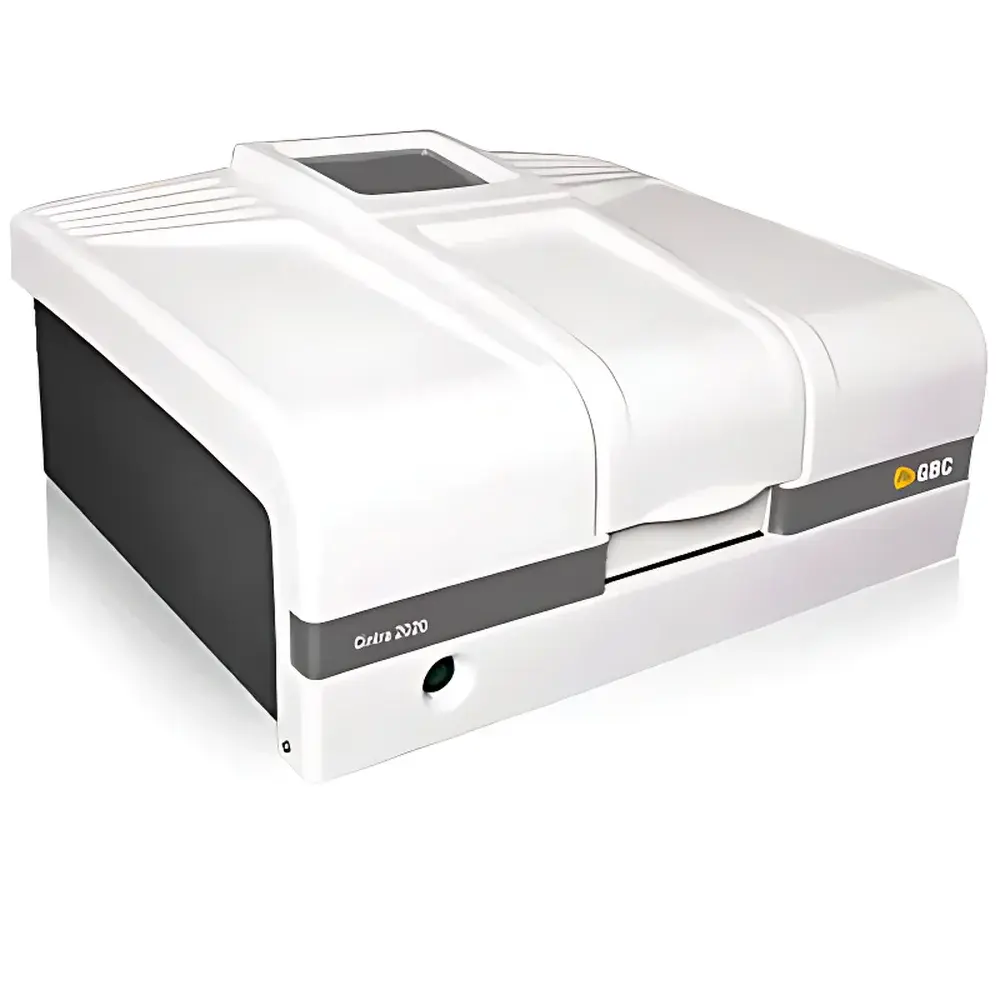
GBC Cintra2020 Dual-Beam UV-Vis Spectrophotometer
| Brand | GBC |
|---|---|
| Origin | Australia |
| Model | Cintra2020 |
| Optical Design | Dual-Beam |
| Detector Type | Photodiode Array (PDA) |
| Wavelength Range | 190–1200 nm |
| Spectral Bandwidth | Adjustable from 1.0 to 5.0 nm |
| Wavelength Accuracy | ±0.3 nm |
| Stray Light | <0.01% T at 220 nm and 340 nm |
| Automation | Motorized Wavelength Scanning & Auto-zeroing |
| Compliance | ASTM E275, ISO 6223, USP <857>, FDA 21 CFR Part 11 (with optional audit trail module) |
Overview
The GBC Cintra2020 is a high-performance dual-beam ultraviolet-visible (UV-Vis) spectrophotometer engineered for precision absorbance, transmittance, and reflectance measurements across a broad spectral range of 190–1200 nm. Utilizing a Czerny-Turner monochromator with holographic gratings and a thermally stabilized photodiode array (PDA) detector, the instrument delivers high photometric accuracy, low noise (<0.0004 AU RMS), and exceptional baseline stability. Its true dual-beam optical architecture continuously compares sample and reference beams in real time, minimizing drift caused by lamp intensity fluctuations or environmental thermal shifts—critical for extended kinetic studies, multi-sample QC workflows, and regulatory-compliant pharmaceutical testing. Designed and manufactured in Melbourne, Australia, the Cintra2020 meets internationally recognized performance benchmarks for analytical instrumentation, including ASTM E275 (Standard Test Methods for Absorbance Accuracy of UV-Vis Spectrophotometers) and ISO 6223 (Spectrophotometers — Performance Verification).
Key Features
- Wide spectral coverage from 190 nm (deep UV) to 1200 nm (near-infrared), enabling analysis of organic chromophores, transition metal complexes, semiconductor materials, and biological macromolecules.
- Variable slit width (1.0–5.0 nm) for user-selectable resolution–sensitivity trade-off; optimized for both high-throughput screening and high-fidelity spectral profiling.
- Low stray light (<0.01% T at 220 nm and 340 nm), essential for accurate quantitation of highly absorbing samples (e.g., concentrated dyes, nucleic acids above 2.0 A) and compliance with pharmacopeial limits (USP , EP 2.2.25).
- Thermally regulated PDA detector with 1024-element linear array ensures rapid full-spectrum acquisition (<1 s per scan) and high pixel-to-pixel reproducibility.
- Motorized optical components—including wavelength drive, shutter, and beam splitter—support fully automated measurement sequences, calibration routines, and system verification protocols.
- Robust mechanical design with vibration-damped optical bench and sealed optical compartment minimizes alignment drift and maintains long-term photometric repeatability (RSD <0.002% over 8 h).
Sample Compatibility & Compliance
The Cintra2020 accommodates standard 10 mm pathlength cuvettes (quartz, fused silica, or high-transmission plastic), microvolume adapters (down to 0.5 µL via integrated capillary flow cell), and solid-sample holders for reflectance or diffuse transmission measurements. All hardware and firmware are designed to support Good Laboratory Practice (GLP) and Good Manufacturing Practice (GMP) environments. When configured with the optional Cintra Software Suite (v5.5+), the system provides full 21 CFR Part 11 compliance—including electronic signatures, role-based access control, and immutable audit trails for all method changes, calibration events, and raw data exports. IQ/OQ documentation packages are available, aligned with ICH Q7, USP , and EU Annex 11 requirements.
Software & Data Management
Cintra Software is a Windows-based, modular application supporting method development, instrument control, spectral processing, and report generation. Core modules include Quantitative Analysis (single/multi-point calibration, Beer-Lambert fitting), Kinetics (time-resolved absorbance monitoring with customizable sampling intervals), DNA/RNA Analysis (A260/A280 ratio, concentration, purity), Colorimetry (CIE L*a*b*, ΔE calculations), and System Performance Verification (SPV)—an automated workflow that executes wavelength accuracy, photometric linearity, stray light, and baseline flatness tests per ASTM and pharmacopeial standards. Data files (.cin) are structured XML archives containing metadata, raw spectra, processing history, and user annotations—ensuring full traceability and interoperability with LIMS and ELN platforms.
Applications
- Pharmaceutical QC: Assay of active pharmaceutical ingredients (APIs), excipient compatibility testing, dissolution profile analysis per USP .
- Environmental monitoring: Nitrate/nitrite quantification in water (EPA Method 353.2), heavy metal complexation studies.
- Academic research: Ligand-binding kinetics, enzyme reaction monitoring (e.g., NADH oxidation), nanoparticle plasmon resonance characterization.
- Food & beverage: Anthocyanin stability, chlorophyll degradation, caramel color intensity (AOAC 974.01).
- Materials science: Thin-film optical density, bandgap estimation of semiconductors, polymer degradation kinetics.
FAQ
What is the minimum detectable absorbance change the Cintra2020 can resolve?
The instrument achieves a photometric noise level of ≤0.0004 AU (RMS) at 546 nm with a 1.0 nm bandwidth, enabling reliable detection of absorbance differences as low as 0.001 AU under optimal conditions.
Does the Cintra2020 support fiber-optic probes or remote sampling?
Yes—via optional FC/PC-coupled fiber optic interfaces compatible with immersion, flow-through, and reflection probes (wavelength range dependent on fiber transmission window).
Can the system be integrated into an automated liquid handling platform?
Fully supported via RS-232, USB CDC, and Ethernet (TCP/IP) communication protocols; SCPI command set enables seamless integration with third-party robotics and scheduling software.
Is validation documentation provided for regulated industries?
GBC supplies comprehensive IQ/OQ templates, factory test reports, and metrology-certified wavelength and photometric standards traceable to NIST and NMIA (National Measurement Institute Australia).
How often does the deuterium and tungsten-halogen lamp require replacement?
Typical lamp lifetimes are ≥2,000 hours (deuterium) and ≥5,000 hours (tungsten-halogen); the software monitors cumulative usage and alerts users prior to end-of-life.





