
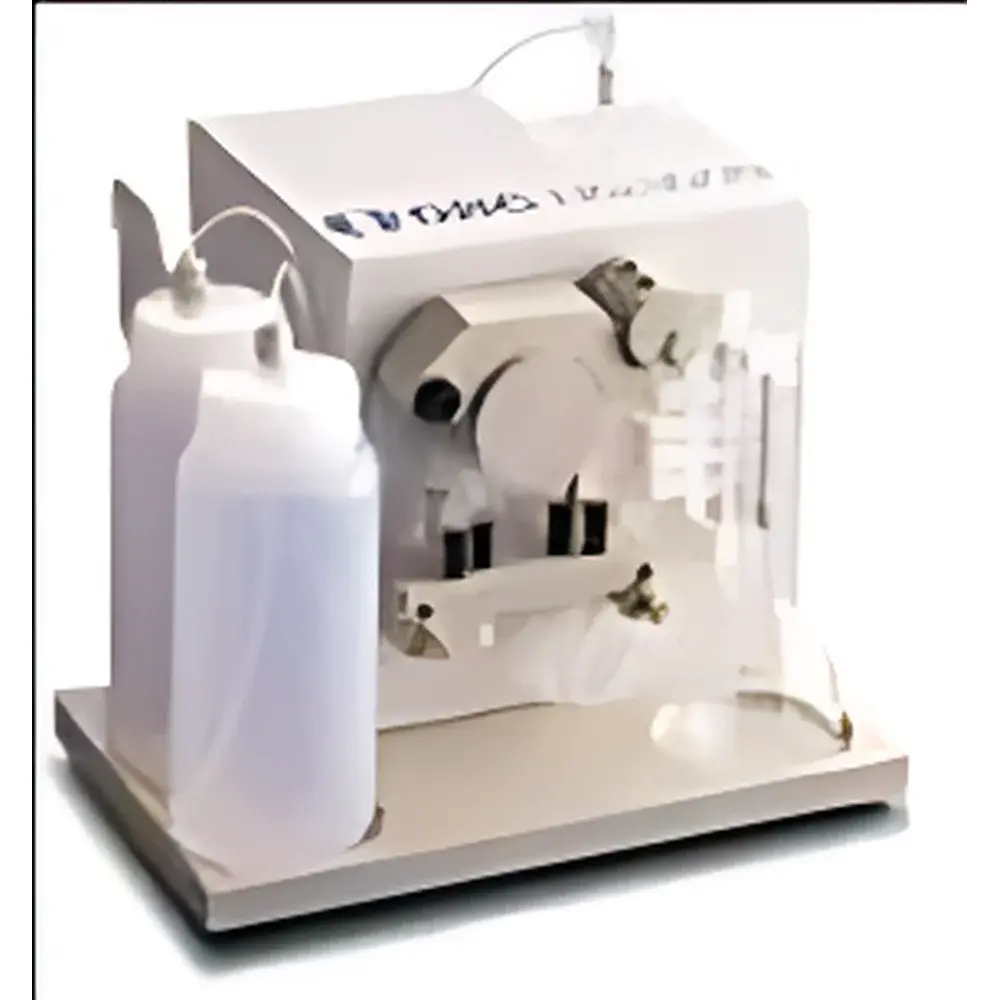
GBC HG3000 Continuous-Flow Hydride Generation System
| Brand | GBC |
|---|---|
| Origin | Australia |
| Model | HG3000 |
| Type | Continuous-flow hydride generation system for atomic absorption and atomic fluorescence spectroscopy |
| Compatible Elements | As, Sb, Bi, Ge, Pb, Se, Te, Sn, Hg (via cold vapor mode) |
| Detection Capability | Sub-ppb (ng/L) level for all supported elements |
| Sample Throughput | Up to 60 samples/h (triplicate readings) |
| Operating Principle | Acid–sodium borohydride (NaBH₄) reduction in laminar-flow segmented manifold |
| Compliance | Designed to meet ISO/IEC 17025 method validation requirements |
Overview
The GBC HG3000 is a precision-engineered continuous-flow hydride generation system designed for trace-level quantification of hydride-forming elements in environmental, clinical, food safety, and geological matrices. It operates on the principle of controlled acid–sodium borohydride (NaBH₄) reduction within a segmented, laminar-flow manifold, where analyte species (e.g., As(III), Sb(III), Se(IV), Bi(III), Te(IV), Sn(II), Pb(II)) are selectively reduced to volatile covalent hydrides (e.g., AsH₃, SbH₃, H₂Se). These gaseous species are swept by inert carrier gas into a quartz cell positioned in the optical path of an atomic absorption spectrometer (AAS) or atomic fluorescence spectrometer (AFS), enabling highly sensitive detection at sub-part-per-trillion (sub-ppt) concentrations. Unlike batch or flow-injection hydride generators, the HG3000 sustains a stable, time-resolved signal profile—enabling integration-based signal processing that inherently suppresses transient noise, improves signal-to-noise ratio (S/N), and lowers method detection limits (MDLs) without increasing sample volume or digestion time.
Key Features
- Continuous-flow architecture with precisely regulated peristaltic pumping and gas–liquid phase separation, ensuring reproducible hydride transport and minimal memory effects.
- Dual-mode operation: optimized hydride generation for As, Sb, Bi, Ge, Pb, Se, Te, Sn, and cold vapor mercury (Hg⁰) analysis using SnCl₂ reduction—eliminating the need for separate instrumentation.
- Integrated reagent delivery with independent control of acid (HCl) concentration and NaBH₄ stability—critical for element-specific optimization and inter-element interference mitigation.
- Modular design compatible with major AAS and AFS platforms (including GBC Avanta, AA240Z, and third-party systems via standard gas inlet interfaces).
- Robust construction using chemically resistant fluoropolymer tubing and PTFE-coated manifolds, minimizing reagent carryover and corrosion under long-term operation.
- No external heating or quartz furnace required—hydride formation occurs at ambient temperature, reducing power consumption and thermal drift.
Sample Compatibility & Compliance
The HG3000 accepts aqueous liquid samples following standard acid digestion (e.g., EPA Method 200.9, ISO 11969) or microwave-assisted digestion protocols. It accommodates matrices with up to 10% v/v organic content (e.g., diluted wine, digested biological tissues) when paired with appropriate matrix modifiers. The system supports method validation per ICH Q2(R2), ASTM D5673 (for arsenic in drinking water), and USP for elemental impurities. Its stable signal output and integrated blank subtraction capability facilitate compliance with ISO/IEC 17025 requirements for measurement uncertainty estimation. When connected to compliant data acquisition software, it supports audit trails, electronic signatures, and 21 CFR Part 11–ready reporting—essential for regulated laboratories operating under GLP or GMP frameworks.
Software & Data Management
While the HG3000 operates as a hardware module without embedded firmware, its analog output (0–1 V DC proportional to absorbance/fluorescence intensity) is fully compatible with GBC’s AvantaSuite™ and third-party spectroscopic control platforms (e.g., Thermo Fisher QI, PerkinElmer WinLab32). Signal integration, peak area calculation, and calibration curve fitting (linear, quadratic, or weighted least-squares) are performed within the host spectrometer software. All raw signal traces and processed results are timestamped and exportable in CSV or ASCII format for LIMS integration. Optional RS-232 or USB-to-serial adapters enable remote start/stop triggering and synchronization with autosampler events—supporting unattended overnight runs and multi-method sequences.
Applications
The HG3000 delivers validated performance across high-throughput regulatory testing environments: quantification of inorganic arsenic in rice flour (AOAC 2013.05), total mercury in fish tissue (EPA 1631E), antimony leaching from PET packaging (EU Commission Regulation (EU) No 10/2011), selenium speciation in infant formula (ISO 18563), and bismuth monitoring in pharmaceutical intermediates. Its 60-sample/h throughput (triplicate reads) significantly reduces cost-per-analysis compared to discontinuous systems—particularly valuable in contract testing labs serving EPA, FDA, and EU reference laboratories. Field-deployable variants (with battery-powered peristaltic drive) have been deployed in mobile environmental screening units for real-time groundwater arsenic assessment.
FAQ
What hydride-forming elements does the HG3000 support?
As, Sb, Bi, Ge, Pb, Se, Te, Sn, and Hg (via cold vapor mode).
Is the HG3000 compatible with non-GBC spectrometers?
Yes—it features universal gas transfer tubing and analog voltage output, supporting integration with PerkinElmer, Thermo Fisher, Agilent, and Shimadzu AAS/AFS systems.
Does the system require external heating or quartz tube atomization?
No. Hydride generation and transport occur at ambient temperature; atomization is performed in the spectrometer’s flame or graphite furnace.
How is reagent consumption managed to ensure long-term stability?
NaBH₄ solution is delivered via gas-tight syringe pump or stabilized peristaltic line with inline degassing; HCl concentration is adjustable from 1–10% (v/v) to balance sensitivity and interferences.
Can the HG3000 be used for speciation analysis?
Not directly—but when coupled with HPLC (e.g., anion-exchange separation of As(III)/As(V)/MMA/DMA), it serves as a selective hydride-generation detector for hydride-active species only.
Related Products





