
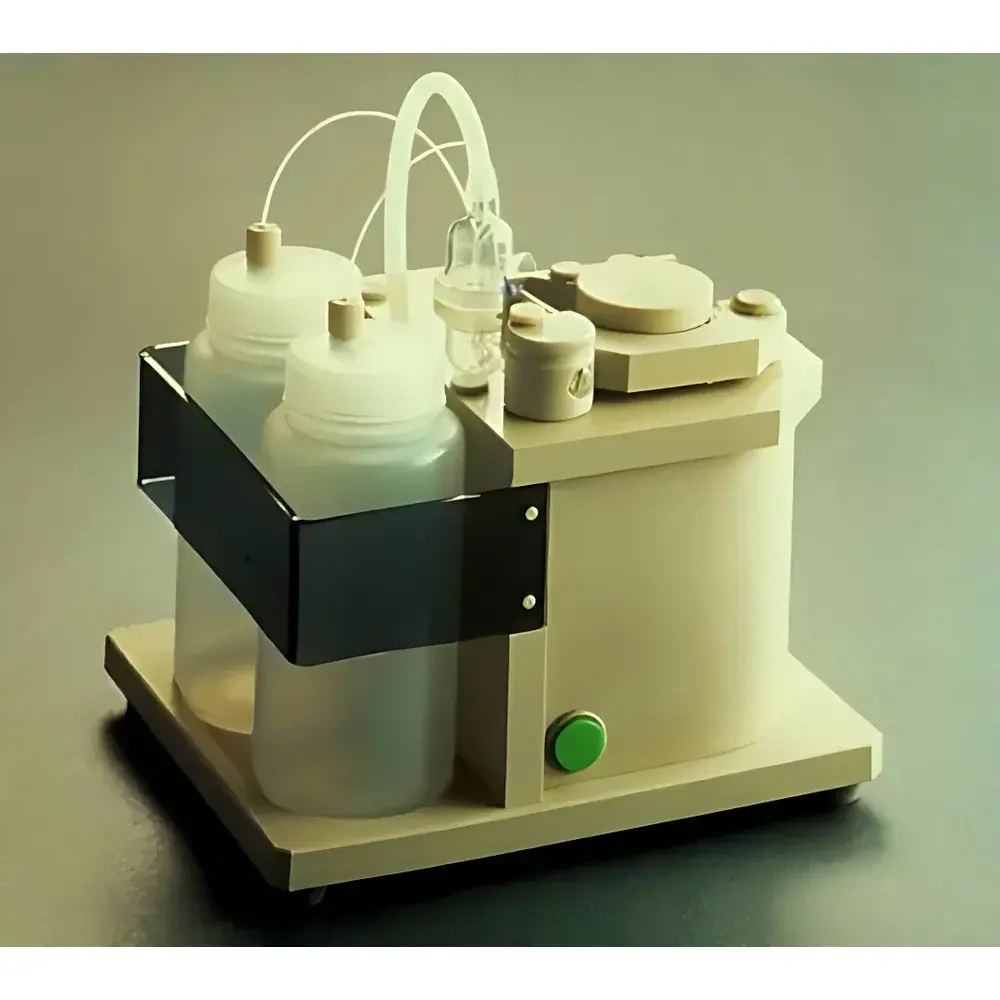
GBC HG3000PII Continuous-Flow Hydride Generation System
| Brand | GBC |
|---|---|
| Origin | Australia |
| Model | HG3000PII |
| Type | Continuous-Flow Hydride Generation System |
| Sample Throughput | Up to 60 samples/h |
| Detection Capability | Sub-ppt for As, Bi, Sn, Sb, Te, Se, and Hg |
| Construction | Precision Borosilicate Glass Reaction Manifold |
| Flow Architecture | Segmented Gas-Liquid Flow with Integrated Phase Separation |
Overview
The GBC HG3000PII Continuous-Flow Hydride Generation System is a dedicated accessory engineered for coupling with atomic absorption spectrometers (AAS), inductively coupled plasma optical emission spectrometers (ICP-OES), or atomic fluorescence spectrometers (AFS) to enable ultra-trace determination of hydride-forming elements. It operates on the principle of acid-mediated sodium borohydride (NaBH₄) reduction in a precisely controlled segmented flow environment: analyte species (e.g., As(III), Sb(III), Se(IV), Bi(III), Sn(II), Te(IV)) are reduced to volatile covalent hydrides (e.g., AsH₃, SbH₃, SeH₂), while mercury is reduced to elemental cold vapor (Hg⁰). These gaseous species are swept by inert carrier gas into a quartz cell or flame atomizer for quantification. The system’s core design emphasizes hydrodynamic stability, minimal memory effects, and stoichiometric consistency—critical for achieving sub-pictogram-per-liter (sub-ppt) detection limits and high inter-run reproducibility across regulated environmental, clinical, and geochemical laboratories.
Key Features
- Precision-engineered borosilicate glass reaction manifold ensures chemical inertness, thermal stability, and resistance to corrosion from strong acids (e.g., HCl, HNO₃) and reducing agents (NaBH₄), eliminating metal leaching and baseline drift.
- Optimized segmented continuous-flow architecture enables rapid reagent/sample mixing, efficient hydride generation kinetics, and near-instantaneous gas–liquid phase separation—reducing analysis cycle time without compromising sensitivity.
- Integrated gas–liquid separator with controlled residence time minimizes aerosol carryover and solvent vapor interference, directly enhancing signal-to-noise ratio and measurement precision.
- Robust pneumatic control system maintains stable carrier gas flow (Ar or N₂) and precise peristaltic pumping rates for sample, reductant, and acid streams—ensuring long-term operational repeatability (RSD < 2.5% for replicate injections).
- Modular design allows seamless integration with GBC AA spectrometers (e.g., Avanta series) and third-party ICP-OES/AFS platforms via standardized gas transfer lines and TTL synchronization interfaces.
Sample Compatibility & Compliance
The HG3000PII supports aqueous liquid samples—including filtered natural waters, digested biological tissues, acid-leached soils, and pharmaceutical excipients—without requiring derivatization or pre-concentration for most routine applications. It accommodates variable sample volumes (1–5 mL) and is compatible with standard 16-mm or 18-mm borosilicate test tubes. The system meets fundamental requirements for GLP-compliant trace metal analysis: all wetted components are non-metallic; reagent delivery paths are chemically isolated; and operation adheres to ASTM D3974 (As, Se, Sb in water), ISO 11969 (Hg in foodstuffs), and USP / elemental impurities guidelines. While the instrument itself does not include electronic audit trails, its analog control architecture is fully compatible with externally validated data acquisition systems compliant with FDA 21 CFR Part 11 when paired with certified AAS/ICP software platforms.
Software & Data Management
The HG3000PII operates as a hardware-controlled peripheral with no embedded firmware or onboard software. All timing, valve actuation, pump sequencing, and gas flow initiation are synchronized via TTL-level trigger signals from the host spectrometer’s acquisition software (e.g., GBC SpectraAA, Thermo Fisher iTEVA, Agilent ICP Expert). This architecture ensures deterministic event timing and eliminates software-layer latency that can degrade peak shape fidelity in transient hydride signals. Raw intensity data (absorbance or fluorescence) are acquired and processed entirely within the spectrometer’s validated software environment, supporting full calibration curve generation (linear/logarithmic), internal standard correction, and QC flagging per ICH Q2(R2) analytical method validation requirements.
Applications
- Environmental monitoring: Quantification of arsenic in groundwater per EPA Method 200.9 and ISO 17294-2; selenium speciation in wastewater after hydride generation–gas chromatography coupling.
- Clinical toxicology: Mercury vapor analysis in whole blood and urine using cold vapor AFS, meeting CLIA and CAP proficiency testing criteria.
- Pharmaceutical quality control: Screening for residual antimony in catalyst residues per ICH Q3D, with detection confirmed at ≤0.1 µg/L in API dissolution matrices.
- Geochemical prospecting: Rapid field-deployable screening of bismuth and tellurium in acid-digested rock leachates for mineral exploration surveys.
- Food safety: Arsenic speciation support (inorganic As vs. organic As) when interfaced with HPLC–HG–AAS systems for rice and seaweed testing per EU Commission Regulation (EU) No 82/2014.
FAQ
What hydride-forming elements does the HG3000PII support?
It is optimized for As, Bi, Sn, Sb, Te, Se, and Hg (as cold vapor); performance is validated for these elements under standardized acidic reduction conditions (e.g., 3–5 M HCl, 1–2% w/v NaBH₄).
Can it be used with ICP-MS?
Yes—with appropriate interface modifications (e.g., desolvation, membrane introduction) and careful optimization of carrier gas flow to avoid plasma instability; however, sensitivity gains over direct nebulization are element-specific and require method validation.
Is the glass manifold replaceable as a field-serviceable unit?
Yes—the complete reaction manifold assembly is supplied as a single OEM part (GBC P/N HG3000PII-MANIFOLD) and can be replaced without recalibration or alignment tools.
Does it require external cooling or exhaust ventilation?
No active cooling is needed; ambient air convection suffices. However, connection to a certified laboratory fume hood or dedicated vent line is mandatory for safe handling of hydrogen and arsine-class vapors per OSHA 1910.1200 and local hazardous gas protocols.
How is carryover minimized between high-concentration and low-concentration samples?
Through a combination of inert glass surfaces, programmable post-run acid flush cycles (configurable via host software), and optimized gas purge duration—validated to achieve <0.5% carryover for 100 ng/mL As into blank matrix.
Related Products







