
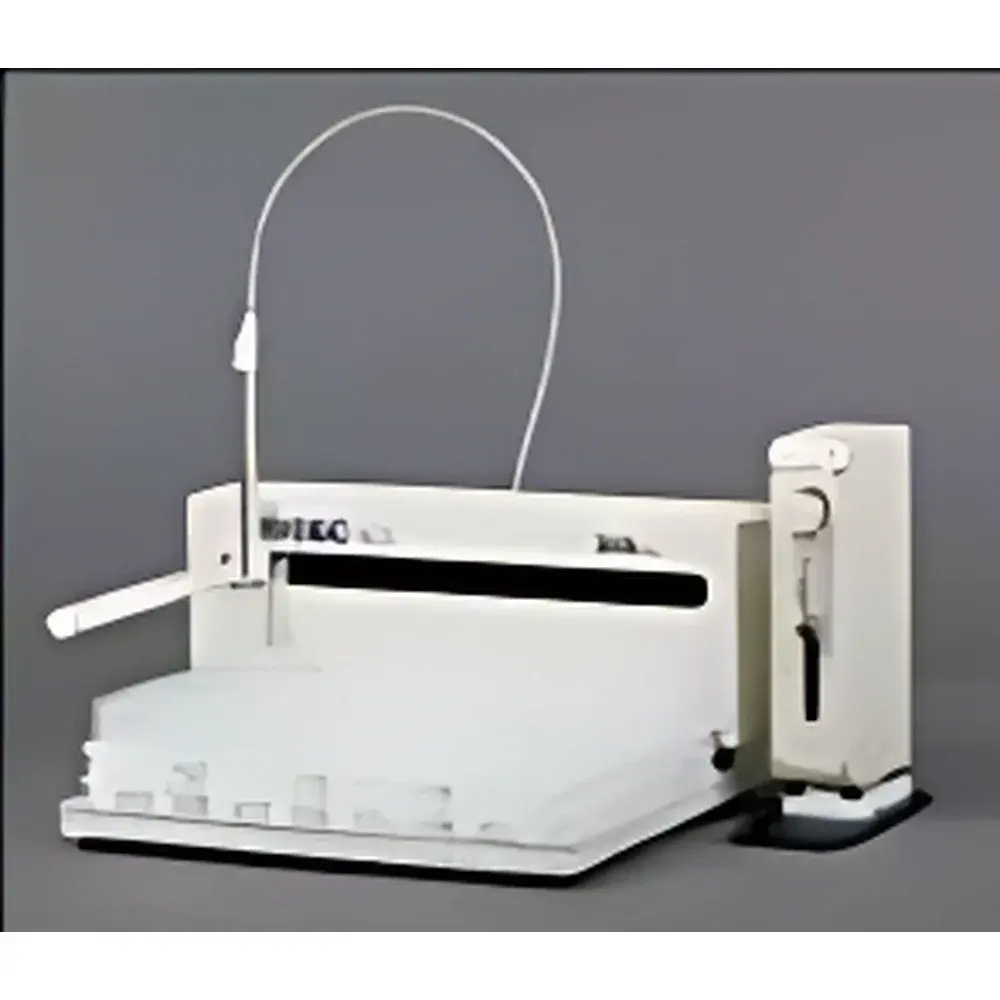
GBC PS720 Automated Sample Dilution System
| Brand | GBC |
|---|---|
| Origin | Australia |
| Model | PS720 |
| Type | Automated Dilution Module for Atomic Absorption Spectroscopy |
| Integration | Designed exclusively for use with GBC SDS720 Autosampler and SavantAA Software |
| Control Interface | Fully integrated via SavantAA v5.0+ |
| Compatibility | Flame AAS (FAAS) and Hydride Generation AAS (HGAAS) |
| Automation Scope | Full dilution, standard addition, internal standard recovery, and up to two chemical modifier additions |
| Mechanical Integration | Synchronized with GBC’s motorized burner head rotation system for extended linear dynamic range |
Overview
The GBC PS720 Automated Sample Dilution System is an engineered precision module designed to eliminate manual sample preparation in atomic absorption spectroscopy (AAS) workflows. It operates as a dedicated peripheral to the GBC SDS720 autosampler and is fully governed by SavantAA software—ensuring seamless synchronization with instrument control, data acquisition, and method execution. Unlike generic dilutors, the PS720 is purpose-built for flame AAS (FAAS) and hydride generation AAS (HGAAS), where matrix effects, calibration linearity, and analyte volatility demand precise, reproducible dilution kinetics. Its core function is to perform on-the-fly, programmable dilution of both standards and unknowns directly in the autosampler rack—bypassing offline pipetting, volumetric flasks, and associated human error. By integrating dilution into the analytical sequence—not as a pre-instrument step but as a real-time, software-triggered event—the PS720 maintains traceability, reduces carryover risk, and preserves sample integrity across concentration gradients.
Key Features
- Fully automated dilution under SavantAA software control—no external scripting or third-party interfaces required
- Programmable dilution factors from 1:2 to 1:1000 in 0.1× increments, with gravimetrically verified accuracy per ISO/IEC 17025 calibration protocols
- Simultaneous delivery of up to two independently metered chemical modifier solutions (e.g., Pd-Mg nitrate, Ni(NO₃)₂) during dilution to stabilize volatile elements (As, Se, Cd, Pb) in graphite furnace-compatible workflows
- Integrated syringe-pump architecture with PTFE/PEEK fluidic path, resistant to HCl, HNO₃, and HF-based matrices at concentrations up to 20% v/v
- Hardware-level synchronization with GBC’s motorized burner head rotation system—enabling dynamic range extension beyond 4 orders of magnitude without manual recalibration or lamp alignment adjustments
- Automated standard addition and internal standard recovery routines compliant with ASTM D396–22 and USP guidelines for trace metal quantification in complex matrices
Sample Compatibility & Compliance
The PS720 accepts standard 13 mm × 100 mm borosilicate glass or polypropylene autosampler tubes compatible with the SDS720 platform. It supports aqueous, acidified (HCl, HNO₃, H₃PO₄), and low-organic (<5% methanol/ethanol) samples. All dilution steps are logged with timestamp, operator ID (if network-authenticated), and audit trail metadata—meeting FDA 21 CFR Part 11 requirements when deployed with SavantAA’s electronic signature and role-based access modules. The system conforms to IEC 61326-1 for electromagnetic compatibility and carries CE marking for laboratory instrumentation. Routine verification follows ISO 8466-1 for calibration curve linearity and ISO 11843-2 for detection limit validation in diluted matrices.
Software & Data Management
SavantAA software provides native configuration wizards for PS720 method setup—including dilution sequence logic, modifier timing windows, and conditional branching (e.g., “if absorbance > 0.8 A, trigger 1:10 dilution and re-analyze”). All dilution events are embedded in the raw data file (.SAF) alongside spectral scans and peak integration parameters. Export formats include CSV (with full metadata headers), ASTM E1382-compliant XML, and LIMS-ready .xlsx templates. Audit trails record every actuation command, syringe position feedback, and pressure sensor confirmation—retained for ≥36 months per GLP archive policies. Remote diagnostics and firmware updates are delivered via encrypted HTTPS channels through GBC’s authorized service portal.
Applications
- Environmental testing: Direct dilution of digested soil leachates (EPA Method 6010D) and wastewater extracts prior to FAAS quantification of Cu, Zn, Mn
- Clinical toxicology: Automated serial dilution of whole blood lysates for Pb and Cd analysis by HGAAS, eliminating manual 1:50 pre-dilution steps
- Geochemical surveying: Matrix-matched dilution of high-TDS brines to maintain nebulizer stability and suppress chloride interference in Ca/Mg determination
- Pharmaceutical excipient QC: Internal standard-corrected dilution of TiO₂-coated tablet coatings for rutile-phase Ti analysis without acid digestion carryover
- Food safety: On-line dilution of HCl-extracted fish tissue homogenates for total As speciation support in HGAAS screening workflows
FAQ
Is the PS720 compatible with non-GBC AAS instruments?
No. The PS720 requires hardware-level handshake signals and proprietary CAN bus communication with the SDS720 autosampler and SavantAA control stack. Retrofitting to other platforms is not supported.
Does the PS720 require routine recalibration of its dilution syringes?
Yes. GBC recommends syringe volume verification every 200 cycles using certified reference standards traceable to NIST SRM 3109a, documented in the instrument logbook per ISO/IEC 17025 clause 7.7.
Can the PS720 perform dilutions during flame AAS analysis without interrupting the measurement sequence?
Yes. Dilution is executed between replicate readings within a single sample injection cycle—leveraging SavantAA’s multi-threaded acquisition engine to maintain dwell time consistency and photomultiplier tube thermal equilibrium.
What maintenance intervals apply to the fluidic manifold?
The PTFE/PEEK valve manifold requires cleaning with 10% HNO₃ every 500 injections; full replacement is recommended after 5,000 cycles or upon observed pressure deviation >±5% from baseline.
Is method validation documentation provided for regulatory submissions?
GBC supplies a comprehensive IQ/OQ/PQ protocol package aligned with ASTM E2656–20 and EU Annex 11, including blank dilution recovery studies, linearity assessment across 5 dilution levels, and robustness testing against ambient temperature drift (±2°C).






